Fort Bliss, TX, has notable “firsts” in its long history. It was the first official United States military post established in the El Paso de Norte region to secure the new border with Mexico in February 1848. Nearly a century later, in 1946, it became the U.S. Army’s first Anti-Aircraft Artillery and Guided Missile Center.
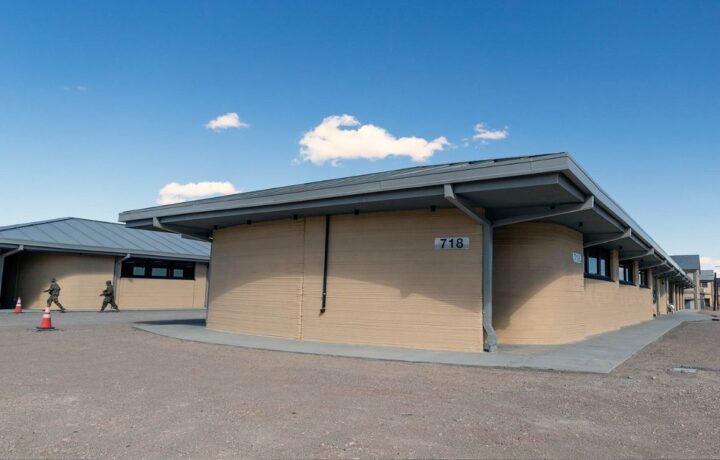
Last month, the base – known as the “Home of America’s Tank Division” – opened the first of ten planned 3D-printed barracks, marking the largest deployment of robotic construction capabilities for the service to date.
“The project, the largest 3D-printed military housing development in the Department of Defense, demonstrates the potential of additive construction to deliver durable facilities while reducing construction time, material waste and long-term costs,” the United States Army announced. The effort was the culmination of nearly two years of collaboration between the United States Army Corps of Engineers’ (USACE’s) Fort Worth District, Fort Bliss, and Austin-based construction company ICON, which physically printed the structures.
A total of 10 buildings have been constructed utilizing ICON’s large-scale robotic printer, the Army explained. The production included successive layers of a specialized “cementitious” material to create the walls for each structure. The entire building didn’t come out of a printer, of course, and traditional construction methods were employed to install the roofing systems, windows, doors, utilities, HVAC systems, and interior finishes.
Moreover, each building was designed to meet the stringent U.S. Army building standards.
Still, the process demonstrated the potential benefits that additive construction could play in the U.S. military. That includes increased resiliency, reduced material waste, improved energy efficiency, and enhanced structural performance.
“We are extremely excited about the potential that 3D-printing represents as yet another construction technique available for the Nation,” explained Brig. Gen. George Walter, commanding general of the U.S. Army Corps of Engineers’ Southwestern Division. “As we seek to deliver our projects with increasingly efficient manners, we will continue to utilize all available technology. We are very thankful for our relationship with Fort Bliss, ICON and IMCOM.”
Time Crunch
Construction began in late March, and the teams quickly transformed the printed shells into fully operational facilities.
“These facilities were fully 3D-printed in just 58 days,” said Maj. Gen. Curtis Taylor, the Commanding General for the 1st Armored Division and Fort Bliss. “By leveraging this emerging technology, we built these barracks four times faster than the typical construction model and 9% less expensive than our initial estimates. Saving the taxpayer over $5.6 million just in overhead. But this project is more as much more than impressive statistics, 3D printing or cost savings.”
According to the U.S. Army, the structures fully comply with the Pentagon’s updated Unified Facilities Criteria, a mandate updated annually that provides construction guidance department-wide and now reflects standards for additive manufacturing, or 3D-printed, facilities.
Each building encompasses 5,700 square feet, and when construction began on the barracks in 2024, these were the largest planned 3D-printed structures in the Western Hemisphere.
Three buildings were recently opened at Fort Bliss, including two in the Pershing Heights area, and one at Camp McGregor on the Fort Bliss Training Complex in New Mexico. Each barrack can house up to 56 soldiers, and the Pershing Heights facilities will be first used by the 382nd Military Police Detachment, an Army Reserve unit from Massachusetts, which is heading to Fort Bliss in support of the Mobilization Force Generation Installation mission.
More Than Just A Big Printer
The United States military has been employing 3D printing, also known as “additive manufacturing,” for years. It has been used to create mockups of parts for aircraft carriers, streamlining production efforts, as more traditional methods using wood or metal to make the models would have taken far more time and labor. In recent years, the use of 3D printing has gone from mockups to actual components.
Even as 3D printing can replicate key components, it requires an understanding of the technology involved – including computer-aided design (CAD) principles, material selection, operational needs, and proper documentation.
In the case of the barracks, the process began with CAD software, creating the structure digitally. It was then “sliced” into horizontal layers and vertically rejoined.
ICON’s Vulcan printer handled the physical printing. The five-ton, gantry-style 3D printer stands nearly 16 feet tall and 47 feet wide. Instead of polymers or additive metals, it uses a proprietary concrete-based material called Lavacrete, which can be tailored to local environmental conditions, including humidity and temperature, ensuring optimal performance and aesthetic appeal, the Army explained.
The Texas facility was seen as being the perfect location to see the first 3D-printed barracks.
“Fort Bliss is not only a military installation; it’s a cornerstone of our nation’s defense and a symbol of resilience, strength, and enduring commitment to our nation – a place of growth and transformation. This post has evolved with the times, embracing new technologies, new strategies, and new ways of serving our country,” said
Lt. Gen. David Wilson, deputy Army chief of staff, G-9 (Installations). “So, it’s fitting that we gather here today to open new barracks that embody the same spirit of evolution and progress.”


