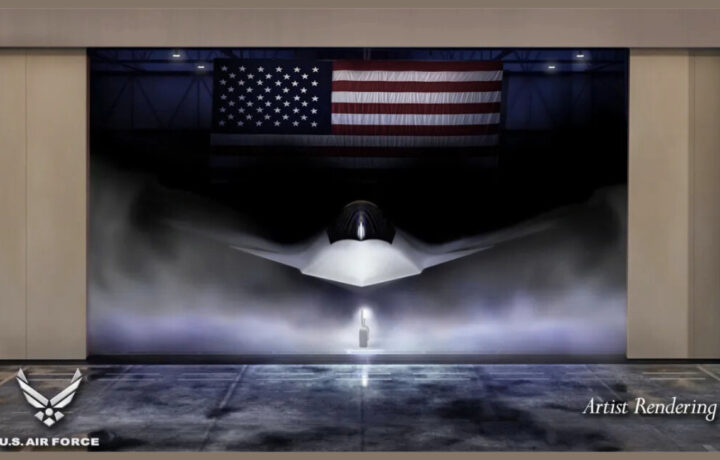
Even as numerous Pentagon programs are now behind schedule and over budget, that isn’t the case with two of the United States Air Force’s next-generation aircraft, according to the official who oversees their development.
At last month’s Life Cycle Industry Days in Dayton, Ohio, General Dale White, the U.S. Air Force’s director of Critical Major Weapons Systems, told attendees that the Northrop Grumman B-21 Raider long-range stealth bomber and the Boeing F-47 sixth-generation fighter remain on track.
White addressed the challenges that the U.S. military faces in defense acquisition.
“For too long, we have sat back and relaxed under the idea that we’re an administrative and mission support function,” White suggested. “Those days are gone. The time is now for this community to deliver.”
F-47 Set for 2028 Maiden Flight
The F-47, which was officially unveiled in the Oval Office in March 2025, is the centerpiece system of systems of the Next Generation Air Dominance (NGAD) program. The aircraft is intended to replace the Lockheed Martin F-22 Raptor, the world’s first “fifth-generation” stealth fighter that was introduced in 2005.
The manned aircraft will operate as the command center of a network combat system, supported by unmanned aerial systems (UAS), likely the drones now being developed via the Collaborative Combat Aircraft (CCA) program. The drones will serve as so-called “loyal wingmen,” acting as a force multiplier by providing reconnaissance, extending sensors and firepower, conducting electronic warfare (EW), and serving as decoys, where they can absorb the tactical risk to protect the manned aircraft.
The F-47 is now scheduled to make its maiden flight in 2028, with the prototypes supporting developmental testing of the advanced airframe, propulsion systems, avionics, and the stealth coatings. Although the Air Force had previously hoped for an aggressive 2030 operational capability of the sixth-generation fighter, current timelines see the aircraft entering service in the mid-2030s due to the complex engine development.
“The upcoming flight-test campaign will evaluate the fighter’s aerodynamic performance, stealth characteristics, software reliability, weapons integration, and overall mission capability before full-scale production begins,” Interesting Engineering explained.
Future air combat continues to evolve, and modern air superiority fighters aren’t likely to engage in Hollywood-style dogfighting. Instead, the F-47 will be armed with Beyond-Visual Range (BVR) missiles, equipped with artificial intelligence that can serve as a digital co-pilot to analyze the battlefield and prioritize threats. In addition, the manned fighters will be outfitted with EW systems, cyber capabilities, and supported by the CCA drones.
Fewer F-47s Will Be Built Than Other Modern Aircraft
As the F-47 will replace the aging F-22, the U.S. Air Force has indicated it would purchase at least 185 to 200 of the aircraft to make the operational size of the Raptor fleet. It should be noted that original plans for the F-22 called for as many as 750 of the air superiority fighters, but that was significantly scaled back due to the high costs, the end of the Cold War, and a lack of a clear mission.
With the F-47, the number of aircraft is being kept smaller as the Air Force sees the fighters serving as a type of “quarterback” in the sky, supported by a far larger fleet of CCA drones. Each F-47 could be paired with two to eight drone loyal wingmen, and the Air Force envisions a total fleet of at least 1,000 drones, which could be tailored to specific missions.
The U.S. Air Force’s fiscal year 2027 (FY27) budget request has called for $5.03 billion to support the F-47 program.
First B-21 Raider “On the Ramp” For Deployment
The United States Air Force also confirmed that the first B-21 Raider is set to arrive at Ellsworth Air Force Base (AFB), SD, in 2027. Northrop Grumman began initial production of the bombers, the first to be built in a generation, last year, and the aircraft will be “on the ramp” at the base next year, White added during his keynote address.
Flight testing of the next-generation bomber began in late 2023 at Edwards AFB, California.
The eventual production rate for the bombers is set to reach seven aircraft per year, and the Air Force will receive at least 100 of the Raiders, named for the World War II pilots who carried out the daring “Doolittle Raid” on Tokyo in the spring of 1942. The B-21s are set to replace the aging fleet of Rockwell B-1B Lancers and Northrop B-2 Spirit bombers by the late 2030s.
Due to concerns of a capability gap, both of the legacy bombers will undergo modernizations to ensure they can remain flying until the full fleet of Raiders enters service. Some lawmakers and Air Force officials have questioned whether 100 B-21s will be enough, even as the new aircraft are expected to operate alongside the even older Boeing B-52 Stratofortress bombers until the 2050s.


