Despite inventory improvements, security clearance processing times for Department of Defense industry applicants continues to tick up.
At the latest National Industrial Security Program Policy Advisory Committee (NISPPAC) meeting, DCSA officials acknowledged an uptick in investigative inventory during the third quarter, driven largely by increased demand for initial vetting investigations since February.
The latest timeliness numbers show just how significant the wait can be.
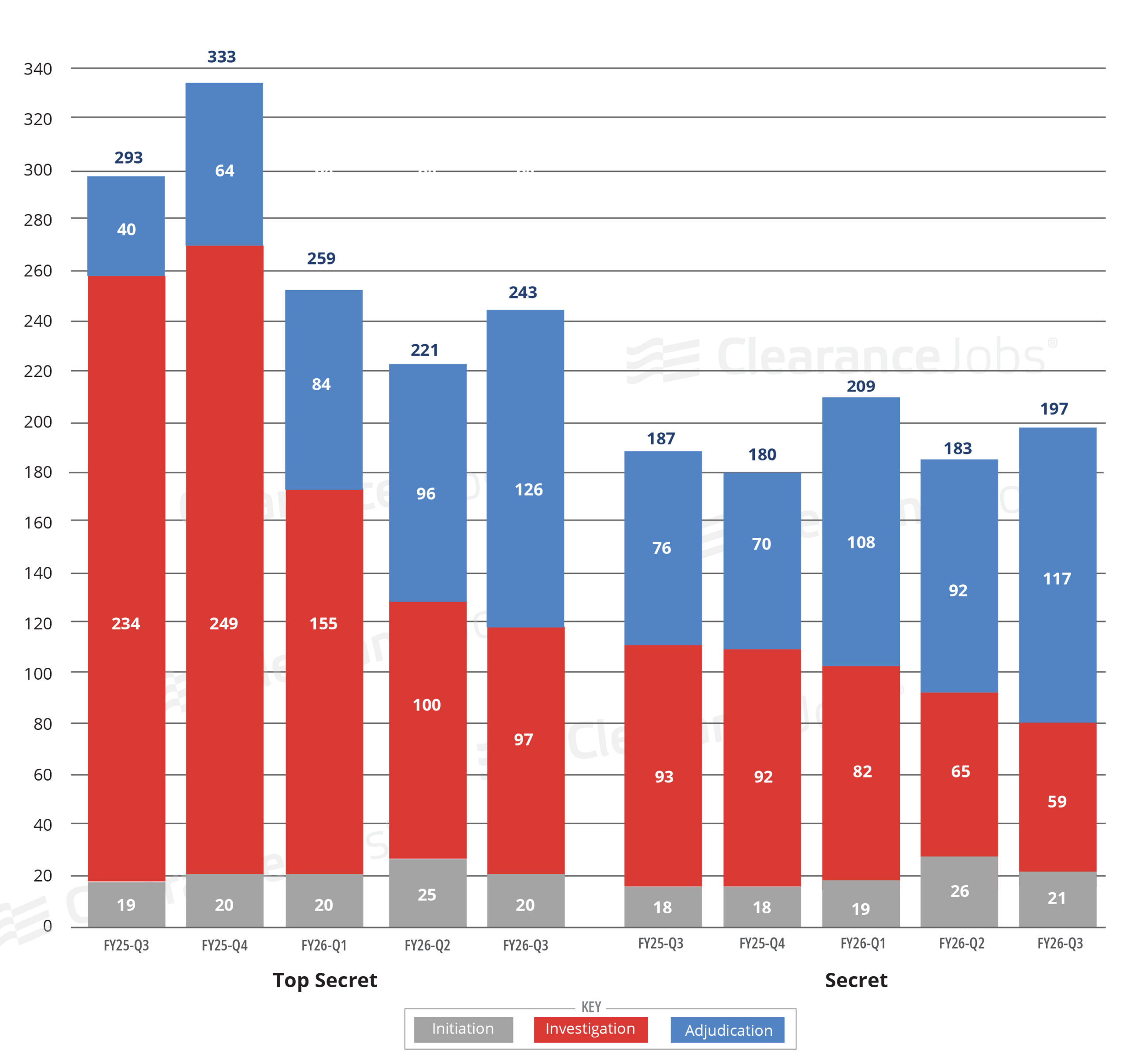
For an initial Top Secret clearance for industry, the current end-to-end timeline is 243 days: 20 days for initiation, 97 days for the investigation and 126 days for adjudication.
For an initial Secret clearance, the total is 197 days: 21 days for initiation, 59 days for investigation and 117 days for adjudication.
That’s roughly eight months for a Top Secret and six and a half months for a Secret.
For government contractors trying to put people on programs, those aren’t abstract numbers. They’re mission delays.
A New Way of Measuring Clearance Timeliness
Lest we bury the lead, there is an important caveat when comparing today’s numbers with previous DCSA reporting.
Tom Giancoli, DCSA, who presented the data at NISPPAC, noted that DCSA has changed how it reports timeliness to align with the government’s Personnel Vetting Performance Management Standards Implementation Guidance, or PMIG.
Historically, security clearance timeliness discussions frequently focused on the fastest cases. The new reporting focuses on the overall average. That’s a significant distinction. It means you can’t necessarily put today’s 243-day Top Secret figure next to an older “fastest 90%” number and conclude processing has deteriorated by exactly that amount. Particularly notable is where the time is accumulating.
For Top Secret cases, the investigation itself averages 97 days. Adjudication takes 126.
For Secret cases, investigation averages 59 days. Adjudication takes 117.
In other words, completing the investigation isn’t necessarily the finish line. For both clearance levels, adjudication is now taking longer than the investigation itself, now that reporting is considering the full picture. That matters enormously for employers. A completed investigation doesn’t put someone in a classified seat. A favorable eligibility determination does.
Inventory Is Down. Demand Is Up.
There is some good news in the numbers.
Giancoli said DCSA’s overall investigative inventory remains lower for FY 2026 despite the Q3 increase. But he also pointed to elevated demand for initial investigations beginning in February, including from industry. That’s worth watching.
Clearance processing has always been a supply-and-demand problem as much as a policy one. When hiring surges, investigations surge. When investigations surge without enough capacity across initiation, investigation and adjudication, timelines eventually feel the pressure.
The government’s challenge isn’t simply keeping the overall inventory low. It’s ensuring the personnel vetting enterprise can absorb changing demand without creating another backlog cycle. Investigation timelines aren’t the only place industry is feeling friction.
Continuous Vetting Is Creating Its Own Processing Questions
Some of the most interesting discussion at NISPPAC wasn’t about initial investigations at all. It was about Continuous Vetting.
Industry representatives pressed DCSA for better metrics around CV alerts, including what types of alerts are being generated and, critically, how long those alerts take to resolve.
DCSA said industry represents approximately 25% of its Trusted Workforce 1.5 CV enrollment population, with roughly 984,000 industry enrollments. That’s a tremendous expansion of the government’s ability to continuously identify potential risk. It’s also a tremendous operational workload. DCSA acknowledged some of the challenges.
Under the old model, an individual might interact with the personnel vetting system every five years during a periodic reinvestigation. Continuous Vetting changes that relationship entirely. Information is flowing continuously, including on individuals who may have changed employers, left trusted positions or otherwise become difficult for the government to contact. That can make resolving alerts complicated.
But industry made an equally important point: Some of the people caught in unresolved cases are very much still working in trusted positions. And when they try to move to a new contract, program or Special Access Program, an open issue can bring processing to a halt.
The concern raised at NISPPAC was straightforward: Industry doesn’t have a clear service-level agreement or reliable timeline for when those issues will be resolved. That creates another kind of clearance delay, one that may not show up neatly in the traditional investigation and adjudication statistics.
Put the FSO Back in the Loop
Industry also offered DCSA a practical recommendation: involve the Facility Security Officer earlier when the government is trying to reach an employee about a CV issue.
One participant noted that some contacts appear to be going directly to individuals, with the FSO coming into the process later. That greats operational and employment concerns.
FSOs know whether an employee is still affiliated with the company. They frequently have current contact information. And, perhaps most importantly, they understand the urgency when an unresolved personnel security issue is preventing someone from moving onto a contract or program.
DCSA officials said they would take the feedback back and continue developing better CV metrics, including data around alert management and issue resolution. The discussion also raised questions about FBI Rap Back enrollments and whether DCSA can distinguish issues generated through that expanded data stream. The theme is measurement.
Continuous Vetting has dramatically changed how the government monitors its trusted workforce. The next phase has to be proving that the government can resolve the information it receives quickly enough to make that monitoring operationally sustainable.
Clearance Timeliness Is a Workforce Issue
Participants asked DCSA whether it could provide data on how many initial personnel clearance investigation submissions are rejected and returned to agencies or industry partners. The answer was essentially that the data likely exists, but DCSA would need to better define the population and determine exactly which metrics should be pulled.
That may sound like a minor data question. It isn’t.
If cases are being rejected because of incomplete submissions, bad information or process errors, understanding the volume and causes could identify another opportunity to reduce clearance timelines without hiring another investigator or adjudicator. That’s why the industry’s increasing focus on clearance metrics matters.
How many cases are coming in? How many are rejected? How long does initiation take? How long does the investigation take? How long does adjudication take? How many CV alerts are generated? How quickly are they resolved? And where exactly are cases getting stuck?
The security clearance process has spent the past decade trying to move from episodic investigations toward a continuous, data-driven vetting model. The government now needs the performance data to match. Because whether a clearance takes 197 days or 243 days, or an unresolved CV alert leaves an employee sitting on the sidelines, the ultimate impact is the same: A qualified worker isn’t doing the national security job they were hired to do.
And for an industry already competing aggressively for cleared talent, every additional day matters.


