The Department of Homeland Security has been on a hiring push – but behind new hires is the need to properly vet the personnel into those mission critical positions. At the September 2 meeting of the National Industrial Security Program Policy Advisory Committee, DHS presented a detailed look at its personnel vetting workload, onboarding timelines, continuous vetting program and self-reporting activity. The department also did something government agencies do not always do when presenting performance data: It openly discussed where its own numbers may be incomplete, inconsistent or distorted by system limitations.
That kind of transparency should be viewed as progress.
According to the NISPPAC presentation, DHS manages a personnel vetting population of 508,531 individuals. That includes 323,287 individuals in national security eligible positions, 136,635 in non-sensitive public trust positions and 48,609 in low-risk positions.
During the reporting period, DHS completed 21,538 cases. The department reported average processing times of 10 days for reciprocity, 23 days for preliminary determinations and 100 days for final determinations.
Those numbers are useful. The explanations behind them are even more valuable.
DHS Onboarding Slowed, but National Security Cases Met Their Goals
DHS reported that its average “favorable to onboard” timeline increased by six days between the second and third quarters of fiscal 2026, moving from 35 days to 41 days.
One slide elsewhere in the presentation lists the third-quarter figure as 42 days. But rather than obscuring the broader performance picture, DHS provided an explanation of the trends driving the increase.
Contractor investigation timelines grew by 16 days, from 60 to 76 days. Employee investigation timelines increased by four days, from 99 to 103 days. At the same time, national security eligibility case volume more than doubled, rising from 79 cases in the second quarter to 185 in the third.
Despite that increased volume, DHS reported that those national security cases remained within the government’s Personnel Vetting Performance Management Standards. The cases averaged five days to initiate, 32 days to investigate, 16 days to adjudicate and 52 days from initiation to completion. The applicable end-to-end goal is 90 days.
That is an encouraging result. Workload increased significantly, but the cases included in the metric continued to meet federal timeliness objectives.
DHS is also making substantial use of preliminary determinations to get people working before every step of the full vetting process is finished. For contractors, preliminary determinations averaged 13.4 days. Employee preliminary determinations averaged 50.7 days. That difference helps identify where additional attention may be needed, while also showing how preliminary decisions can reduce the time it takes to place many contractors on the job.
Component-Level Data Brings Needed Context
DHS did not stop at a department-wide average. It released timeliness figures for individual components and separated contractor and employee populations.
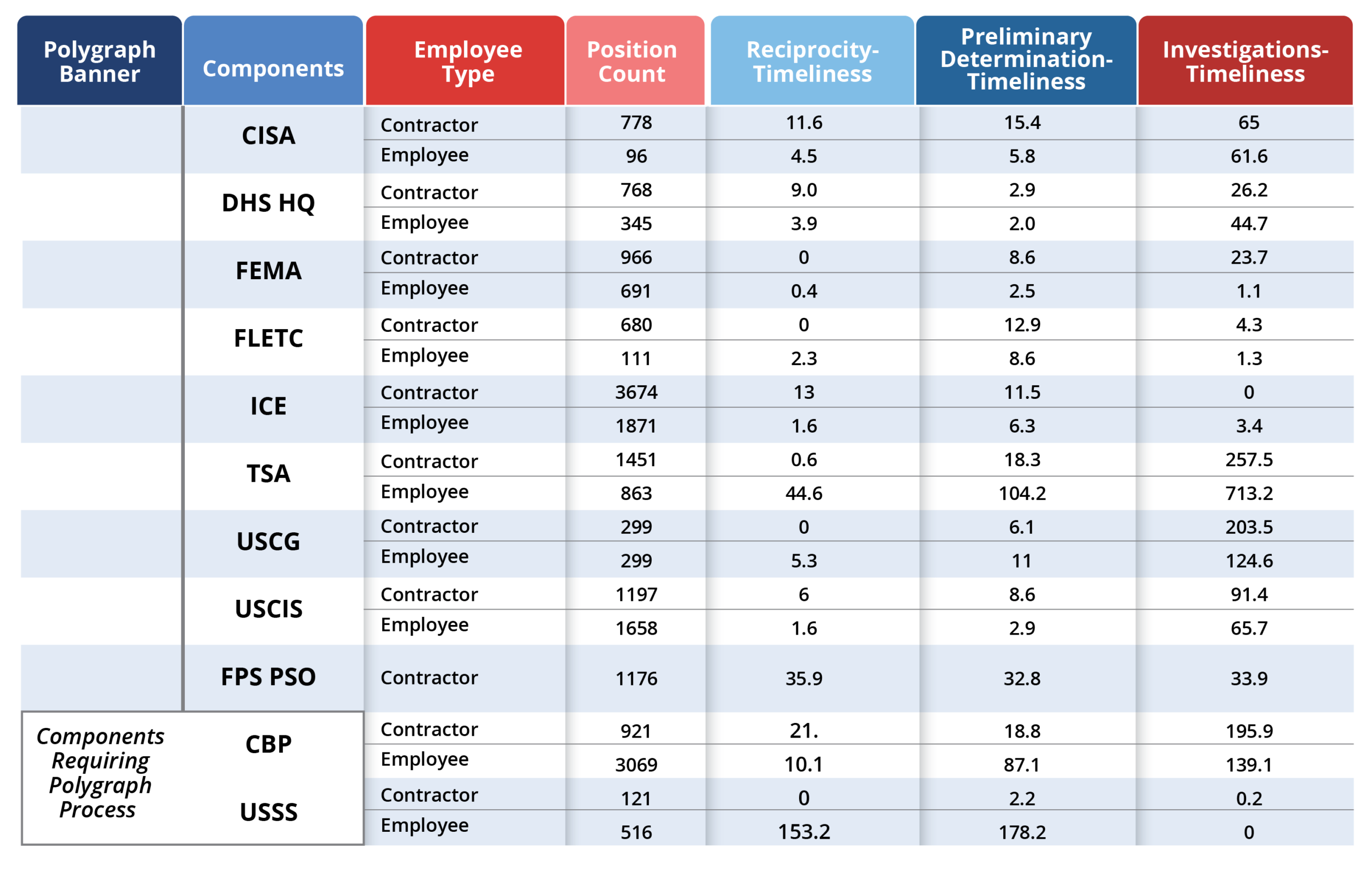
The results varied widely across the department. Some components reported relatively short reciprocity, preliminary determination and investigation timelines. Others showed much longer averages, particularly for investigations associated with polygraph processing.
At first glance, those differences could suggest uneven performance. DHS went further by explaining that some of the variation may result from how components enter information, reuse position records and calculate metrics.
That context matters. A number without an explanation invites assumptions. DHS instead showed where the data came from, identified possible distortions and outlined what it plans to do about them.
This is the kind of transparency that can actually lead to process improvement.
DHS Is Examining the Reliability of Its Own Data
DHS identified several concerns involving its Integrated Security Management System, or ISMS.
Some components use a “Copy & Inherit” tool that may retain original dates rather than update them for a current case. Components have also reused positions created five to 13 years ago instead of creating new position records. Both practices can affect the accuracy of timeliness calculations.
The U.S. Secret Service enters information into ISMS from its own internal system, and DHS found discrepancies between the dates recorded in the two systems. The department acknowledged that those differences affect data integrity and said they warrant additional review and better synchronization.
DHS also discovered an issue with how ISMS calculates reciprocity timelines. Reciprocity performance is based on “Date In” and “Date Out” fields. But opening a different type of case, such as a continuous vetting case, can alter the reciprocity “Date Out” and make the original action appear to have taken longer.
In one Immigration and Customs Enforcement case, opening a continuous vetting matter changed the number of days attributed to an earlier reciprocity decision. DHS also found that components were not always using the same method to calculate reciprocity timelines.
None of those findings is ideal. But identifying and disclosing them is exactly what an effective performance management program should do.
DHS is not simply publishing a 10-day reciprocity average and declaring victory. It is asking whether that figure means the same thing across every component and whether the supporting system is measuring the process correctly.
That is a much more useful conversation.
Continuous Vetting at Scale
The presentation also provided an unusually detailed view of the operational scale of continuous vetting.
DHS reported 233,075 individuals enrolled in the Continuous Evaluation System and 285,908 enrolled in the FBI’s Rap Back program. The department recorded 503,785 CES alerts, with 92% categorized as low risk, 6% as medium risk and 2% as high risk.
The average continuous vetting case took 13 days to adjudicate.
DHS also reported 22,968 self-reporting cases under Security Executive Agent Directive 3. Of those, 18,108 had been completed, 4,815 remained open and 45 were canceled.
Foreign travel accounted for most of that activity, generating 13,493 reports. Debriefings involving foreign travel to diplomatic facilities accounted for another 7,703. Reports involving foreign contacts, financial issues, marriage, cohabitation, arrests and outside employment were much smaller by comparison.
The figures illustrate what continuous vetting looks like when translated from policy into operations. It means hundreds of thousands of enrolled individuals, more than half a million alerts and thousands of employee self-reports requiring review.
It also shows that most reported activity is routine. The overwhelming majority of continuous vetting alerts were categorized as low risk, and foreign travel drove much of the self-reporting workload.
For security managers, that information can help put continuous vetting into perspective. The system is designed to identify potential risk earlier, but it must also efficiently sort routine activity from information requiring additional attention.
Transparency Can Drive Better Reciprocity and Faster Hiring
DHS has formed a Data Integrity Action Group that includes the Personnel Vetting Program Management Office, Enterprise Security Services Division and the metrics team. The group has already met to address discrepancies and pursue corrective actions, including requests for system changes.
The department also plans to conduct standardization sessions with its components covering reciprocity, preliminary determinations and other personnel vetting processes. Those sessions will incorporate feedback from MITRE and focus on consistent data entry and case processing.
That may be the most promising takeaway from the DHS presentation.
Security clearance reform depends on more than faster investigations. Agencies need common definitions, consistent data-entry practices and systems that measure what leaders think they are measuring. Otherwise, it is impossible to identify the source of a delay or determine whether a reform is producing results.
The federal government frequently releases vetting statistics without providing enough context to understand them. DHS took a different approach. It showed its workload, its performance, its component-level differences, the limitations of its systems and the actions underway to improve them.
For applicants and employers, better data could eventually mean more accurate onboarding estimates and a clearer understanding of where a case is delayed. For government leaders, it could reveal which practices should be expanded and which systems need to change. For reciprocity, standardized measurement may finally help separate actual policy delays from reporting and technology problems.
DHS is not claiming that every number is perfect. It is demonstrating a willingness to examine the numbers publicly and improve the processes behind them.
That is what meaningful transparency looks like. And if other agencies follow the DHS model, the future of personnel vetting could include not just more data, but data the government, industry and cleared workforce can actually use.


