In the corporate world, public and private entities differ primarily in ownership, funding, and transparency. Simply put, public companies are owned by shareholders who buy stock through an initial public offering (IPO) or on a stock exchange. In contrast, private companies are owned by founders, management, or private investors/venture capital.
The situation is a little different when we discuss public vs. private shipyards, which differ primarily in ownership, core missions, cost structures, and the types of work they handle.
What gets confusing is that a “privately owned” shipyard can be publicly traded on stock exchanges. The term “publicly owned” doesn’t mean a public company; it implies government ownership.
What Is A Private Shipyard?
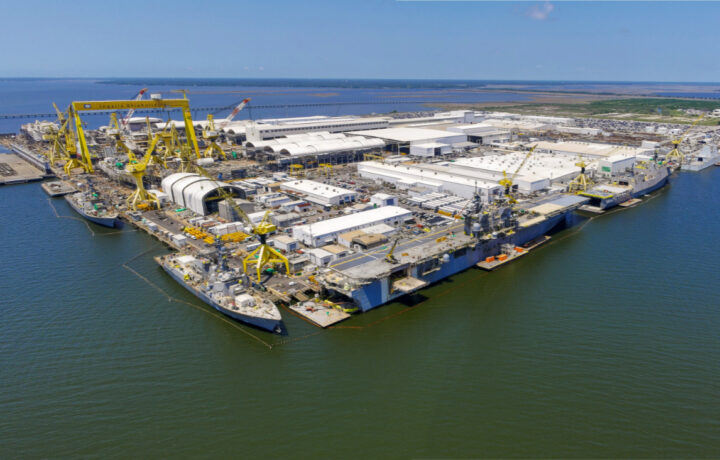
Today, many large private shipbuilding companies, including those owned by major defense contractors or publicly traded corporations like General Dynamics Electric Boat or Huntington Ingalls Industries’ Newport News Shipbuilding, are owned by public shareholders through the stock market, even though they function as private commercial/defense entities.
“Like any other private-sector organization, the decision-making power and implementation of the desired frameworks are taken at the management level. The net turnover, after necessary taxation, is the profit for the yard and that acts as a key determinant for improvement of processes and incorporation of more infrastructure,” Maritime Insight explained.
In the United States Navy, a private shipyard’s primary mission is to build new combatants, support ships, and commercial vessels, while also taking on select military overhauls and depot maintenance.
Along with NNS and Electric Boat, about 22 major private yards remain active.
The key strength of private shipyards is that historical studies from government watchdogs, notably the Congressional Budget Office (CBO) and the Government Accountability Office (GAO), have found certain submarine and ship maintenance tasks performed at private yards to be roughly 31% to 38% less expensive on average than at public yards.
A major limitation of private shipyards is that they face intense commercial and defense market competition, capacity bottlenecks, and the heavy burden of balancing new vessel construction backlogs with repair demands. Still, private yards can help absorb overflow maintenance, retrofitting, and construction demands that public shipyards cannot handle alone due to aging infrastructure and limited dry-dock availability, the GAO noted in a February 2025 report to Congress.
Not All Private Shipyards Work With the U.S. Navy
Today, public shipyards employ approximately 107,000 to 110,000 direct workers, according to data from the U.S. Maritime Administration (MARAD) and industry reports. The workforce spans roughly 154 active private shipbuilding yards and over 300 repair-focused facilities across 29 states and the U.S. Virgin Islands. Around 64% of all private direct shipyard jobs are concentrated in just five states: Virginia, Connecticut, Mississippi, California, and Louisiana.
The U.S. Navy also still relies on a select subset of private shipyards to build and repair its fleet. In contrast, most commercial shipyards in the United States do not perform naval work, although a small group of private yards currently handles specialized repair, overhaul, and auxiliary vessel construction. Today, major warship production is heavily consolidated among large defense contractors.
Given the shortage of shipyards that can build and maintain U.S. warships, the question is why more of these facilities aren’t vying for Pentagon contracts. The reason is straightforward enough.
U.S. naval vessels require specialized classified technology, shock-hardening, nuclear-certification capabilities, and compliance with strict Department of War oversight that commercial yards lack. Moreover, most U.S. commercial shipyards lack the massive drydocks, heavy-lift cranes, and secure infrastructure required to build modern destroyers, submarines, or aircraft carriers.
What is a Public Shipyard?
In a public shipyard, the government and the United States Navy directly own, fund, and operate it. Its primary mission is to handle specialized, high-security maintenance, overhauls, and refuelings for nuclear-powered vessels – specifically aircraft carriers and nuclear attack submarines.
These shipyards are uniquely equipped and staffed to handle such work. Unlike private commercial or defense contractors driven by profit margins, federal civilian employees in public shipyards work directly under Navy command, ensuring alignment with national security priorities during crises or tight schedules.
In theory, but not always in practice, public shipyards can provide a dedicated baseline of repair and maintenance infrastructure needed to keep combat-ready nuclear ships in the rotation, mitigating fleet bottlenecks.
The U.S. Navy’s public shipyards are now positioned strategically on both the East and West Coasts, as well as Hawaii, at Norfolk, Va., Portsmouth, Me., Puget Sound, Wash., and Pearl Harbor, Hi., providing regional support to the active-duty fleet without requiring ships to transit to distant facilities or private builders. In addition, the public shipyards maintain institutional knowledge because a long-term federal civilian workforce staffs the facilities.
A major concern, however, is that many of the shipyards are constrained by aging 19th- and 20th-century infrastructure and dry docks, leading to significant maintenance backlogs and delays. Another issue is that only four public shipyards remain active, down from the 13 the U.S. Navy once operated.
Currently, the U.S. Navy’s four public shipyards employ approximately 38,000 civilian workers.


