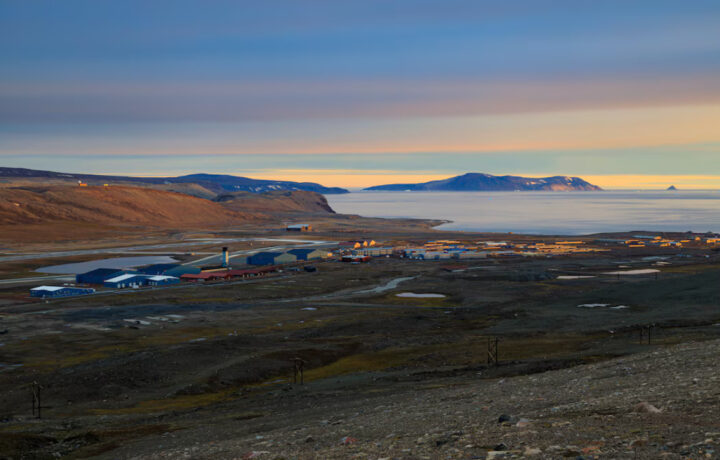
While speaking at the World Economic Forum in Davos, Switzerland, on Wednesday, President Donald Trump said he would not use military force to obtain the semi-autonomous territory of Greenland. The president has repeatedly called for the United States to acquire the Danish territory, citing national security.
However, critics have noted that the United States already has a military presence in Greenland and, by treaty, could significantly increase its military footprint on the world’s largest island.
First Efforts to Obtain Greenland
President Trump isn’t the first U.S. official to seek to obtain the territory, which has been under Danish control since the 1720s, more than 50 years before the U.S. Declaration of Independence.
The earliest attempt occurred in 1867 during the administration of President Andrew Johnson, after Secretary of State William H. Seward concluded the purchase of Alaska from the Russian Empire.
As an expansionist, Seward proposed buying Greenland from Denmark, but the effort gained little traction as Johnson battled with Congress and became the first president to face impeachment.
In 1910, the United States Ambassador to Denmark, Maurice Francis Egan, discussed a trade of U.S.-controlled islands in the Philippines, gained following the Spanish-American War just over a decade earlier, for the Danish West Indies and Greenland. The plan wasn’t actually to see Copenhagen and Washington trade a handful of islands, but it could have allowed the Danes to make a deal with Germany for Northern Schleswig, which it had lost to Prussia in 1864.
That proposal also didn’t go forward, but it should be noted that the U.S. did purchase the Danish West Indies in 1917 to help protect the Panama Canal, and today they are known as the U.S. Virgin Islands. The U.S. also agreed to recognize Denmark’s claim to the whole of Greenland.
As for Northern Schleswig, Denmark didn’t need to trade anything, as it regained the lands from Germany following the First World War, when Berlin was forced to hold two plebiscites as part of the Treaty of Versailles.
Washington Tried Again
During the 1920s, some in the U.S. Armed Forces, notably U.S. Army General Billy Mitchell, an early advocate of military aviation, recognized the need for American bases on Greenland and Iceland. However, no efforts were made.
It was only after the swift defeat and occupation of Denmark during the Second World War that Washington was forced to act. There were fears that Nazi Germany, which defeated the Danish Army in less than six hours on April 9, 1940, would claim Greenland.
Beyond the strategic concerns, which could allow the basing of German U-Boats or even aircraft that could threaten supply lines to Europe, was the fact that Greenland was the only significant source of cryolite, a vital ingredient in the production of aluminum needed for military aircraft.
Washington applied the Monroe Doctrine and landed U.S. Coast Guard personnel in 1940, beginning an informal occupation. The troops were formally discharged and then reconstituted as a force of “volunteers.”
On April 9, 1941, a year after the German invasion of Denmark, Secretary of State Cordell Hull signed a treaty with Danish Ambassador to the United States Henrik Kauffmann that authorized the U.S. defense and occupation of Greenland.
Approximately 5,800 troops were stationed in Greenland, and several military bases were established. U.S. forces eventually accoutered for 25% of the island’s population.
After the end of the Second World War, Copenhagen expected the U.S. military to withdraw, but, much to the Danish government’s surprise, Washington made clear it was staying. Under the administration of President Harry S. Truman, the United States again tried to buy Denmark. It was suggested that Denmark be paid $100 million in gold.
Proposals have continued in the decades since.
In the 1950s, the U.S. Joint Chiefs of Staff suggested Washington try to obtain the island, and the idea was floated again by Vice President Nelson Rockefeller in the 1970s. Political pundit Patrick Buchanan stated in the 1990s that the U.S. simply needed patience and that Greenland would eventually become part of the United States.
A 1951 Treaty Makes it a Moot Point
It should be abundantly clear that Denmark isn’t interested in selling Greenland, and that the residents of the semi-autonomous territory have no interest in becoming American citizens. President Trump has suggested Greenland is needed for national security, including for the proposed Golden Dome for America.
Yet experts have argued it is a moot point because of a 1951 treaty that granted the U.S. “the right to expand its military presence in Greenland far beyond World War II levels,” History.com explained.
During the Cold War, there were more than 50 U.S. military installations, including radar and communication sites, with the largest being Thule Air Base—now Pituffik Space Base—in northern Greenland. At its height, it was manned by more than 10,000 US military personnel. As History.com also noted, the U.S. wasn’t going to take no for an answer and planned to build the base even if Denmark disagreed.
Even when it came to the treaty, “Denmark did not have much bargaining power in the negotiations over the future security of Greenland,” History.com added. “NATO’s ‘mutual defense’ orders were clear, and the U.S. was the only country with the military resources to provide defense for the island.”
The Department of Defense didn’t ask; instead, it just did what it wanted, sometimes without even informing Copenhagen.
Notably, that included the construction of Camp Century, which was operated from 1959 to 1967. The underground base was powered by a nuclear reactor and served as a testament to “Project Iceworm,” which determined if the U.S. Army could build a network of mobile nuclear missile launch sites under the Greenland ice sheet.
The project was ambitious as it sounds, and was to include hundreds of miles of rail lines under the ice, which could allow the U.S. military to secretly move nuclear weapons as part of a literal shell game to confuse the Soviets.
In attempts to build it, the troops fought a “cold war” against the ice and snow, which constantly moved and made tunnel construction impractical.
Just a single 1,300-foot (400-meter) tunnel was constructed.
By the early 1960s, the U.S. military abandoned Camp Century, leaving behind tons of waste now buried just 30 meters (100 feet) beneath the ice sheet. There are fears that, as the climate warms, the waste, including millions of gallons of frozen sewage, could resurface. Even more toxic materials, including asbestos-covered pipes and lead paint, might be unsealed in the coming years.
There are dozens of other abandoned bases that are in need of cleanup.
Just One Base Remains
Pituffick Space Base is the only U.S. military facility still in operation, with the others from World War II and the Cold War long shuttered. That remaining installation is now focused on space surveillance and missile warning for NORAD.
However, the 1951 treaty remains in effect, meaning the U.S. can build new bases or reoccupy shuttered bases. It can do so without the U.S. needing to purchase, annex or otherwise control Greenland.


