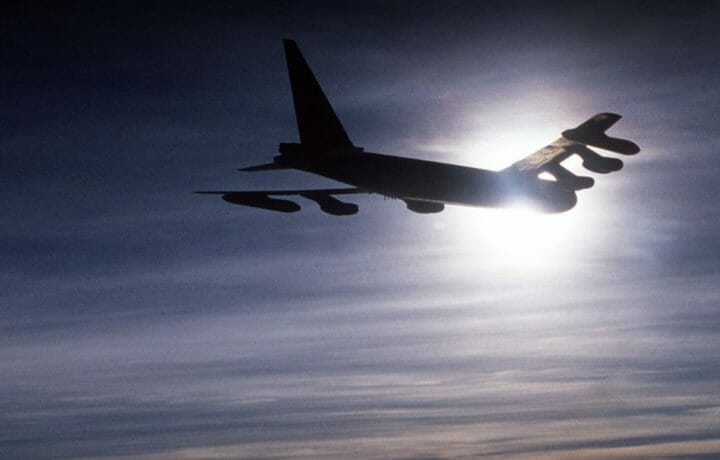
The United States Air Force was established on September 18, 1947, after having been part of the United States Army. Although it is the second youngest branch of the U.S. military, it is fourth in order of precedence, and its core missions are air supremacy, global integrated intelligence, surveillance and reconnaissance, rapid global mobility, global strike, and command and control.
Today, along with China’s People’s Liberation Army Air Force (PLAAF) and the Russian Aerospace Forces, the U.S. Air Force is just one of three operators of significant fleets of long-range strategic bombers. Several factors explain why other nations have retired their bomber forces, including the prohibitively high cost of building, flying, and maintaining bombers, and the fact that many nations employ multirole jet fighters, cruise missiles, or submarine-launched missiles to deliver precision strikes.
Many of those reasons also explain why the United States Air Force currently operates far fewer bombers than it did during the Cold War and today relies on just three aircraft.
All three bomber platforms have been used in the ongoing Operation Epic Fury against targets in Iran. Even in the 21st century, it seems that some missions still require bombers!
Here is a rundown of the three strategic bombers now in service, and some background on the aerospace firms that built them.
The Boeing B-52 Stratofortress
The U.S. Air Force’s main workhorse is the Boeing B-52H Stratofortress. It is also the final bomber to be built by the aerospace firm that first opened its doors in Seattle in 1916 and became practically famous for its heavy combat aircraft.
In total, Boeing produced nearly a dozen distinct bomber models and prototypes, including the “Big Four” – the B-17 Flying Fortress, the B-29 Superfortress, the B-47 Stratojet, and finally the B-52 Stratofortress.
There are currently 76 of the latter aircraft in the current inventory, with 58 in the active forces, and an additional 18 in the reserve fleet. Another dozen or so are preserved at Davis-Monthan Air Force Base (AFB) in the famed aviation “Boneyard,” which could be returned to service if needed. The active B-52s are stationed at Barksdale AFB, Louisiana, and Minot AFB, North Dakota, both under Air Force Global Strike Command.
The fleet has been steadily reduced in size; yet, the Stratofortress won’t fly off into the sunset anytime soon.
A total of 744 B-52s were built during the Cold War by Boeing at two primary locations: Seattle, WA, and Wichita, KS, with production spanning from the early 1950s until the final B-52H model was delivered in October 1962.
The B-52s have flown under various commands over those 67 years, beginning with the Strategic Air Command, which was disestablished at the end of the Cold War in 1992, when its aircraft were absorbed into the Air Combat Command. Since 2010, all B-52 Stratofortresses have operated under the Air Force Global Strike Command.
The current fleet of bombers is set to receive new engines, radar, and other enhancements to ensure they remain in service through the early 2050s or even later.
In addition to the B-52, Boeing is noted for producing the KC-135 Stratotanker. The aerospace giant also acquired the aviation business from rival McDonnell Douglas in 1997 and has since produced the F/A-18 Super Hornet for the United States Navy and developed a modernized version of the F-15 Eagle, the F-15EX Eagle II.
Last year, Boeing was also awarded the contract to produce the F-47, a sixth-generation manned fighter that is the centerpiece of the Air Force’s Next Generation Air Dominance (NGAD) program. The company is also currently competing with rival Northrop Grumman for the U.S. Navy’s F/A-XX contract, which calls for a sixth-generation carrier-based multirole fighter that will eventually replace the Super Hornet.
The Rockwell B-1B Lancer
During the Carter administration in the 1970s, the Rockwell B-1 Lancer was canceled, and that could have been the end of the story. However, the program was revived by President Ronald Reagan, with a total of 104 Lancers rolling off the assembly line.
The U.S. Air Force maintains a fleet of 45 active-duty B-1B Lancers, with the aircraft stationed at Ellsworth AFB and Dyess AFB, Texas.
The supersonic variable-sweep wing heavy bomber was developed by North American Rockwell, which was subsequently renamed Rockwell International. The company’s aviation division traces its origins to North American Aviation, the aerospace firm that produced such aircraft as the T-6 Texan trainer, the twin-engine B-25 Mitchell used in the famed Doolittle Raid on Tokyo in 1942, and the P-51 Mustang.
During the Cold War, North American also developed the F-86 Sabre, the best-known of the U.S. Air Force’s first swept-wing fighters, which engaged Soviet MiG fighters in the skies over Korea. The F-86 was one of the most produced post-World War II combat aircraft.
However, in the late 1950s, following the cancellation of the F-107 and F-108 programs, North American went into a tailspin and never fully recovered. It was merged with Rockwell-Standard, becoming North American Rockwell in the late 1960s. It continued to play a role in the U.S. aerospace and defense sectors, including the development of the Space Shuttle for NASA.
The B-1B Lancer was the final combat aircraft made by Rockwell. Boeing acquired the company’s core aerospace and defense divisions in the mid-1960s.
Northrop B-2 Spirit
One factor that led President Jimmy Carter to cancel the B-1B Lancer was that he knew something many in the Pentagon might not have known at the time: the U.S. Air Force was working on an even more advanced bomber to replace the aging B-52 Stratofortress.
That aircraft turned out to be the Northrop B-2 Spirit.
In the 1980s, rumors circulated that the Air Force was developing an advanced bomber, but it wasn’t until November 22, 1988, that the first B-2 was rolled out at Plant 42 in Palmdale, California. According to a now-infamous story, the U.S. Air Force didn’t intend for so many details to be shared, and to keep key details secret, attendees at the unveiling were kept 70 yards away. However, photographers flying in a Cessna took authorized photos of the Spirit’s top and back.
Although it was designed for a feared war with the Soviet Union, the B-2 Spirit was first used in combat operations in 1999 during Operation Allied Force in Serbia, and then saw use in Operation Enduring Freedom in Afghanistan in 2001, and Operation Iraqi Freedom in 2003
The Air Force originally planned to produce 132 bombers, but following the dissolution of the Soviet Union and the end of the Cold War, that number was reduced to 21 aircraft, including a prototype and 20 production aircraft. Two B-2s have been lost in catastrophic accidents, and just 19 are now in service.
Seven Spirits took to the sky and were used in last year’s Operation Midnight Hammer, where the aircraft flew CONUS-to-CONUS missions from Whiteman Air Force Base (AFB), Missouri, and back to strike Iran’s nuclear program.
Northrop Grumman – the result of the 1994 merger between Northrop Corporation and the Grumman Corporation – is now developing the B-21 Raider. This next-generation bomber will replace the aging B-1 and B-2 bombers and serve alongside the B-52.
The Pentagon has approved plans for the Air Force to receive approximately 100 B-21s, even as some Air Force officials have said the service will need at least 145 to more than 200 aircraft to meet long-term strategic demands. The Raider is now in low-rate initial production and continues to undergo flight testing.
The aerospace firm is also competing for the aforementioned F/A-XX program. Northrop Grumman has famously developed many carrier-based aircraft for the U.S. Navy, including the F4F Wildcat, F6F Hellcat, F8F Bearcat, F9F Panther/Cougar, and F-14 Tomcat. Northrop also produced the TBF Avenger torpedo bomber, A-6 Intruder attack plane, and E-2 Hawkeye airborne early warning aircraft.
Northrop produced the P-61 Black Widow night fighter, the F-5 Freedom Fighter, T-38 Talon trainer, and F-89 Scorpion interceptor.


