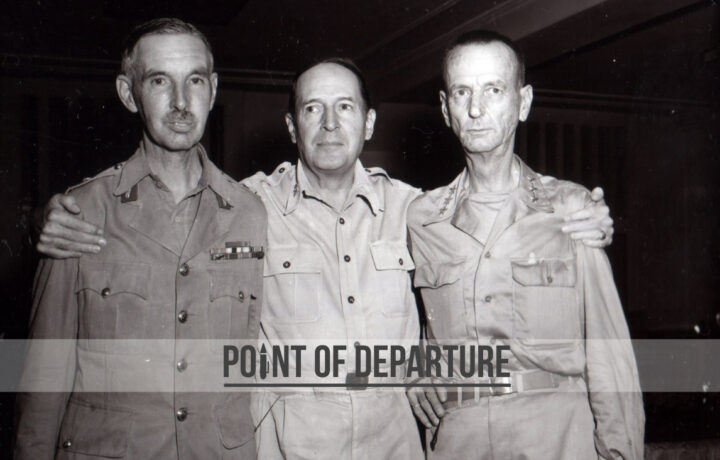
On September 10, 1945, General Jonathan Wainwright stood with his family and a few friends in the White House rose garden as President Harry S. Truman took his place before the microphones. The general was frail, and concerns about his health convinced the President to keep his comments brief. He hung the solitary medal around Wainwright’s neck, then proceeded to read aloud from the citation.
When he finished reading, Truman looked up and said, “And so it gives me more pleasure than most anything I’ve ever done to present General Wainwright with the Congressional Medal of Honor – the highest honor this country can bestow on any man.”
After recognizing Wainwright, Truman took the general by the arm and escorted him before the newsreel cameras. The journey to that moment was fraught with death, sorrow, and pain. It required exceptional courage and resilience to lead in the face of seemingly insurmountable odds, but Wainwright was exceptional in every sense of the word.
The Road to Corregidor
Wainwright arrived in the Philippines in September 1940, taking command of the Philippine Division cavalry and the later the North Luzon Force. When Japanese forces invaded the archipelago in the days after the Pearl Harbor attack, Wainwright found himself commanding troops who were outmanned, outgunned, and cut off from reinforcement.
In a desperate gamble to buy time in hopes of relief from the Unites States, General Douglas MacArthur ordered a fighting withdrawal to the Bataan Peninsula. There, Filipino and American forces endured months of grinding jungle warfare, combatting a relentless Japanese advance while subsisting on reduced rations and battling diseases – malaria, dysentery, and beriberi – that ravaged the ranks.
When MacArthur evacuated to Australia, he left Wainwright to command a force that was starving, sick, and fighting without air or naval support. When Bataan fell on April 9, 1942, 78,000 troops were taken captive and forced to endure the infamous Bataan Death March, a grueling 65-mile trek characterized by severe abuse, torture, and death. Before the prisoners arrived at Camp O’Donnell, as many as 18,000 Filipinos and 650 American troops were dead.
Wainwright held out on the island fortress of Corregidor with a force shrinking by the day. When the Japanese landed on the island on May 6, Wainwright made the most agonizing decision of his military career – he surrendered all remaining American and Filipino forces on the archipelago. He would spend the rest of the war in captivity.
The Lessons of Endurance
As a prisoner of war, Wainwright was subjected to constant and deliberate humiliation: marched before cameras, forced to participate in staged propaganda events, and confined in conditions intended to break him, both in body and spirit. He also carried the additional burden of the shame of surrender, a belief persistently reinforced by his captors.
He bent, but he didn’t break.
Though it all, three important lessons helped him to endure despite the conditions of his captivity. First, dignity is a choice. Despite Japanese efforts to strip him of his identity and self-worth, he surrendered neither. He maintained his bearing, sense of command responsibility, and loyalty to his fellow prisoners. Second, duty is paramount. As a commander, Wainright held true to his belief that his first duty was to his men, not his reputation. Though haunted by Corregidor, he believed that history would judge him for how we led his people when it mattered. Third, the quiet power of perseverance. Survival in captivity was a day-to-day, incremental effort. The Japanese stripped him of every formal instrument of command, but he maintained his bearing. He survived for the men around him; they could take his rank, but not his character.
The Legacy of Leadership
Jonathan Wainwright’s years as a prisoner of war were harsh and cruel. The physical and psychological toll were severe. But, through it all, he persevered, forging a leadership legacy that proved both deeply personal and universally instructive.
1. Grace shines under impossible odds.
MacArthur left Wainwright with an impossible task: lead a campaign that, from the outset, was unwinnable. He didn’t have enough troops, ammunition, or support. What he did have was composure – a military bearing second to none. Leaders who can maintain clarity of purpose when the odds are stacked against them are rare.
2. The burden of command can be heavy.
Wainwright’s command inheritance was, to put it bluntly, poisoned. Despite the insurmountable odds, he accepted full ownership of an impossible situation. He exemplified a fundamental truth of leadership: the burden of command must be borne without reservation or excuse.
3. Trust is a two-way street.
Wainwright was revered by his men, trusted in a way that defied the odds. He shared their hardships, endured their suffering, and chose their welfare over his own. Leaders who extend the same loyalty that they ask of others find trust in abundance.
4. Authenticity is revealed under duress.
Despite over three years of captivity, deprivation, and humility, the Japanese were unable to break Wainwright. He didn’t discover his true self behind the barbed wire, he confirmed it. Character forged in the crucible of leadership is sustained when the fire rages around you.
5. Redemption is an act of leadership.
Wainwright stood resolute at the Japanese surrender aboard the USS Missouri – gaunt, aged beyond his years, but unbowed. His presence sent a message to every other prisoner of war: duty faithfully performed in defeat is a form of restoration. Leaders who understand redemption build teams that are deeply resilient, capable of facing down incredible adversity.
Wainwright reluctantly retired on August 31, 1947, but only after reaching the mandatory retirement age. He died six years later and remains one of the few leaders to be memorialized in the lower level of Arlington’s Memorial Amphitheater. His legacy endures, a man who, despite losing everything a commander can lose, held onto the things that define a true leader – honor, integrity, and character.

