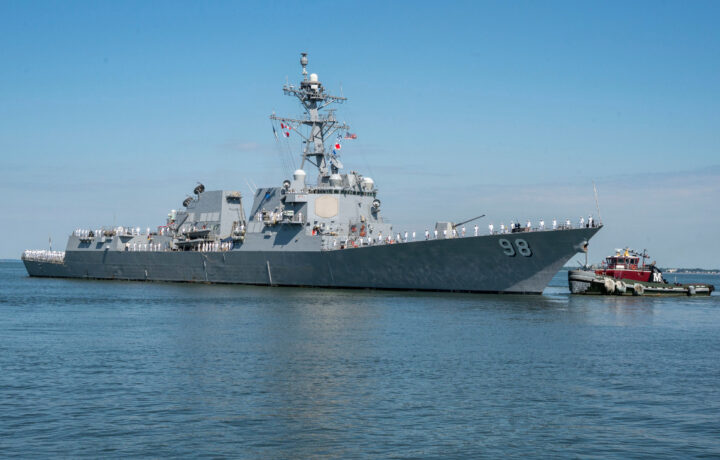
Much attention is given when the United States Navy dispatches one of its nuclear-powered supercarriers to a global hotspot, but those flattops don’t head out alone. Among their primary escorts that make up the carrier strike group (CSG) are the Arleigh Burke-class of guided missile destroyers, which remain the service’s premier multi-mission warships, capable of conducting anti-air, anti-submarine, and anti-surface warfare.
The vessels were named for highly decorated U.S. Navy Adm. Arleigh Albert Burke, who served with distinction as a destroyer command in World War II, and later as the 15th Chief of Naval Operations (CNO), where he led the modernization of the service, including the adoption of nuclear propulsion and the Polaris missile system.
Individual ships of the class have been named for other American heroes, naval leaders, and Medal of Honor recipients.
The most recent Arleigh Burke-class destroyer to be commissioned is the USS Harvey C. Barnum Jr. (DDG-124), a Flight IIA Technology Insertion variant, named in honor of Harvey C. Barnum Jr., a retired United States Marine Corps officer who received the Medal of Honor for valor during the Vietnam War.
Cold War-era Vessels
The multi-role guided-missile destroyers were developed during the Reagan era and first entered service under President George H.W. Bush (number 41). The threat at the time was the Soviet Navy, and its massive fleet of submarines.
Yet the Arleigh Burke-class guided-missile destroyers have played a role in U.S. Navy operations in numerous conflicts in the post-Cold War era. The lead vessel, the USS Arleigh Burke (DDG-51) was laid down in 1988, launched in 1989, and commissioned on July 4, 1991.
The class has since had the longest production run of any post-Second World War U.S. Navy surface combatant. To date, 78 have entered service, and with the decommissioning of the last Spruance-class destroyer in 2006, the Arleigh Burke-class remained the sole active U.S. Navy destroyer until the Zumwalt-class first entered service in 2016.
General Dynamics Iron Works and Huntington Ingalls Industries have built the vessels. Current plans call for more than 90 to be constructed, and the warships have been steadily improved, consisting of Flight I, II, IIA, and the latest Flight III variants.
Large And Capable Warships
The Alreigh Burke-class remains among the largest destroyers built for the United States Navy, while the hull form was designed to permit high speeds. The design also featured various stealth techniques, including the use of angled rather than traditional vertical surfaces and a tripod mainmast, which create a low radar cross-section – making it more difficult for warships to be targeted by anti-ship missiles. The ship also utilizes an electronic warfare suite that can provide passive detection and decoy countermeasures.
With an overall length of 505 to 509.5 feet (153.9 to 155.3 m), and a displacement ranging from 8,230 to 9,700 tons, the Arleigh Burke-class vessels are larger, and with weaponry including more than 90 missiles, are also more heavily armed than most previous ships classified as guided missile cruisers.
The entire ship, except the two aluminum funnels, is made of steel, with vital areas protected by two layers of steel and 70 tons of Kevlar armor.
The Arleigh Burke-class destroyers are equipped with an Aegis combat system that integrates the ship’s sensors and weapon systems to engage anti-ship missile threats; while the Aegis system has a federated architecture with four subsystems, AN / SPY-1 multifunction radar, a command and decision system (CDS), an Aegis display system (ADS), and the weapon control system (WCS).
Flight Plans and Improvements
The initial 21 Arleigh Burke-class destroyers in the class, DDG-51 to DDG-71, are categorized as Flight I; while the next seven, DDG-72 to DDG-78 are Flight II; followed by revised Flight IIA ships.
The newest Flight III variants, the fourth and most significant upgrades to the class, are equipped with the SPY-6(V)1 Air and Missile Defense Radar, Aegis Baseline 10 combat system, and upgraded generators with a new 4,160 volt power grid to support the energy-intensive systems.
The SPY-6(V)1 is the most advanced ever system yet deployed on the class of guided-missile destroyers. Developed by RTX subsidiary Raytheon with support from the Navy and Johns Hopskins University Applied Physics Laboratory (APL), it was designed to provide enhanced threat detection and tracking capabilities for the U.S. Navy’s surface combatants. It was. The radar features four array faces, with each outfitted with 37 radar modular assemblies. That enables continuous, 360-degree situational awareness.
The SPY-6 can defend against a variety of threats, including ballistic, cruise, and even hypersonic missiles, as well as enemy aircraft and surface ships, and, according to RTX, can respond to these threats simultaneously. It has increased detection range and sensitivity over legacy platforms, and “more accurate discrimination.”
The USS Jack H. Lucas (DDG-125), named to honor Medal of Honor recipient Captain Jacklyn H. Lucas, is the first Flight III variant.
Combat Operations
The guided-missile destroyers have played a central role in modern conflicts, and that included supporting operations in Bosnia in 1993, and later during the Iraq War in 2003 and later in Syria, where the warships fired Tomahawk missiles at enemy targets.
The Arleigh Burke-class has also showed true survivability, as noted by the al-Qaeda suicide attack on the USS Cole (DDG-67). Although 17 crew members were killed in the attack in Aden, Yemen, in October 12, 2000, which also left a 40-foot hole in the size of the ship, DDG-67 remained afloat and was repaired and returned to service. The Flight I destroyer is named after Marine Corps Sergeant Darrell S. Cole, a hero of the Battle of Iwo Jima who was killed in action in 1945.


