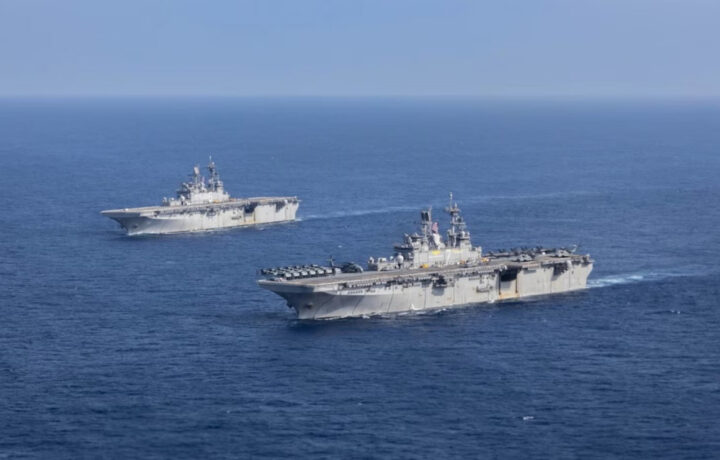
Given its full-length flight deck and island, it would be easy to mistake the USS Tripoli (LHA-7) for an aircraft carrier. The warship can even operate with upwards of 20 fixed-wing Lockheed Martin F-35B Lightning II, the short takeoff, vertical landing (STOVL) variant of the Joint Strike Fighter.
Its flight deck, at nearly 850-feet in length, is just slightly shorter than the 872-feet length of the “short-bow” Essex-class aircraft carriers built during and just after the Second World War.
Yet, USS Tripoli is an America-class amphibious assault ship. The conventionally-powered warship displaces around 45,000 long tons under full load, more than the approximately 41,000 long tons displaced by a “long-bow” Essex-class carrier. Yet, while the warship is nearly as large as a World War II-era flattop, it is significantly smaller than the U.S. Navy’s Nimitz-class nuclear-powered supercarriers, which displace approximately 100,000 long tons.
A Very Different Role
It is also worth noting that USS Tripoli is larger than many aircraft carriers in service with foreign navies, which explains why she might be mistaken for one. Still, unlike the U.S. Navy’s nuclear-powered supercarriers, the America-class vessel is conventionally powered, and air dominance isn’t its primary mission.
Instead, an amphibious assault ship serves as the flagship of a United States Marine Corps expeditionary strike group or amphibious ready group, and USS Tripoli is reported to be carrying elements of the 31st Marine Expeditionary Unit (MEU), a rapid-response force of 2,200 personnel based on Okinawa, Japan.
As CNN explained last month, “An MEU consists of four elements: command, ground combat, air combat and logistics combat. MEUs typically have been used for missions like evacuations and amphibious operations that require ship-to-shore movements, like raids and assaults.”
An MEU can further provide ground and aviation combat components, with some units specifically trained for special operations.
An LHA Doesn’t Do It Alone
Just as an aircraft carrier strike group is supported by guided-missile destroyers or cruisers, which ensures it can accomplish its mission, amphibious assault ships—both the Americaclass LHAs (Landing Helicopter Assault) and Wasp-class LHDs (Landing Helicopter Dock)—are typically accompanied by amphibious transport docks (LDPs), which are part of an Amphibious Ready Group (ARG). USS New Orleans (LPD-18) and USS San Diego (LPD-22) are now operating in the U.S. Central Command (CENTCOM) area of responsibility (AOR) with LHA-7.
Those vessels provide complementary capabilities for landing Marines, equipment, and supplies. Although LHDs/LHAs focus on aviation, LPDs offer extensive well decks for transporting and launching landing craft (LCACs), which bridge the gap between sea-based forces and short-based operations.
USS America (LHA-6) and USS Tripoli do not have a well deck, but beginning with the third ship of the class, the future USS Bougainville (LHA-8), and all subsequent LHAs, will have the decks to restore the ability to launch surface assault craft.
The U.S. Navy sought to restore capabilities after determining that, although air power is essential, air transport wasn’t efficient for moving heavier equipment to shore. The aviation-centric design didn’t provide the flexibility offered by having air and sea-based landing options.
Lightning Carriers
The U.S. Navy has explored how amphibious assault ships, including LHA-7, could serve as “lightning carriers,” operating with a full load of F-35Bs, to supplement traditional supercarriers and to project power in contested maritime environments.
However, some critics have warned that conventionally powered flattops lack the range of supercarriers, don’t carry enough aircraft, and simply lack the survivability of a true nuclear-powered aircraft carrier. Yet, in a pinch, the amphibious assault ships could bolster the U.S. Navy’s aerial capabilities in contested waters.
LHA-7 is the third U.S. Navy warship to be named to honor the U.S. Marine Corps victory against the Regency of Tripoli at the Battle of Derna during the First Barbary War in the spring of 1805. The current USS Tripoli was commissioned in July 2020 and took part in her maiden deployment in the Indo-Pacific in 2022. She is now forward-deployed to Sasebo, Nagasaki Prefecture, and is on her first Middle Eastern operation.


