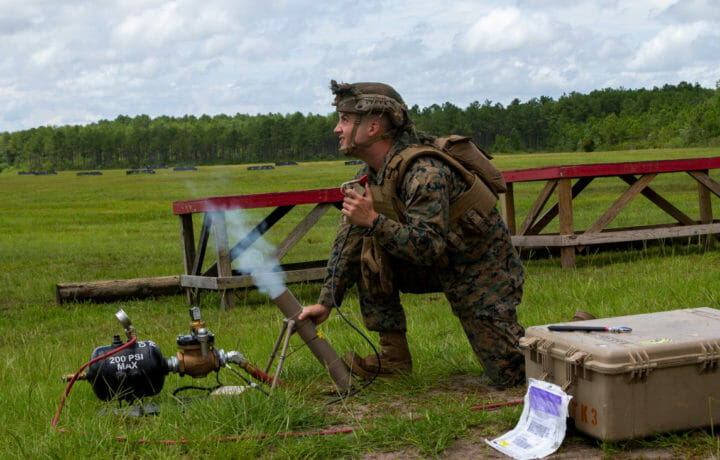
An old movie trope reminds you not to bring a knife to a gunfight. It leaves the bladed opponent at a massive, likely fatal disadvantage. However, the ongoing conflict in Ukraine has shown that you can bring a Switchblade to a tank fight and come out victorious. The Switchblade 600 is a man-portable, long-range loitering munition, also called a “kamikaze drone.” It is designed and built to destroy armored vehicles and hardened targets at distances of around 60 miles (100 km).
This week, drone developer AeroVironment was awarded a $51 million delivery contract from the United States Army for additional Switchblade 600 Block 2 loitering munition systems.
“The order also includes Switchblade 600 Block 1 systems in support of a Foreign Military Sale to a key United States ally,” the company announced.
The new contract is part of the U.S. Army’s existing five-year, $990 million Indefinite Delivery, Indefinite Quantity (IDIQ) contract for Lethal Unmanned Systems (LUS), originally issued in August 2024.
The Drone Wars
This new award is a follow-on procurement to the service’s initial order for the next-generation Switchblade product line. It underscores the strong, sustained demand for the company’s battle-proven long-range, precision loitering munitions. The Switchblade was developed for precision attacks against a variety of targets including hardened forward positions and armored vehicles. Unlike guided munitions that are fired at a predetermined target, the Switchblade can loiter to seek out targets of opportunity, and even return to base if none are presented.
“Continued investment by the U.S. Army in Switchblade 600 Block 2 reflects both the growing demand for long-range, precision loitering munitions and the proven reliability of the Switchblade family in demanding operational environments,” said Brian Young, senior vice president of Loitering Munitions at AeroVironment. “Building on the success of Switchblade 600 Block 1, Block 2 continues to deliver the meaningful upgrades in autonomy, resilience, and lethality tailored to the Army’s needs in contested, multi-domain operations.”
About the Switchblade
Development of the line of Switchblade drones predates the ongoing conflict in Ukraine. The U.S. Air Force Special Operations Command (AFSOC) initially conceived the concept in 2011, and the Switchblade was then developed with insight from the United States Army as a platform to allow warfighters to respond to enemy ambushes in Afghanistan.
The Block 2 variant was developed for multi-domain operations in collaboration with the United States Special Operations Command (SOCOM). It was ruggedized for maritime operations and features upgraded avionics, improved navigation, and more resilient communications, including Silvus MANET radios, supporting distributed operations, and extended handoff ranges. The newer model is outfitted with advanced automatic target recognition, including SPOTR AiTR, to enable faster detection, identification, and engagement of threats, even in contested environments.
“This new delivery order under the LUS IDIQ further validates Switchblade 600 Block 2 as a next-generation, scalable fires solution for the Army,” added Young. “As we expand our manufacturing capacity and accelerate delivery timelines, we’re ensuring that U.S. soldiers have reliable, combat-proven loitering munitions that deliver precision effects at range while keeping them out of harm’s way.”
According to AeroVironment, it has been fielded to more than 20 brigade combat teams, with hundreds of U.S. soldiers trained to operate the system.
June Contract for P5550 UAS
In June, AeroVironment was awarded a $117 million firm-fixed-price contract for the procurement and delivery of 82 AeroVironment P550 unmanned aircraft systems (UAS) to provide organic reconnaissance, surveillance, and target acquisition capability for battalion commanders and their organizations.
The P550 is an autonomous Group 2 electric vertical take-off and landing (eVTOL) uncrewed aerial system designed for long-range reconnaissance, surveillance, and tactical strike missions. It requires no runway, catapult, or launch gear. It can carry up to 15 pounds of multi-sensor payloads, including electronic warfare systems or precision munitions. Its Modular Open Systems Approach (MOSA) allows field operators to hot-swap batteries and payloads in less than five minutes without tools.


