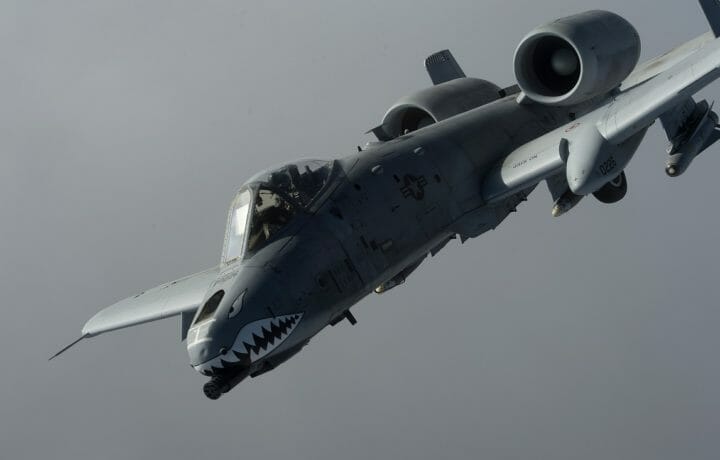
Another chapter in the long saga of the famed Fairchild Republic A-10 Thunderbolt II has been closed. The final A-10 close air support (CAS) aircraft assigned to Nellis Air Force Base (AFB), Nevada, departed for the last time on Tuesday. According to the United States Air Force, approximately 70 airmen lined up on the flight line to give one last salute as the aircraft took off.
The first A-10 Thunderbolt II arrived at Nellis AFB in 1977. Over the past five decades, the facility served as a primary proving ground for the aircraft that was affectionately known as the “Warthog” to its pilots and maintainers.
“Nellis-based units refined the aircraft’s software, avionics, and precision weapons, while the U.S. Air Force Weapons School’s 66th Weapons Squadron trained more than 300 A-10 weapons officers across 100 classes,” the Air Force explained.
The squadron will apply what it learned with the A-10 to other aircraft as it continues to train the next generation of ground-based specialists, including combat rescue officers, pararescue, special tactics officers and combat controllers.
“We are maintaining the culture of the A-10 by involving as many other fighter communities as possible in the close air support mission,” explained Lt. Col. Ridge Flick, the 66th WPS commander. “We are also training F-15 Eagle, F-35 Lightning II and F-16 Fighting Falcon pilots to take on some roles we have had in combat search and rescue.”
Four Thunderbolt II Squadrons Inactivated
Just last week, the final squadrons flying the A-10 Thunderbolt II from Davis-Monthan AFB, Arizona, were also inactivated. The units included the 355th Operations Group, 357th Fighter Squadron, 357th Fighter Generation Squadron and the 355th Training Squadron.
At a ceremony at the base last Friday, each of the A-10 unit’s guidons was rolled up and cased by their respective commander and U.S. Air Force Col. Jose Cabrera, 355th Wing commander, who presided over the historic event that closed another chapter in the famed aircraft’s history.
“For decades, every single active-duty pilot, who flew into harm’s way, was built right there on this flightline,” Col. Cabrera said in a statement. “For nearly 50 years, the A-10 Thunderbolt has occupied a sacred place in American air power. It was never just an airplane. It was a promise. Davis-Monthan was part of that promise.”
F-35 to Absorb the CAS Role
The United States Air Force’s Lockheed Martin F-35A Lightning II, the conventional takeoff and landing (CTOL) variant of the Joint Strike Fighter, will take on the CAS and combat search-and-rescue command roles in its operational profiles, the air service acknowledged.
Even as the A-10 is being retired after more than five decades of service, approximately 160 remain operational.
Critics have warned that the F-35 can’t replicate many of the A-10’s capabilities, as the fifth-generation stealth fighter lacks the Warthog’s 30mm tank-busting GAU-8 gun. The multi-barreled weapon has a very high muzzle velocity that is 20 times that of the 75mm gun fitted to some of the North American B-25 Mitchell medium bombers in World War II. The GAU-8 also offers an unparalleled rate of fire for an aircraft weapon, firing up to 4,200 rounds per minute. No attack aircraft in history has ever mounted a gun with the GAU-8’s tank-killing capability.
Will Remain in Service a While Longer
The Air Force had previously pushed to aggressively retire the entire fleet, citing that it is no longer viable against near-peer adversaries; it has proven capable in recent combat operations in the Middle East.
The National Defense Authorization Act had mandated that the Air Force keep a minimum of 103 A-10s operational through September 2026. Under an adjusted force-structure plan, the fleet will be drawn down in stages.
The U.S. Air Force will retain 54 of the Thunderbolt IIs across three distinct squadrons through 2029.
That number will drop to 36 aircraft by the end of 2030, before the platform’s final retirement.
Active-duty A-10 operations will remain concentrated at Moody AFB, Georgia, with the 74th and 75th Fighter Squadrons, and with an Air Force Reserve contingent maintained by the 303rd Fighter Squadron at Whiteman AFB, Missouri.


