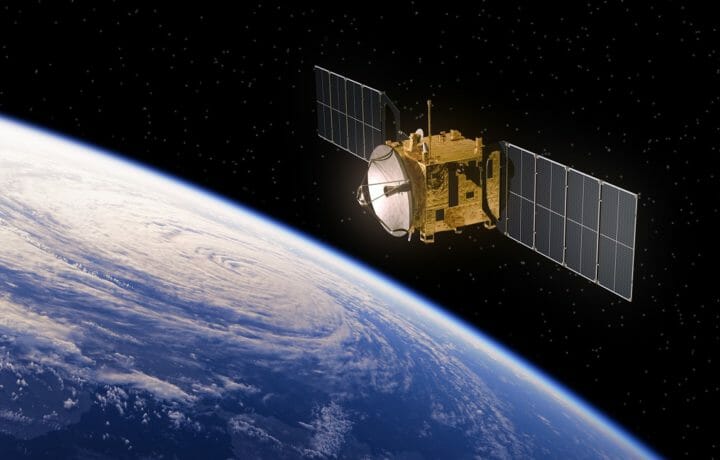
Space is vast, and while we like to think of it as being empty, that’s not really the case, especially in Earth’s orbit. Even before the launch of the first satellite, the Soviet Union’s Sputnik 1, in 1957, humanity had accumulated approximately 50,000 large trackable objects.
More than 32,000 of those are large enough – meaning they are greater than 10 cm (3.8 in) – to be regularly cataloged by the United States Space Surveillance Network. It includes defunct satellites, spent rocket bodies, and fragmentation debris.
According to newly released data from the European Space Agency (ESA) this month, an estimated 1.5 million are medium fragments, ranging in size from 1 cm to 10 cm (.38 in to 3.8 in), and even more alarmingly, there are an estimated 230 million even smaller pieces of debris circling the planet. These range from 1 mm to 1 cm (.038 in to .38 in).
There are approximately 100 million microscopic flecks of paint, metal, and solid propellant particles in orbit. Size matters, as those objects can still travel at hypervelocities up to 56,000 km/h (35,000 mph). Despite their seemingly small size, their kinetic energy increases with the square of velocity. That means even a microscopic paint flake, dust grain, or metal fragment packs an enormous punch upon impact, hitting with the force of a much heavier object moving at highway speeds on Earth.
In the worst case, the debris can pit, crack, or chip spacecraft and satellite windows (such as past impacts on the International Space Station Cupola windows. But the microscopic objects also cause a constant sandblasting effect on spacecraft, wearing down blankets, solar panels, and outer casings over time.
High-speed impacts can also vaporize the particle into a high-temperature plasma cloud, which can trigger electrical shorts, radio-frequency anomalies, or system glitches in satellites.
Weighty Issue
Although objects are essentially weightless in orbit, the cumulative weight of all human-made materials now in Earth orbit is estimated at over 6,600 tons. The ESA noted that most of the material comes from the 19,610 satellites now in orbit, of which approximately 15,800 are still functioning.
The remaining thousands continue to circle the Earth, where they could be struck by smaller objects, which would only increase the volume of space debris.
“If current behaviors and trends in orbit continue, crucial orbital regions will become entirely unusable, with many millions of debris pieces already swirling around,” the ESA warned.
There is the danger of a runaway chain reaction, known as the “Kessler Syndrome,” where one collision in Low Earth Orbit shatters a satellite into thousands of new pieces.
Should such a catastrophic Kessler scenario unfold, it would cripple modern global communication, weather forecasting, GPS, and scientific observation networks, cutting humanity off from space access and satellite-dependent tech, potentially rendering low-Earth orbit unusable for generations.
Whether the truth is out there remains debatable, but there is no shortage of debris that could be a serious problem.
Cleaning Up the EARTH’S Orbit
The problem of space debris is comparable to the plastics now polluting Earth’s oceans. More than eight million tons of plastic enter the oceans every year, adding to an estimated 170 trillion plastic particles currently circulating at sea. The damage is already embedded in living organisms, deep-sea trenches, and human bodies worldwide, making it a serious problem.
Still, efforts to clean up the oceans could help inform how orbit can be cleaned up as well.
The ESA’s ClearSpace-1, built by Swiss-founded startup ClearSpaceSA, is the world’s first active space debris removal mission. It calls for rendezvousing with, then capturing, and guiding a derelict object out of Earth’s orbit so that both the debris and the chaser spacecraft safely burn up during atmospheric reentry. ClearSpace is on track to launch in 2029, with the goal of removing two dead satellites from orbit by 2032.
NASA has its own initiative to clear space debris.
The U.S. space agency introduced its Space Sustainability Strategy in April 2024, acknowledging that space debris was becoming one of the biggest challenges to the future of spaceflight. NASA has called on the public through its “Detect, Track, and Remediate: The Challenge of Small Space Debris” competition, inviting global innovators to design systems to find and clean up tiny debris (1 mm to 10 cm).
It also involves designing and testing concepts such as the Active Debris Removal Vehicle (ADRV) for autonomous capture and deorbit of larger non-cooperative objects, alongside passive deorbit aids like drag sails and electrodynamic tethers.
The most significant effort might be partnering with other government agencies, international groups, and commercial companies to establish unified guidelines to reduce the creation of new debris and enforce mission end-of-life disposal rules. That could include 25-year or stricter post-mission LEO decay standards.
Space is the final frontier, but the part of it close to home is getting crowded, and solving that problem will be required to ensure that we can reach infinity and beyond.


