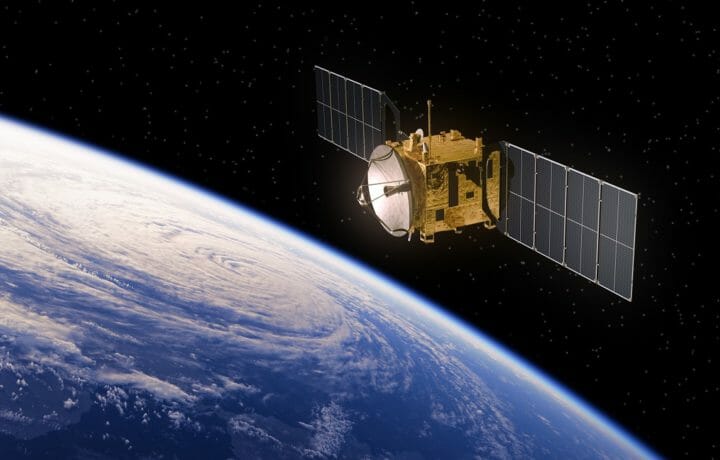
Speaking at the Air & Space Cyber Conference on Monday, Secretary of the Air Force Troy Meink confirmed that the United States Space Force has deployed a weapon platform into orbit. The type of weapons or how they may work was not disclosed, but the top civilian overseeing the Air Force said it could respond to threats from other nations.
“We are increasing readiness against existing threats, and the United States has on-orbit space control weapons capable of defending the Joint Force against hostile adversary action,” Meink explained.
Orbital Weapons
Meink also didn’t disclose when the weapons were launched into orbit. Still, reports circulated two years ago claiming Russia was developing an anti-satellite weapon that could be launched into orbit. The White House had downplayed the threat at the time.
However, concerns remain that Russia or China could weaponize orbit and potentially disrupt satellite communications.
Several types of conventional and electronic warfare (EW) weapons could be placed in Earth’s orbit for either space control or anti-satellite warfare. These could include signal jammers, devices that emit radio frequencies to block or disrupt communication links between a satellite and a ground station; laser dazzlers, directed-energy tools that can temporarily blind or permanently disable optical sensors and cameras on reconnaissance satellites; and cyber and electromagnetic attack payloads. Those systems could infiltrate or degrade the data streams and command networks traveling to and from a satellite without physically destroying it.
Moreover, concepts include maneuverable spacecraft, including so-called “space tugs” equipped with robotic arms and thrusters that can grapple, disable, nudge, or redirect other spacecraft into useless, or at least less ideal, orbits. Then there are space-based munitions that could be fired at a satellite, and other kinetic interceptors that could crash into a satellite, disabling or even destroying it by sheer force.
Russia and China have been conducting maneuvers in space, also known as “rendezvous and proximity operations” (RPOs), that have “buzzed” Western satellites.
“Theoretically, these RPO sats can become hunter-killer satellites by physically colliding with them or by nudging them out of orbit,” Dr. Rod Thornton of the Russian Defense and Security Studies at King’s College, London, told the BBC.
In April 2020, the Russian military tested its PL-19 Nudol, a direct-ascent anti-satellite (DA-ASAT) missile capable of destroying Low Earth Orbit (LEO) satellites. The system was designed to protect Moscow and other Russian cities from a missile attack, but it can also become a satellite killer that can shoot down other satellites.
What Do the Treaties Say?
There are international treaties that currently regulate the deployment of weapons in space, but these only ban weapons of mass destruction rather than calling for a total ban on all orbital weapons – likely realizing that the Soviet Union/Russia and the United States wouldn’t sign on to such a treaty.
However, all nations have signed the Outer Space Treaty of 1967, which bans the deployment of nuclear weapons or any WMDs into Earth’s orbit. The treaty also bans the deployment of WMDs on the Moon or other celestial bodies.
The 1967 agreement doesn’t explicitly ban conventional weapons, electronic warfare systems, or kinetic anti-satellite tools from being placed in orbit, which is why the United States, China, and Russia continue to develop counterspace capabilities and conventional systems that can operate in Earth orbit without violating the treaty’s literal text.
It is also worth noting that although the 1967 treaty explicitly bans placing weapons into orbit or stationing them in space, ground-based strategic missiles could briefly travel through space during suborbital or intercontinental flight.
Rods From God
Although still a theoretical military concept, “Rods From God” calls for a kinetic bombardment system in which heavy tungsten rods are dropped from space, destroying targets on Earth through pure speed and mass.
Such a weapon carries no chemical or nuclear explosives, but the rods would fall at hypersonic speeds of around Mach 10, making them extremely difficult to counter.
The downside is size: each rod would need to be the size of a telephone pole, roughly a foot in diameter and at least 20 feet long. Getting such rods into orbit would be a real challenge, but if deployed from orbit, they would strike the ground at thousands of miles per hour, with a single rod delivering an impact equivalent to several tons of TNT. Such a weapon could pierce deep underground bunkers without leaving radioactive fallout.


