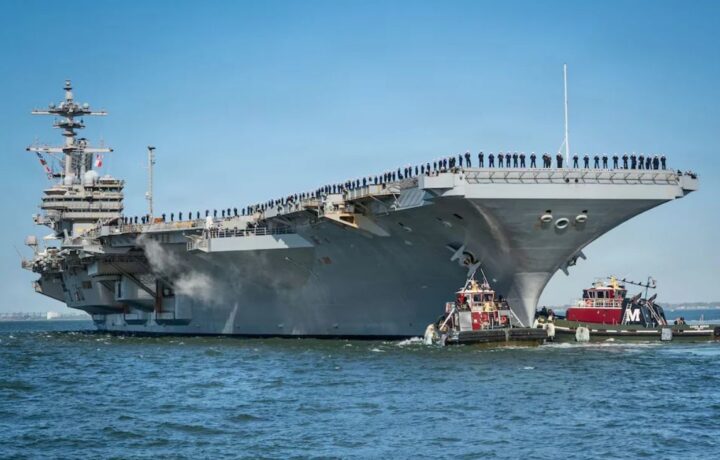
As of Sunday, the United States Navy had three Carrier Strike Groups (CSGs) operating in the Middle East, as the Naval Base San Diego, California-based Nimitz-class nuclear-powered supercarrier USS Theodore Roosevelt (CVN-71) arrived in the Arabian Sea, joining the USS George Washington (CVN-73) and the USS George H.W. Bush (CVN-77). CVN-71’s arrival coincided with Iranian strikes on a military facility in Bahrain, the first attack conducted by Tehran on a Gulf state in several weeks.
The United States Navy has continued to rotate its few aircraft carriers to the region, resulting in extended deployments. It is unclear how long the Pentagon plans to maintain three nuclear-powered flattops in the Middle East, given that it has left a lack of presence elsewhere.
CVN-71 to Relieve CVN-77, But When?
It has been expected that CVN-71 would be relieving CVN-77, which began its current deployment on March 31, 2026, possibly allowing the Naval Station Norfolk, Virginia-based aircraft carrier to return home for the holidays. However, at a town hall meeting at the base earlier this month, U.S. Navy officials told families of the crew and other personnel serving with the USS George H.W. Bush Carrier Strike Group (CSG-10) that the group won’t be home for Christmas and likely won’t be until spring.
Acting Secretary of the Navy Hung Cao reportedly told families in the auditorium at the naval base, “I’m sorry, I’ve been there. I know what it feels like, I know how hard it is when your kids are asking, ‘When’s daddy coming home? When’s mommy coming home?'”
Family members have expressed frustration and even anger, with one attendee warning that families were “burning out” under the strain. Approximately 7,000 service members are deployed with CSG-10, which is now in the Arabian Sea.
CSG-10, led by the flagship USS George H.W. Bush, the tenth and final Nimitz-class supercarrier, traveled to the Middle East via a longer route around Africa, likely to avoid drone and missile threats from Iranian-backed Houthi forces in the Red Sea, Suez Canal, and Bab el-Mandeb Strait.
It is unclear if the same route will be taken when CSG-10 returns home, but it will largely depend on whether the conflict with Iran – and, by de facto, any threat from the Houthis in Yemen – is resolved. If the conflict continues, the US Navy may opt to avoid the narrow chokepoints, sailing around Africa, which added 12 days to the journey.
Family members were told earlier this month that the carrier and escorts might not return home until March, meaning a year-long deployment, but it could be even longer.
CVN-73 Skipped Much of Its Planned Patrol
The USS George Washington is the U.S. Navy’s only forward-deployed aircraft carrier, based at U.S. Fleet Activities Yokosuka, Japan, as part of the U.S. 7th Fleet. Based in Japan, it cuts an average of 17 days of transit time to regional flashpoints in the Indo-Pacific compared to sending a ship from the U.S. West Coast.
Unlike stateside carriers that deploy periodically from the U.S. mainland, the forward-deployed carrier typically spends roughly half of the year at sea, but on a more frequent patrol cycle.
CVN-73 began its current patrol on May 23, 2026. During that time, it visited Da Nang, Vietnam, in late July 2026, and participated in Operation Valiant Shield 2026 in the South China Sea and Western Pacific with regional partners and allies. It was dispatched to the Middle East in August. It entered U.S. Central Command’s area of responsibility around August 19, 2026, to support regional operations and to relieve the San Diego-based USS Abraham Lincoln (CVN-72).
The previously unscheduled deployment to the Middle East has left the U.S. Navy without a carrier in the Western Pacific, where the primary mission is to maintain a continuous maritime presence, deter regional threats, and reassure allies in the region and beyond. As of Tuesday, the USS George Washington has also been deployed for 178 days, nearing the 184 days of the roughly six-month patrol conducted in 2025.
Extending the deployment is likely to impact the tightly choreographed, shorter bursts at sea. Every extra week at sea adds operational hours to propulsion systems, catapults, and flight decks. When a carrier finally returns to its forward port, the scheduled Selected Restricted Availability (SRA) maintenance period often has to be extended to fix deferred issues.
Moreover, forward-deployed shipyards have rigid schedules. If a carrier misses its scheduled arrival, it can lose its dry dock slot or push back maintenance for other forward-deployed destroyers and cruisers.
Deterrence and Strike Capabilities
The U.S. may seek to maintain three carriers in the Middle East as leverage to push Tehran to a deal. Having three full CSGs in the region provides a massive concentration of hundreds of aircraft, guided-missile cruisers, Aegis-equipped destroyers, and Tomahawk missiles. That may serve as a heavy deterrent against Iran and Iranian-backed groups, notably the Houthis. The deployment also coincides with discussions in Washington about resuming large-scale or short, sharp offensive operations against Iranian military and dual-use infrastructure – such as energy points and transport links – if diplomatic efforts and the stalled ceasefire fail to reopen the Strait of Hormuz.
“The Secretary of the Navy told us that our loved ones will return home when Iran agrees to a non-nuclear Iran, and hearing those words made me sick to my stomach,” Julie Fairchild, whose husband is a sailor on the USS George H.W. Bush, told the Military Times. “If Iran hasn’t agreed to have a nuclear weapon for the past 47 years, why are our sailors responsible for ending it now?”


