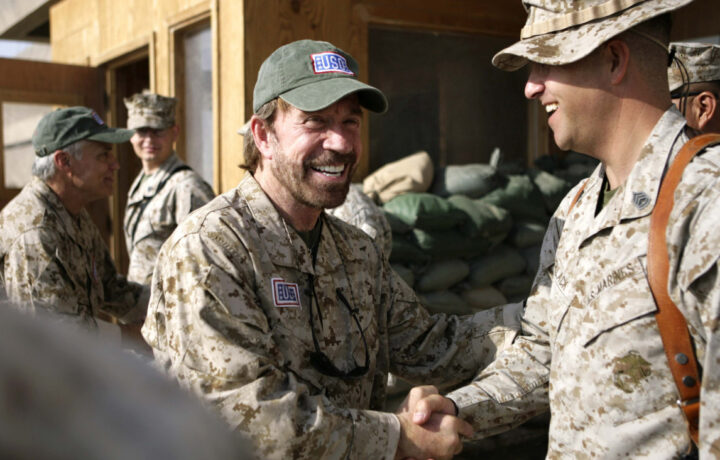
Certain names transcend entertainment. They become part of culture, part of language, and part of survival. For many service members and veterans like myself, Chuck Norris was one of those names.
Today, as news of his passing spreads, it hits differently for those of us who served, especially during the early years of the Global War on Terror.
Between 2004 and 2008, I found myself in places that most people will never experience. Desolate training grounds, unforgiving deployment environments, and long stretches where the days blurred together under stress, exhaustion, and uncertainty. In those moments, morale wasn’t built from big speeches or grand gestures. It came from the smallest, most unexpected places.
A moment of escape
Imagine a 100+ degree day, you’ve been outside working on trucks, drinking from hot bottles of water, and you’ve sweated so much that the salt is making your tan t-shirt stiff as a board. It feels like you’re in hell, mentally, emotionally, and physically. You need to take a break.
You walk into a shaded smoke-pit and grab the first available seat. You glance at the wall to your left, and what do you see? In black marker, some other heat-exhausted soldier has written, “Chuck Norris has already been to Mars. That’s why there are no signs of life.”
In one of the worst places, at the worst of times, this little joke allows you to crack a smile. It allows you a moment of freedom, of respite, and escape. And sometimes that is all you need to keep pushing forward.
They were everywhere.
My ‘battle-buddies’ and I found these quotes everywhere. In latrines, carved into plywood or written in marker like sacred texts. On the back of bus seats during long, silent movements. Inside makeshift hooches. Scratched into desks. Passed along in chow lines like currency. Even in foxholes, places where humor had no business existing, it somehow thrived.
“Chuck Norris doesn’t do push-ups. He pushes the Earth down.”
“Chuck Norris counted to infinity. Twice.”
“Death once had a near-Chuck Norris experience.”
They were ridiculous. Over-the-top. Completely absurd.
And exactly what we needed.
Because in environments where everything felt heavy, where the mission was serious, and the stakes were real, those jokes gave us something rare: a moment to breathe. A split second where the tension cracked, where someone smirked, where another laughed just loud enough to break the silence.
It was more than humor. It was a reset.
It reminded us that no matter how far we were from home, no matter how tough the conditions were, we still had each other, and we still could laugh. That matters more than people realize.
The ‘Common Man’ Hero Persona
Chuck Norris was not only an actor, known for his roles in Walker, Texas Ranger, and a long career in martial arts and film, but he was also a veteran. He served during the Cold War. He joined because he wanted a career in Law Enforcement. As part of the ‘Air Police’, later known as the Air Force Security Forces, he was deployed to Osan Air Base in South Korea. It is there that he began to study Judo. The rest is history.
I am sure that Chuck never imagined that his legacy would include being an unofficial morale officer for deployed troops around the world. But that’s exactly what he became.
Not through policy. Not through intent. But through culture.
Through us. And he even embraced it. His final social media post was of himself, sparring, with the caption, “I don’t age. I level up.”
We took his larger-than-life persona and turned it into something that could survive sandstorms, long patrols, and the kind of fatigue that settles deep into your bones. We carried those jokes with us, shared them, added to them, and in doing so, built a strange but powerful thread of connection.
In a world where everything could feel uncertain, Chuck Norris facts were constant. Reliable. Predictable. And always good for a quick laugh when you needed it most.
A Legacy Forged In Fire
For veterans, those memories don’t fade. They stick with you, not because of the joke itself, but because of where you were when you heard it… and who you were with.
That’s the real legacy here.
So today, we don’t just remember a man. We remember the moments. The laughter in places where laughter shouldn’t exist. The shared glances between exhausted teammates. The brief escape from reality when we needed it most.
Rest easy, Chuck.
You may not have been in those foxholes with us, but in a way, you were everywhere in hard times, and you were there for us when we needed you most. And for that, we thank you.


