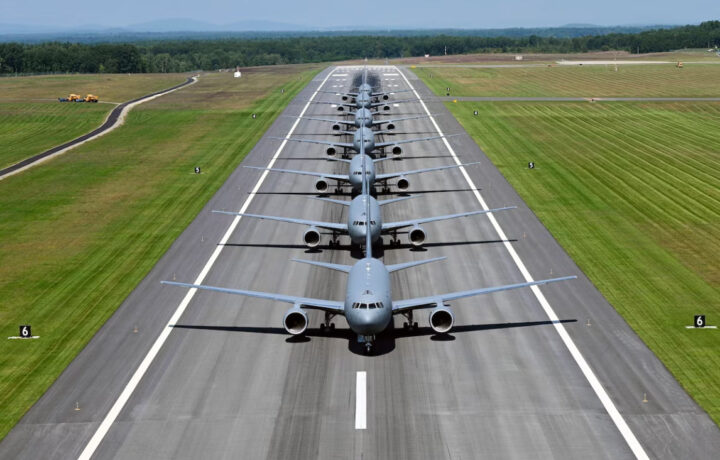
The United States Air Force and aerospace giant Boeing are developing a plan to improve the KC-46 Pegasus aerial refueler’s readiness and accelerate capability delivery across the Air Force’s fleet. Just last month, the Air Force announced it would increase the number of aerial tankers it sought to acquire,
The service will now seek to have 263 KC-46s in service, up from the originally planned 179. According to Air Force budget documents released last month, the Air Force requested $3.9 billion to acquire 15 of the aerial tankers as part of its fiscal year 2027 (FY27) budget, with that number increasing to 18 for the years 2028 to 2031.
Development of the KC-46A, which is based on the Boeing 767 jet airliner, began in 2011, and it was subsequently selected by the US Air Force as the winner of the KC-X tanker competition to replace the aging KC-135 Stratotankers. The first Pegasus was delivered to the U.S. Air Force in January 2019.
The aerial refueler was designed to refuel most fixed-wing and receiver-capable aircraft, and it can also accommodate a mixed load of passengers, aeromedical evacuation, and cargo.
It was just a year ago that the Air Force began accepting delivery of the KC-46 after issues were discovered in winter 2025.
Boeing indicated that it had identified the root cause of the issues and had begun the process to resume deliveries.
Accelerating Readiness
The new efforts are meant to accelerate the delivery. According to the Air Force, the current plan “pursues three primary lines of effort.” That includes repurposing early-built Pegasus aircraft for immediate operational impact, accelerating the Remote Vision System 2.0 retrofit schedule, and, finally, implementing performance-based logistics efforts to resolve systemic readiness challenges.
The refueling tanker’s remote vision system (RVS), which provides images to boom operators in the aircraft’s two Aerial Refueling Operator Stations (AROS), has faced repeated delays, and RVS 2.0 may not be employed on the refueling aircraft until summer 2027.
The RVS had promised to be a major improvement over older tankers, including the KC-10 Extender and KC-135 Stratotanker, which required boom operators to look through a window at the rear of the aircraft. In the case of the KC-135, boom operators even have to lie on their stomachs during the operation. RVS 2.0 was meant to address the issues, but they have persisted throughout its development.
It is now three years behind schedule.
Although RVS 2.0 utilizes enhanced 4K cameras and 3D imagery to address the original system’s distorted depth perception and lighting issues, its effectiveness has yet to be fully demonstrated through operational testing.
The current plan seeks to address the ongoing issues.
“The KC-46 is a cornerstone of U.S. power projection, and we are proactively partnering with Boeing to ensure it is always ready to deliver,” said Secretary of the Air Force Troy Meink. “By establishing this multi-pronged approach, we are directly improving aircraft availability, accelerating the delivery of vital new capabilities, and significantly enhancing the overall supportability of the fleet.”
The New Plan for the Pegasus
According to the FY27 Presidential Budget Request, the Air Force could see an increase in KC-46 aircraft availability by more than 20% by 2030. That could be accomplished by “unlocking critical materiel earlier and establishing limited performance-based logistics,” ensuring that the service and the aerospace firm can address both near- and long-term readiness.
“This is a decisive step forward for the KC-46 enterprise,” suggested William Bailey, performing the duties of the Assistant Secretary of the Air Force for Acquisition, Technology, and Logistics. “This partnership secures Boeing’s continued investment in both KC-46 readiness as well as the production line, effectively lowering risk for our transition to the KC-46 Production Extension and ensuring this critical mobility platform continues to flow to the warfighter without delay.”
The Three Lines of Effort
The Air Force acknowledged that the specifics of the plan remain protected to safeguard operational security; its three lines of effort are intended to provide a near-term boost in aircraft availability of approximately 6% and a longer-term increase of 20% by 2030.
Repurposing Early-Built Aircraft
The Air Force has confirmed that it will repurpose five early-build aircraft. That will serve a dual purpose: first, providing the Air Force with dedicated test assets to keep the combat-ready tankers focused on the mission; and second, providing high-value spare parts to the operational fleet.
“Because these aircraft were not scheduled to reach the fleet until early 2031, this effort allows the Air Force to immediately free otherwise ‘trapped’ materiel,” the service explained.
That will include “high-value parts,” such as engines and landing gear, from three non-operational, early-build aircraft, providing a significant near-term boost to fleet readiness by resolving existing parts shortages.
Accelerating RVS 2.0 Retrofits
The second phase of the plan is meant to accelerate the fielding of the critical RVS 2.0 upgrade. It is scheduled to begin fielding in early 2028, creating a partnership with Boeing to bundle the modification with the Air Force’s depot-level maintenance and accelerate kit deliveries.
“This strategy reduces the retrofit timeline from 13 years to seven years, while simultaneously reducing the retrofit’s impact on aircraft availability by 90%,” the Air Force added.
Implementing Performance-Based Logistics
The final part of the joint plan will direct the U.S. Air Force and Boeing to pursue a temporary Performance-Based Logistics agreement to target the supportability of the aerial-refueling subsystem and other key components. It notes that reliability and parts availability of the aerial-refueling subsystem collectively represent the largest detractors of KC-46 availability.
“This effort makes Boeing responsible for improving the availability of these critical systems and is designed to ensure a successful transition back to organic Air Force sustainment after a limited five-year period,” the service further noted.
The KC-46A Is a “Bridge” Tanker To NGAS
This newly announced plan is the latest update to the KC-46 program. The U.S. Air Force initially planned to cap its acquisition of the Pegasus at just 179 aircraft, as it was seen as a “bridge” between the service’s legacy KC-10 and KC-135 aerial refuelers and the future Next Generation Air-refueling System (NGAS).
Although the NGAS tankers are likely still coming, those aerial refuelers may be part of a chain of aircraft that deliver fuel in contested environments. The NGAS may “shuttle” from traditional tankers, such as the KC-46A, and then use low-observable technology to evade detection while refueling aircraft like the F-35 Lightning II, the future F-47, and perhaps even the B-21 Raider, while operating deep inside enemy-contested airspace.
Given the effort being put into the Pegasus, it will likely be much more than just a bridge to another future program.


