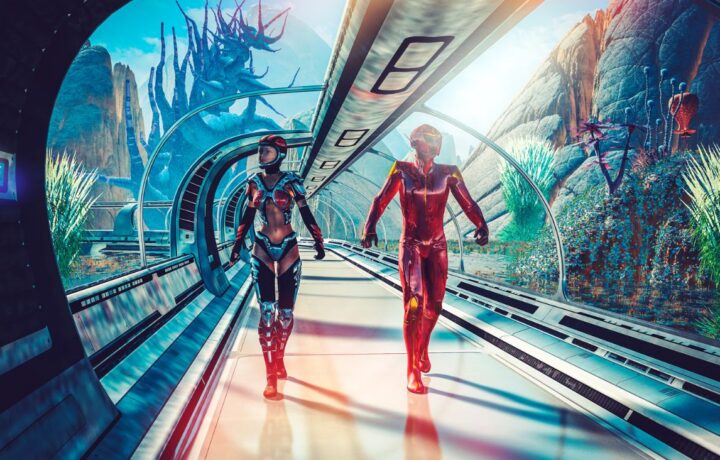
If you grew up watching science fiction movies in the 1980s, 1990s, or early 2000s, there’s a good chance you assumed 2026 would look quite different from what it actually is. Just like me, you are probably super disappointed.
By now, we were supposed to have flying cars weaving between skyscrapers, robot assistants (not just AI on necklaces and in your glasses) handling our daily chores, and thriving colonies on Mars. Humanity was expected to conquer traffic, disease, communication barriers, and maybe even mortality itself.
Instead, most people are still fighting with unstable Wi-Fi connections, sitting in traffic jams, and resetting passwords every few weeks because a system suddenly decided it now requires twelve characters, a symbol, and multi-factor authentication tied to three separate devices.
Where did it all fall so far behind?
Science fiction has always served as a kind of technological crystal ball. Sometimes it gets things shockingly right. Video calls, smartwatches, tablets, voice assistants, and AI-powered tools all existed in science fiction long before they became reality. A healthy 90% of technology was dreamed up for shows like Star Trek, movies like Star Wars, and books like Dune and Starship Troopers.
But sci-fi has also always been overly optimistic about timelines. By the way, I am sure we are currently in the darkest timeline. And humanity tends to underestimate how difficult infrastructure, regulation, ethics, security, and human behavior make technological advancement.
Still, the gap between what we imagined and what actually arrived creates an interesting conversation. Especially for the national security community, because if some of the technologies Hollywood promised us really did exist today, they wouldn’t just change everyday life. They would completely reshape intelligence operations, cybersecurity, counterintelligence, defense planning, and global power competition.
For the cleared workforce, many of these futuristic tools would create incredible operational advantages while simultaneously opening doors to entirely new vulnerabilities. And history has shown that every major technological advancement eventually becomes both a tool and a weapon.
Flying Cars
One of the most iconic sci-fi predictions came from films like Back to the Future Part II and Blade Runner, where crowded highways had been replaced by layered air traffic systems filled with personal flying vehicles. The idea seemed inevitable. As cities became more congested, moving transportation into the sky looked like the logical next step.
In reality, we’re still nowhere near mass adoption. While companies are experimenting with electric vertical takeoff and landing aircraft, the challenges are enormous. Infrastructure would need to be redesigned. Air traffic systems would need complete modernization.
Safety regulations alone could take decades to establish fully. And unlike a broken-down car on a highway, mechanical failure in a flying vehicle has far greater consequences.
Protection and Safety
From a national security standpoint, widespread flying vehicles would create an entirely new layer of complexity. Today, airspace monitoring is already difficult. Expanding that environment to include potentially millions of privately operated airborne vehicles moving through urban areas every day would stretch law enforcement, intelligence agencies, and defense systems to their limits. Every major city would essentially become a low-altitude aviation ecosystem requiring constant surveillance and coordination.
Critical facilities like military bases, intelligence headquarters, power grids, data centers, and government buildings would face a dramatically expanded threat environment. Traditional perimeter security would become far less effective when potential threats could approach from above at nearly any angle.
The rise of consumer drones has already demonstrated how disruptive low-cost aerial technology can be. Flying cars would multiply those concerns exponentially. Smuggling, surveillance, terrorism, espionage, and unauthorized intelligence collection would all become more difficult to detect and prevent. Traffic jams might disappear, but airspace chaos would replace them.
The deeper you dive into the idea of flying cars being a widespread reality, the further from reality it feels.
Autonomous Robot Assistants
If The Jetsons taught us anything, it was that humanity was supposed to have robot assistants by now. Rosie the Robot handled household chores, scheduling, cleaning, and day-to-day support, with a bit of an attitude, as if it was completely normal. Movies like I, Robot expanded the concept further, imagining a society where humanoid robots worked alongside humans in homes, businesses, and public spaces.
While AI and robotics are advancing rapidly, we’re still far from fully autonomous humanoid assistants becoming a normal part of everyday life. Most current systems are highly specialized, limited in capability, or dependent on human oversight.
But if science fiction had been right, the national security implications would be staggering.
A household robot would almost certainly have access to microphones, cameras, wireless networks, schedules, personal habits, building layouts, smart home devices, and potentially even biometric information. In many ways, it would function as a constantly operating sensor platform living inside someone’s private space. And let’s be honest: if we were freaked out by a sensor as simple as the Xbox Kinect, we couldn’t handle a whole robot invading our privacy.
The Intelligence Impact
For intelligence agencies and adversaries alike, that creates an enormous opportunity. Foreign intelligence services would no longer need elaborate physical surveillance operations if consumer robotics systems could simply be compromised remotely. A hacked robot assistant inside the home of a government employee, military officer, defense contractor, or intelligence professional could quietly gather information for months without raising suspicion.
Even something as simple as movement patterns, daily routines, or overheard conversations could become valuable intelligence. We already see concerns today surrounding smart devices, internet-connected cameras, and data-harvesting applications. Fully autonomous robots would magnify those risks by a thousand. The convenience of automation would collide directly with the realities of counterintelligence and cybersecurity.
Your robot vacuum might not just be mapping your living room. It might be mapping your life.
Predictive Crime AI
Few sci-fi concepts have sparked more debate than the “pre-crime” system in Minority Report. The idea of predicting criminal activity before it occurs has fascinated governments, technologists, and law enforcement agencies for decades. The technology is even being demonstrated at expos around the world.
While we obviously don’t have psychic humans floating in futuristic pools predicting murders, predictive analytics and AI-driven behavioral modeling already exist in various forms. Intelligence agencies, cybersecurity firms, and law enforcement organizations routinely use algorithms to identify anomalies, forecast threats, and prioritize investigations. But the fully realized predictive systems portrayed in science fiction remain far beyond current capabilities.
If they ever became highly accurate, however, they could fundamentally alter national security operations.
Imagine an AI system capable of identifying emerging terrorist plots before suspects fully operationalize them. Or software that could accurately forecast cyberattacks weeks in advance by analyzing digital behavior patterns, financial activity, travel, communications, and online interactions. Insider threats inside government agencies could potentially be detected before classified information is leaked. From a security perspective, the possibilities would be revolutionary, but the risks would be equally enormous.
Predictive systems are only as reliable as the data they receive. Biased information, flawed assumptions, manipulated inputs, or inaccurate correlations could produce catastrophic false positives. Innocent people could become targets of investigation based on algorithmic probability rather than actual criminal behavior. Just watch the movie, and you will get how the system will be flawed, and that is with human oversight.
For the intelligence community, the answers to a few questions would become deeply uncomfortable:
- How much authority are we willing to give an algorithm?
- At what point does threat prediction begin to collide with civil liberties, due process, and privacy rights?
Science fiction often frames predictive AI as efficient and objective. Reality would likely be far messier.
Off-World Colonies
Stories like Total Recall, Buck Rogers, John Carter of Mars, and countless others made it seem inevitable that humanity would establish permanent colonies beyond Earth by the early 21st century. Mars bases, lunar mining operations, and commercial space settlements were portrayed as the next phase of civilization.
While space exploration has accelerated again in recent years, humanity remains far from sustaining permanent off-world populations. But once that threshold is crossed, national security enters entirely new territory.
Space is already a contested operational domain. Satellites are critical for military communications, navigation, missile warning systems, intelligence collection, financial systems, and global infrastructure. Modern warfare already depends heavily on space-based assets, even if most people rarely think about it. Permanent colonies would raise the stakes dramatically.
Who Owns What?
Questions about governance, sovereignty, resource control, and military presence would immediately emerge. Who controls the laws on Mars? Who protects commercial mining operations on the Moon? What happens when geopolitical rivalries expand beyond Earth itself?
The militarization of space is no longer science fiction. It’s already happening in quieter ways through anti-satellite weapons development, cyber targeting of space infrastructure, and strategic competition between major powers.
The moment human populations begin living beyond Earth, those tensions become significantly more complicated. Humanity wouldn’t just be expanding civilization. It would be expanding conflict zones.
Fully Immersive Virtual Reality Worlds
In Ready Player One, much of humanity spends its life inside a massive interconnected virtual environment where people work, socialize, conduct business, and essentially escape reality. While virtual reality technology exists today, it still hasn’t evolved into the fully immersive digital universe science fiction imagined. But the trajectory is worth paying attention to.
As VR, augmented reality, AI-generated environments, and digital economies continue evolving, it’s not difficult to imagine a future where millions of people spend significant portions of their lives inside persistent virtual spaces. And if that happens, national security concerns follow closely behind.
A fully immersive virtual ecosystem could become an entirely new battleground for influence operations, espionage, propaganda, recruitment, and psychological manipulation. Governments, corporations, and adversaries would all compete for influence inside spaces where people increasingly work, communicate, and consume information.
Imagine diplomatic meetings occurring inside virtual environments. What about intelligence officers conducting recruitment operations through digital avatars? Or even extremist propaganda campaigns designed specifically for immersive worlds where emotional engagement becomes far more intense than traditional social media.
The line between cyber operations and psychological operations could begin to disappear. And unlike traditional battlefields, the terrain would be shaped by algorithms, platform owners, and whoever controls the digital infrastructure. The next battlefield may not be physical. It may not even be cyber as we currently understand it. It might be fully virtual.
Sci-Fi Is Still a Warning System
Science fiction has never really been about predicting gadgets. At its best, sci-fi explores consequences. It asks difficult questions about power, ethics, security, surveillance, technology, and human behavior before those issues fully arrive in the real world.
That’s one reason many defense professionals, intelligence analysts, cybersecurity experts, and futurists still pay close attention to science fiction. Stories like Blade Runner, Minority Report, I, Robot, and Ready Player One are less about fantasy and more about stress-testing society’s future. The technology itself is usually the easy part. The human consequences are what become difficult.
For the cleared workforce, the lesson is simple: the technologies we haven’t fully developed yet may ultimately reshape the national security landscape more than the ones we already have.
Because every breakthrough creates new vulnerabilities, every convenience creates new attack surfaces.
And every futuristic tool eventually forces governments and security professionals to answer the same question: Not just how do we use it, but how do we defend against it?


