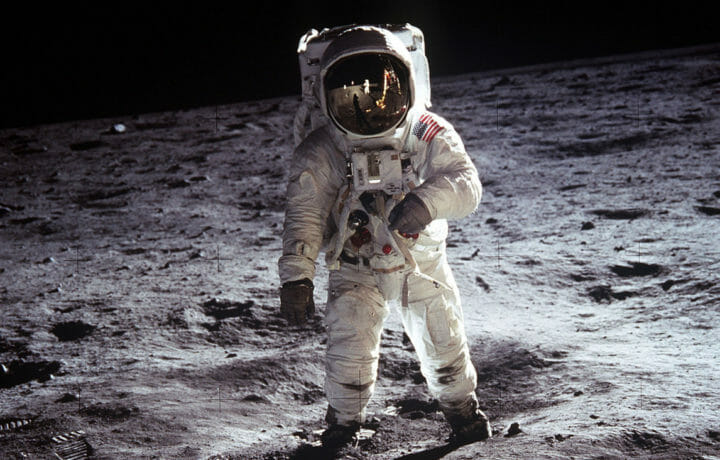
The National Aeronautics and Space Administration (NASA) announced multiple initiatives this month as the space agency seeks to ensure America faces Space Race 2.0, the 21st-century shift from the previous Cold War ideological rivalry to a multi-polar competition that is now focused on lunar permanence, commercialization, and strategic infrastructure rather than brief, symbolic flag-planting.
That included NASA issuing a suite of awards and mission updates that could expand its Moon Base exploration, science, and infrastructure capabilities. According to the agency, the new investments will help advance commercial robotic deliveries, a proposed nuclear-powered rover named PROMISE, new launch and orbital transfer services, and even surface infrastructure. NASA is already working with U.S. industry toward a shared goal: establishing a sustained presence at the Moon’s South Pole.
NASA shared the news at the MAX POWER aerospace expo and air show at NASA’s Kennedy Space Center in Florida.
“We are building the Moon Base mission by mission,” said NASA Administrator Jared Isaacman. “[The] announcements expand nearly every part of that campaign, using the playbook that carried NASA through its greatest eras: fly often, learn, apply those lessons, and get better and more capable with every mission. When our astronauts return to the Moon, they will arrive with the first elements of the Moon Base already waiting for them on the surface.”
The Lunar Base
The new lunar efforts are centered on establishing a permanent human outpost and lunar base at the Moon’s South Pole, allowing it to serve as a stepping stone to Mars. The location was chosen based on potential water ice deposits and continuous or near-continuous sunlight.
“In the eight months since Ignition, we’ve made incredible strides in accomplishing the near-impossible: establishing a permanent outpost on the lunar surface,” said Carlos García-Galán, manager, Moon Base Program. “We’ve consolidated numerous efforts into a streamlined program, evolving our human exploration architecture into an iterative and sustained campaign for Moon Base technology development and implementation. Most importantly, we’ve taken action, awarding new contracts and forging new partnerships to accelerate development.”
As it extends the infrastructure capabilities on the Moon, NASA will purchase commercial components for a Mini-Communications and Solar Tower (miniCAST), including solar arrays, batteries, and wireless power-transfer hardware. The agency awarded Honeybee Robotics, a Blue Origin company, for energy storage capability, Redwire for power generation, and Yank Technologies, Inc., for wireless power transfer in support of miniCAST.
Getting There Is Half the Challenge
Although six manned missions have reached the Moon, establishing a base will require overcoming several challenges, and getting materiel to the satellite is among the biggest. NASA will work with several companies to develop the robust transportation network between Earth and the Moon, with Orbital Transfer Vehicles (OTVs) serving as long-distance “freight trucks.”
Lunar landers will handle the final delivery, bringing supplies, equipment, and other components of the future infrastructure to the Moon’s surface.
“To demonstrate those capabilities, NASA awarded six task orders as part of the agency’s Venture-Class Acquisition of Dedicated and Rideshare (VADR) launch services contract. The awards were given to Arrow Science and Technology, Blue Origin, and Impulse Space to integrate and transport Moon Base cargo,” NASA confirmed.
The missions will be divided into three parts, with the first missions designed to reduce risks of future long-term human spaceflight for lunar exploration. During this time, NASA will verify that communication and navigation methods work properly during the journey from Earth orbit to the Moon, along with OTV capability to support delivery of a Commercial Lunar Payload Services (CLPS) lunar lander to a desired orbit.
That will be followed by missions aimed at preparing the lunar South Pole for human exploration by sending a group of highly mobile drones to survey the surface before astronauts arrive, enabling safer, more informed human missions while demonstrating advanced robotic capabilities.
The third mission, meant to reduce risk, will test navigation technologies. The missions are valued at nearly $1.3 billion and are part of a 10-year VADR indefinite-delivery/indefinite-quantity contract with a maximum total value of $5 billion across all contracts.
NASA has confirmed that the missions will launch aboard Blue Origin’s New Glenn, Relativity Space’s Terran R, and SpaceX’s Falcon 9 rockets. Blue Origin, Firefly Aerospace, Impulse Space, and Quantum Space will provide in-space transportation spacecraft for these missions.
NASA has selected SpaceX for the Cislunar Communications Deployment Demonstration under an existing lunar logistics contract, via a Specialized Delivery Mission task order to launch communications satellites aboard a Starship to cislunar space in 2028. That demonstration will help inform the development of future lunar communications networks that keep astronauts, mission controllers, and the Moon Base connected.
NASA has also selected eight companies for the next phase of its CLPS initiative. The companies include:
- Blue Origin
- Firefly Aerospace
- Intuitive Machines
- ispace-U.S.
- Lockheed Martin Space
- Northrop Grumman Space Systems
- SpaceX
- Voyager Technologies
Under the CLPS 2 framework, the companies will provide lunar delivery services, including managing, building, and operating landers that transport NASA science, technology, and infrastructure payloads to the Moon. The CLPS 2 framework will offer a 10-year, multiple-award, indefinite-delivery/indefinite-quantity master contract with a combined maximum value of $10 billion.
NASA also increased the value of the CLPS 1.0 contract by $2.6 billion to $4.2 billion to support initial Phase One Moon Base objectives, with the original CLPS contract set to remain in place through November 2028. NASA also extended it by five years to complete awarded lunar deliveries through November 2033.
A Nuclear-powered Moon Rover
Once on the Moon, transportation will be required, and NASA is moving forward with the development of the Polar Rover for Observation, Mapping, and In-Situ Exploration (PROMISE). This nuclear-powered, six-wheeled rover can carry scientific instruments and demonstrate technology. More importantly, PROMISE can carry a drill to extract regolith (lunar dust) and characterize ice and other resources up to three feet (one meter) below the surface. It will also carry spectrometers to analyze the chemical composition of surface material, temperature and radiation sensors, and visible-light cameras. Because it is nuclear-powered, it can operate during long lunar nights and in permanently shadowed regions of the lunar surface. The vehicle will also serve to demonstrate the agency’s next-generation, radiation-tolerant computing system, NASA’s High Performance Spaceflight Computing, and advanced autonomy sensors and algorithms.
NASA announced that its Jet Propulsion Laboratory in Southern California, a division of Caltech, will manage the mission and build the rover from a combination of spare flight components and engineering test models for NASA’s Curiosity and Perseverance Mars rovers. By employing proven hardware and software from the Mars rover, this will significantly reduce cost and enable integration and testing of the complex PROMISE rover on a shorter timeline.
Student Input
On Sunday, NASA confirmed that it is calling upon insight from U.S. high schools and post-secondary schools to contribute designs for the Moon Base. The agency announced the opening of its $1 million Moon Base Student Challenge.
“We’re looking for students ready to think creatively, work as a team, and take on real problems connected to NASA’s future on the Moon,” said Isaacman. “You do not have to wait until graduation to contribute. Curiosity, creativity, and the willingness to tackle hard problems without obvious answers are exactly the qualities we need as we build what comes next.”
NASA Seeks Future Space Explorers
Establishing a permanent presence on the Moon, and eventually Mars, isn’t just a technical problem. It will require a new generation of space explorers, and NASA announced it is seeking individuals to help write the next chapter of human spaceflight.
Applications are now open for the next class of astronauts. U.S. citizens can apply now on NASA’s website through December 3, 2026.
“This is an extraordinary time to join NASA’s astronaut corps,” added Isaacman. “The people we select could walk on the Moon, live and work at the Moon Base, and help pioneer the systems and operations that will ultimately carry crews to Mars. Those missions will demand technical excellence, sound judgment, teamwork, and courage. NASA’s astronaut corps has always called on remarkable Americans willing to take on extraordinary challenges in service to the nation. If you are ready to join that tradition, come help write the next chapter of humanity’s greatest adventure.”
NASA expects to make the final selection by the end of 2027, followed by training for the next class of astronaut candidates. The last open applications in 2024 drew more than 8,000 individuals who sought to go to infinity and beyond, and 10 selected in 2025 are now completing nearly two years of training.
“For those who apply, becoming a NASA astronaut is more than a career opportunity,” said Scott Tingle, chief astronaut and chair of the Astronaut Selection Board at NASA’s Johnson Space Center in Houston. “It is a chance to join a legacy of explorers who have pushed the boundaries of discovery and play a role in the missions that will shape humanity’s future in space. The next generation of astronaut candidates could help write history while inspiring future scientists, engineers, and explorers.”


