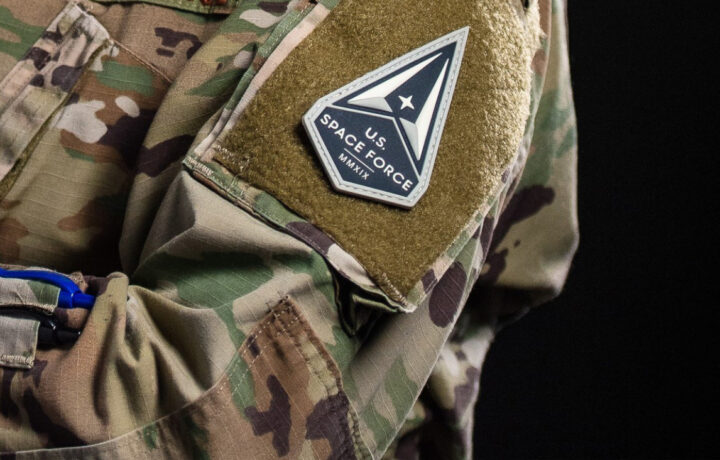
The United States Space Force, the sixth and newest branch of the U.S. Armed Forces, has existed for nearly six and a half years. In that time, it has reached numerous noteworthy milestones.
That included the swearing in of its first chief of space operations (CSO) and “First Guardian,” the activation of the 1st Space Operations Squadron, and the arrival of the first cadre of direct enlistments to the force. Colonel Mike Hopkin is also recognized as being the first U.S. Space Force astronaut, as he transferred from the U.S. Air Force while aboard the International Space Station (ISS) on December 19, 2020, which was also the one year anniversary of the founding of the Space Force.
In April, another milestone was reached when Lt. Col. Mark Natale landed on the ground, becoming the service’s first paratrooper after completing a joint airborne operation.
That followed more than 36 hours of preparation, months of coordination, and several “no-go” attempts. But then on April 24, Natale, chief strategy officer for Space Base Delta 41, made history as the service’s first paratrooper.
He Wanted to Fly Planes
Natale, whose family emigrated from Italy before and after the Second World War and has a long history of serving in the U.S. military, is also an aviation buff. His grandfather Carl had more than 40 years of flying experience and taught Natale to fly on a Cessna 421 Golden Eagle.
That ignited a passion to fly, but it didn’t work out.
“I wanted to be a fighter pilot in the worst way; however, my eyes were not good enough,” Natale acknowledged. “I begged the Navy and the Air Force for a waiver, but it didn’t get approved.”
He couldn’t fly the planes, but he could jump out of them.
He was actually approached by the U.S. Army to become an officer and a paratrooper, and soon after beginning basic training in 2006.Rising to the rank of sergeant, Natale then attended Officer Candidate School and received his commission. He spent 18 years in the United States Army, with more than a decade in special operations forces, and 12 years overseas.
“The average Army officer, once commissioned, usually starts in a conventual unit as a platoon leader, responsible for a handful of NCOs and junior Soldiers,” Natale said. “I was immediately slotted in a captain’s position at a combat engineer battalion and deployed to Baghdad for 15 months.”
Transfer From the Army to Space Force
In 2019, when the Space Force was established, Natale was at a crossroads. He was stationed in the United Kingdom as part of an exchange officer program, supporting the creation of UK Space Centre. He was responsible with ensuring that the U.S. and UK land and space systems could communicate with one another.
“I saw first-hand that any new ‘Space Force,’ whether American or British, needed combat experienced joint warfighters,” said Natale.
With some persuading by his wife Sonia, Natale soon applied for an interservice transfer during the first segment of non-Air Force personnel.
“She knew we were in the next great ‘space race’ and entering the second golden era of space dominance… I wanted to be a part of that,” Natale said. “We need joint warfighters with experience on the front lines as Guardians.”
As of an estimated 300 to 500 soldiers who transferred from the Army, Natale was one of the few Army signal officers that was cross-trained into the “full trifecta of signal operations” that included cyber, electronic warfare and space operations.
“I was lucky enough to be in a position where our tactical units needed these capabilities and I was able to get the training to support my Soldiers in real-world operations,” he said.
The Jump – Becoming the Space Force’s First Paratrooper
During his time in the U.S. Army, Natale had become an experienced senior parachutist and jumpmaster, serving on “jump status” from 2010 to 2021. He was therefore also ideally suited to be the Space Force’s first paratrooper. But first he had to participate in a rigorous recertification process that included a Basic Airborne Refresher, the Jumpmaster Refresher course, Sustained Airborne Training and delivered the Marshalling Area Control Officer brief.
Tatale also conducted rehearsals, inspections and several safety briefs. The various certifications and courses are meant to ensure that each individual is up to date on all airborne safety procedures.
Finally, on April 24, 2026, Natale jumped with the 10th Special Forces Group (Airborne) into the Sullivan Drop Zone at Fort Carson, Colorado, from a U.S. Marine Corp KC-130 Hercules based out of Kaneohe Bay, Hawaii.
“This was much more than a technical demonstration, it was a validation of our proof of concept that we can take a Guardian with a unique skillset, get them cross-trained and recertified, then have them embed with an elite joint force, jump from an aircraft in flight and provide Space capabilities on the drop zone,” Natale said. “The Space Force is a joint combat force by nature, but nothing is more joint than a USMC bird and crew, Army Special Forces paratroopers and a Space Force jumpmaster all working together as a team.”
Natale hopes that other Space Force guardians will follow his path.
“I hope that this shows every Guardian, regardless of rank, that we can expand our capabilities and prove to the Joint Force that we can hang with the most elite of the elite,” Natale said. “As Guardians, we need to operate outside our comfort zone. To prove that we are combat focused, we need to do what they do, train like they train and operate where they operate.”


