Autonomous weapon developer Anduril was one of the two firms first selected by the United States Air Force to develop an unmanned aerial system (UAS) as part of the Collaborative Combat Aircraft (CCA) program. It could provide similar autonomous aircraft capabilities to the United States Army.
The Anduril YFQ-44A, formerly known as the “Fury,” is now undergoing flight testing at Edwards Air Force Base (AFB), CA.
In June, the U.S. Air Force announced that the YFQ-44A and the General Atomics YFQ-42A were cleared for initial production. Anduril had broken ground on a new facility outside of Columbus, OH, to manufacture the drones.
It was just a year earlier that the service activated a new squadron, the Experimental Operations Unit, to help drive operational capability for the CCA.
Loyal Wingmen for a Variety of Aircraft
The CCA program has called for thousands of unmanned drones to support manned fifth- and sixth-generation fighters, serving as a force multiplier. The drones could also work with the U.S. Air Force’s next-generation long-range strategic bomber, the now-in-development Northrop Grumman B-21 Raider.
It will not just be fixed-wing aircraft in service with the United States Air Force that are aided by such “loyal wingmen,” as the United States Navy will also likely employ unmanned drones in a similar capacity.
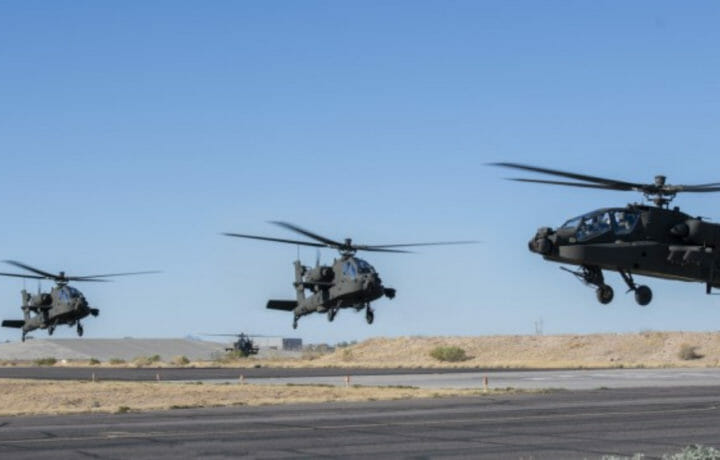
This week, it was reported that Anduril, working with aviation manufacturer Archer, has unveiled a new Group 5 drone dubbed Thunder, which could serve alongside the United States Army’s fleet of helicopters, including the AH-64 Apache.
Crack of Thunder
The hybrid-electric, vertical takeoff and landing autonomous tilt-rotor Thunder UAS, which has been in development for about three years, would be another force multiplier, able to conduct a variety of missions, from scouting for enemy aircraft to carrying weapons to take out adversarial air defenses, and even conducting deep strikes in enemy territory.
As with the loyal wingmen for the fighters and bombers, the goal is the same – to allow human pilots and their aircraft to operate farther from the front lines.
“Attack helicopters and their crews, long the lifeblood of maneuver warfare, are increasingly held at risk by a combination of loitering munitions, cheap air defenses, and ubiquitous persistent ISR platforms that have rendered the near-surface domain one of the most lethal places on the battlefield,” Anduril said in a statement.
The Thunder is meant to exploit an adversary’s weakness, utilizing the principles of speed, agility, reach, and decisive mass. The autonomous developer acknowledged that any of those attributes individually isn’t sufficient, but the combination will enable the “decisive blows” that could allow friendly forces to gain the advantage.
Thunder is part of the Group 5 autonomous attack rotorcraft that are specifically developed to greatly increase the power and survivability of current and next-generation crewed attack and assault aircraft.
“By teaming three Thunder aircraft with each Apache, for example, a Combat Aviation Brigade will achieve a three times increase in available munitions without placing additional pilots in harm’s way, all at a fraction of the cost of a similarly-sized formation of exclusively crewed aircraft,” the company added.
Enhanced Battlespace Awareness
As with other loyal wingmen, Thunder is utilizing a modular design with internal main and nose payload bays that enable the drones to host a “lethal” combination of precision munitions, air-launched effects, rockets, electronic warfare payloads, counter-UAS force protection, and cargo, and is provisioned for rapid integration of future mission systems.
The UAS is built around Anduril’s core Lattice for Mission Autonomy software, which enables a single human operator to command and coordinate large, heterogeneous teams of autonomous systems.
“By translating operator intent into trusted machine-speed route, timing, tasking, and deconfliction decisions, Lattice eliminates the need for pilots to manage Thunder with a stick and rudder, enabling them to focus instead on the most important decisions at hand,” Anduril explained.
The Lattice will also enhance the situational awareness of the battlefield, allowing the Thunder to perform its mission and further enhancing the effectiveness of every platform around it.


