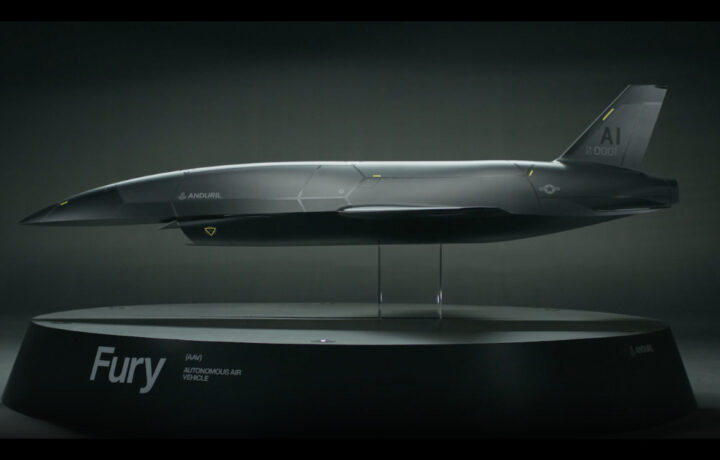
The Anduril YFQ-44A, formerly known as the “Fury,” concluded a “critical exercise” at Edwards Air Force Base (AFB), CA. The unmanned aerial system (UAS) is part of the United States Air Force’s Collaborative Combat Aircraft (CCA) program, and it first began flight testing last October.
The aerospace firm previously announced that it went from a “clean sheet” to the first semi-autonomous flight of a CCA in just 556 days. There had been concerns last fall that the government shutdown, which turned out to be the longest in history, might affect the maiden flight, but it doesn’t appear that progress has been affected.
It was just last summer that the U.S. Air Force announced the activation of a new squadron to drive the operational capability for the CCA.
New Concept of Flight
The U.S. Air Force has stated that its Experimental Operations Unit (EOU), which is part of the Air Combat Command (ACC), has helped drive the new principles of Warfighting Acquisition System into practice, and that it “represents a shift toward the new concept of earlier, operator-driven experimentation to inform tactics and procedures that will accelerate the delivery of this transformative capability to the warfighter.”
Although such aircraft have been flown remotely by drone operators, flight testing has pushed the boundaries of autonomous operations.
EUO airmen worked with the Air Force Materiel Command’s (AFMC’s) 412th Test Wing. They executed a series of sorties to refine core operational and logistical procedures and test the ability to deploy and sustain a CCA in a “contested environment.” The hands-on testing remains a cornerstone for the U.S. Air Force as it seeks to field combat-ready, uncrewed aircraft at speed and scale.
The goal of the CCA program is to develop semiautonomous aerial drones that can operate as so-called “Loyal Wingmen” alongside a manned fighter, serving as a force multiplier. The Air Force has called for at least 1,000 lower-cost unmanned aerial systems (UAS), which could take on a variety of tasks. The recent test flights highlight the progress made to date.
“EOU members executed this experimental operations event from start to finish. Every sortie generated and flown was done with a warfighter, not an engineer or test pilot, kicking the tires and controlling the prototypes,” said Lt. Col. Matthew Jensen, EOU commander. “We are learning by doing, at a speed and risk tolerance accepted by the USAF’s most senior leaders, to ensure CCA is ready to operate and win in the most demanding combat environments.”
The EOU Up And Running
The EOU was formally activated as a fully operational squadron on June 5, 2025, at Nellis AFB, Nevada, operating as a detachment under the 53rd Wing. Its core mission has been to develop CCA concepts with operators at the center of progress.
“By embedding the warfighter’s voice as the driving force from the beginning, the unit forges the initial tactics, techniques, and procedures needed to ensure CCA is integrated and tactically viable for future conflict,” the Air Force explained.
The unit has also united the distinct test authorities of AFMC and the operational authorities of ACC, which has aided in fast-tracking development of the aircraft, including the YFQ-44A.
It was only in April 2024 that Anduril and General Atomics were selected to develop and then test the first loyal wingman drones. General Atomics began testing of its YFQ-42A, formerly known as “Gambit,” in May 2025, with it making its maiden flight in August of last year.
Anduril has played catch-up but began flight testing in October 2025 and announced production of the YFQ-44A CCA in March. The Air Force has not indicated how many drones it has purchased. Still, the service had previously said the fleet could reach at least 1,000 that would operate alongside the fifth-generation Lockheed Martin F-22 Raptor and F-35 Lightning II, and the sixth-generation Boeing F-47 stealth fighter now in development.
In addition, the drones could support the Northrop Grumman B-21 Raider long-range strategic bomber by serving as unmanned escorts.
Moreover, the CCA program is meant to be a pathfinder for the Air Force’s Warfighting Acquisition System, and the service said it was “deliberately structured to move from concept to combat-credible capability in record time.” That was accomplished by fostering a close partnership among operators, developers, and testers.
“The collaboration we saw in this exercise is the cornerstone of our acquisition transformation. By embedding the operators from the EOU with our acquisition professionals, we create a tight feedback loop that lets us trade operational risk with acquisition risk in real-time,” said Col. Timothy Helfrich, portfolio acquisition executive for fighters and advanced aircraft. “This isn’t just a test; it’s a demonstration of how we are adopting a more agile process. An 85% solution in the hands of a warfighter today is infinitely better than a 100% solution that never arrives.”


