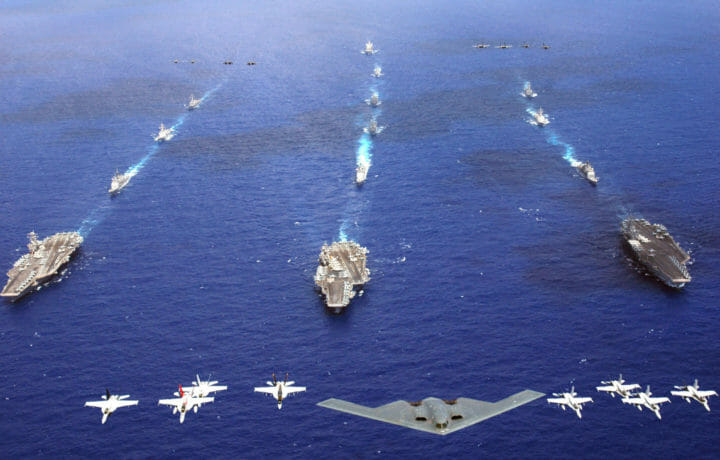
History is nearly repeating itself, as a United States Navy aircraft carrier is now on a return voyage home after having its deployment extended. The USS Abraham Lincoln (CVN-72) is just weeks away from setting the record for the second-longest deployment of a supercarrier since the end of the Cold War.
What makes this all the more noteworthy is that CVN-72’s deployment will only come to an end just three months after the United States Navy’s newest and largest nuclear-powered aircraft carrier, the USS Gerald R. Ford (CVN-78), returned to Naval Station Norfolk, VA, after being deployed for 326 days.
Another Record for the U.S. Navy’s Carrier Force
As of September 12, the USS Abraham Lincoln will have been deployed for 285 days, USNI News reported. The fifth Nimitz-class carrier departed from Naval Base San Diego, CA, on November 21 with little fanfare, for what was expected to be a six-month mission in the Indo-Pacific. In February, while operating in the South China Sea, which Beijing views as its sovereign waters, CVN-72 was ordered to the Middle East as part of the buildup of U.S. military forces.
Aircraft from the carrier took part in Operation Epic Fury, the air and missile campaign launched against Iran on February 28, 2026. Although CVN-78 was also dispatched to the region, later relieved by the USS George H.W. Bush (CVN-77) – which is still operating in the Arabian Sea – the USS Abraham Lincoln saw its deployment extended twice, spending almost seven months on station in the region.
No Port Call
Even as the deployment of the USS Abraham Lincoln will almost certainly be shorter in total length than that of the USS Gerald R. Ford, the mission was made even more grueling by the fact that CVN-72 made just a single port visit to Guam, for just one day, before being dispatched to the Middle East.
There were unconfirmed reports that the supercarrier was in Oman for a day in July, but even if that is true, most of the crew wouldn’t have received liberty or even been allowed to set foot on dry land.
The carrier has set a record of more than 250 days at sea without a port call.
“Deployments are hard. Combat operations make them harder. War is hell and normal routines are disrupted,” said Acting Secretary of the Navy Hung Cao in a statement to the media this month. “One of the hardest aspects about warfighting beyond knowingly placing our service members in harm’s way is that even with the best planning and communication, change and uncertainty will always be in play. Our success depends on how we adapt.”
Heavy Toll on Sailors
The length of the deployment and time at sea has made headlines in recent weeks. The Pentagon has warned sailors and families not to over share sensitive information online, but earlier this month, the U.S. Navy’s only forward-deployed aircraft carrier, the Yokosuka, Japan-based USS George Washington (CVN-73), was dispatched to the Middle East.
The USS Abraham Lincoln is now headed back to San Diego, but is expected to make a port visit to Thailand in the coming days. The U.S. Navy hasn’t confirmed how long the warship will remain in the Maritime Southeast Asian nation, but such port calls typically last three to five days. It is a time to allow the crew to have some time off the ship, but also to take on supplies, including fresh water and food.
Longer Deployments Likely to be the Norm
Even before the start of military operations in the Middle East, the United States Navy was already stretched thin. It has just 11 nuclear-powered supercarriers in service, with two – the USS John C. Stennis (CVN-74) and the USS Harry S. Truman (CVN-75) – undergoing their respective midlife refueling and complex overhaul (ROCH) at the Newports News Shipbuilding facility in VA.
The USS Nimitz (CVN-68), the oldest operational carrier, completed a homeport shift in July and is scheduled to be decommissioned in March, when the next Gerald R. Ford-class carrier, the future USS John F. Kennedy (CVN-79) is commissioned.
The USS Gerald R. Ford, which only completed its record-setting deployment in May, will be sidelined throughout the remainder of 2026 and likely all of 2027 as it undergoes maintenance and receives upgrades.
The San Diego-based USS Theodore Roosevelt (CVN-71) is now preparing for its next deployment, which will likely begin in September. The USS Carl Vinson (CVN-70) is also in San Diego readying for a future deployment later this year or in early 2027. The Norfolk-based USS Dwight D. Eisenhower (CVN-69) is undergoing similar pre-deployment preparation.
The USS Ronald Reagan (CVN-76) is concluding a major overhaul at the Puget Sound Naval Shipyard this month, and will begin to prepare for its 2027 deployment.
Given this cycle, the United States Navy is simply forced to extend each mission, which then in turn requires longer maintenance, meaning that each deployment is longer as there are fewer carriers ready to head to sea.


