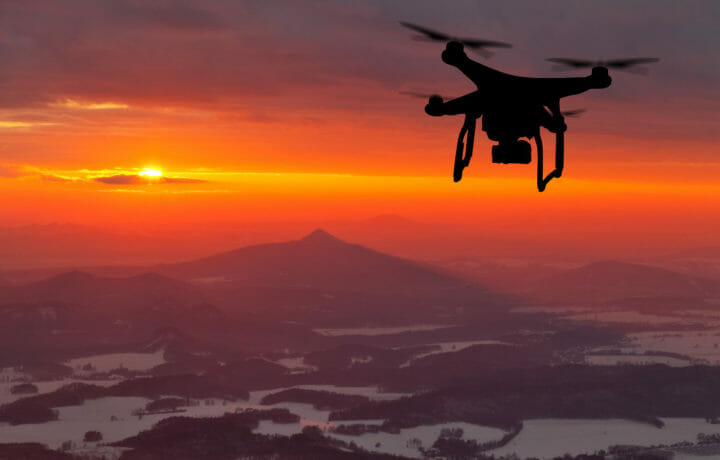
The ongoing war in Ukraine has demonstrated how small, off-the-shelf commercial unmanned aerial systems (UAS), or drones, can be employed to disable or destroy a tank and strike forward positions on the front lines, while larger drones continue to strike critical infrastructure.
The threat of drones has further come into focus in the recent conflict in Iran, where the U.S. military has found that countering low-cost drones with traditional air defense missiles is simply not cost-effective.
Earlier this month, the United States Air Force’s 31st Air Task Force conducted a weeklong training event at Hurlburt Field, FL, focused on a layered counter-small unmanned aircraft system defense capability, including a kinetic “final denial” live-fire demonstration.
The counter-sUAS training field exercises also allowed U.S. Air Force airmen from Hurlburt Field and Nellis Air Force Base, NV, to share knowledge.
“Through a crawl, walk, run approach, Airmen gained practical knowledge of a full spectrum of layered counter-sUAS capabilities,” said the 31st ATF’s force protection superintendent. “The ATF is posturing to provide tiered defense through detection, electronic warfare defeat, and physical interception of hostile drones.”
Detect, Track, and Filter
During the weeklong exercise, airmen trained on artificial intelligence-powered systems that “detect, track, and filter aerial objects from planes and drones to birds,” and then quickly shared the data in real-time across multiple levels of command and control from an expeditionary base defense operations center.
The event further hosted leaders from the Air Force Special Operations Command and the 1st Special Operations Wing, along with experts on drone warfare, precision munitions, and unmanned threat detection and mitigation. The team of experts explored the various methods to protect the warfighter and counter emergent UAS threats.
“It’s inspiring to see a unit at this level proactively tackling a problem-set that is top of mind for leaders across the Air Force and the Department of War,” added Col. Clayton Schuety, 1st SOW deputy commander. “The blend of entrepreneurial foresight, AI surveillance, and human-directed targeting will no doubt create positive impacts for the warfighter. We look forward to seeing how this effort continues to mature and receiving the lessons learned which will benefit Air Commandos and the larger force.”
The 31st ATF is a U.S. Air Force ready Unit of Action, consisting of a command-and-control element and a combat air base squadron with up to 2,500 Airmen across more than 60 Air Force specialty codes. The team can provide base operating support for deployed flying units, also known as mission generation force elements, and the necessary logistics to execute Agile Combat Employment (ACE) in contested environments. It was designed to deploy as a cohesive, pre-integrated unit rather than aggregating individual personnel from separate installations.
A Layered Defense
The exercises at Hurlburt Field highlighted how no single approach to countering drones is effective on its own. The team used a layered defense that began with detection and tracking enhanced by artificial intelligence, but also involved low-tech counter-drone technology consisting of a well-aimed pump shotgun!
“By teaming with top industry partners and using existing Air Force equipment, the 31st ATF trained Airmen on weapons designed to defend against hostile drones and safeguard against electromagnetic warfare threats. Airmen practiced organic reconnaissance and denial of high-speed sUAS targets mimicking hostile flight patterns,” the Air Force explained.
“The team successfully executed a capstone event that validated new tactics, techniques, and procedures across force protection and distributed communications,” said Col. Brad Dvorak, 31st ATF commander. “Our mission is to enable airpower operations, anytime, anywhere. By establishing a sUAS instructor cadre, we trained our personnel on counter-sUAS architecture and employed unique solutions for Airmen to track, jam, and kinetically defeat sUAS threats.”
No Drone Zone
The recent training was likely conducted at Hurlburt Field as the use of drones and other UAS operations are banned within a five-mile radius of the installation due to flight safety concerns. The base has also stated that there are no exceptions made for recreational drone pilots.
The U.S. military has warned civilians that violating military installation airspace can lead to severe penalties, including fines, confiscation of equipment, arrest, and imprisonment.
Other Efforts Underway
The news of the U.S. Air Force efforts follow the U.S. Army announcing earlier this month that Sgt. Ryan Minton, assigned to Regimental Support Squadron, 2nd Cavalry Regiment, showed off a “drone detector” during an open house at the 7th Army Training Command’s Design Innovation Research and Testing (DIRT) Lab, Grafenwoehr, Germany. The detector scans for radio signals associated with a potential drone and then alerts the user accordingly. Minton, a special projects engineer with the 2nd Cavalry Regiment’s Innovation Cell, had been working on his design for nearly two years.
Beyond countering drones, the U.S. military continues to embrace the technology.
Last November, the Pentagon hosted a press event that highlighted 18 American-made drone prototypes that could be produced using off-the-shelf components for rapid manufacturing.


