Last month, during a visit to NASA’s Lyndon B. Johnson Space Center in Texas, President Donald Trump signed an executive order calling for the creation of a United States Space Academy to “educate and develop the next generation of leaders across the space domain.” The president announced the new national service academy during a ceremony honoring members of the Artemis II mission.
The still-proposed academy would serve more than the United States Space Force, the sixth and newest branch of the United States military, formally created in December 2019 during Trump’s first term. It would serve as a pipeline for NASA, a civilian agency, and the U.S. Space Force.
The executive order named NASA Administrator Jared Isaacman as chair of a Presidential Commission on the United States Space Academy. Isaacman will work with NASA Deputy Administrator Matt Anderson, named executive director, and others to determine how to make the academy a reality. The commission was tasked with delivering a report within 120 days on the “governance framework, service obligations for graduates, physical location of the academy, legislative requirements,” and other issues that must be addressed to establish a new service academy.
Key among the issues may be where such an academy could be located.
Several regions have already expressed interest, with Texas lawmakers pushing for a location near the Johnson Space Center in Houston. Colorado has also been floated as a potential home, given that it hosts the United States Air Force Academy and the headquarters of the United States Space Force in Colorado Springs.
Alabama could further be in the running, as Huntsville’s Redstone Arsenal is the future home for the United States Space Command.
The future Space Academy may not see a showdown between Colorado and Alabama, however. The former state may be ruled out because it is already home to the Air Force Academy, and Alabama, as Space Command’s mission is strictly a military organization, serving as the unified combatant command, handling military operations in outer space.
Florida Makes Its Case
Although Texas may have a strong argument for why it should host the Space Academy, the future service academy is likely to end up in Florida, with its “Space Coast,” which includes the Kennedy Space Center (KSC), NASA’s principal center for human spaceflight and vertical rocket launches; and Cape Canaveral Space Force Station (CCSFS), the military installation adjacent to KSC and managed by Space Delta 45.
“Florida built America’s space program. It should build the next generation of leaders who take us further. I’m proud to join the Florida delegation in urging President Donald J. Trump and Jared Isaacman to make Florida home to the new United States Space Academy,” wrote Rep. Vern Buchanan (R-Fla.) in a letter to President Trump last week.
“Florida offers a climate in which Space Academy students could pursue rigorous academic study, conduct research through our state’s universities, learn from NASA and Space Force personnel, engage directly with commercial space companies, and gain firsthand exposure to the nation’s launch and space operations,” a Florida delegation of lawmakers wrote in another letter.
“From launch providers and spacecraft manufacturers to satellite companies, defense contractors, and emerging space-technology firms, Florida’s private sector represents the range and scale of capabilities that will define America’s future in space,” the delegation stated. “These capabilities directly align with the mission outlined in the Executive Order.”
The delegation further highlighted that Florida is home to Eglin Air Force Base (AFB) and Tyndall AFB in the Panhandle, Naval Air Station Cecil Field in Jacksonville and Homestead Air Reserve Base in South Florida, and is a hub for aerospace activity.
The Sunshine State Has Two Competing Visions
Even if the competition is narrowed to the Sunshine State, two areas will likely remain engaged in a “friendly” regional competition. Leaders from both Orange County in Central Florida and Brevard County on the Space Coast have launched distinct bids to host the Space Academy.
Orange County has touted its access to the Greater Orlando International Airport and noted that the University of Central Florida (UCF) is already widely known as “America’s Space University” because of its historical and ongoing ties to NASA and the aerospace industry. It was established in 1963 as Florida Technological University specifically to support the NASA space program at Cape Canaveral, and is located only 35 miles west of NASA’s KSC.
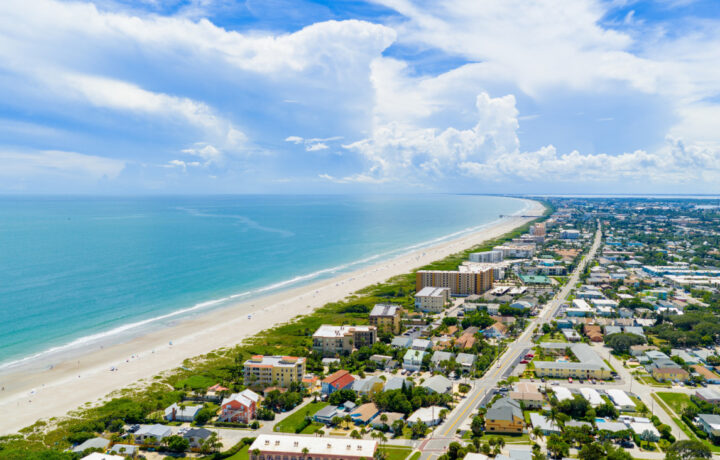
By contrast, Brevard County has direct access to active launch pads at KCS and CCSFS, as well as Patrick Space Force Base.
Space may be the final frontier, but several locations will go to great lengths to host what could be the final American service academy.


