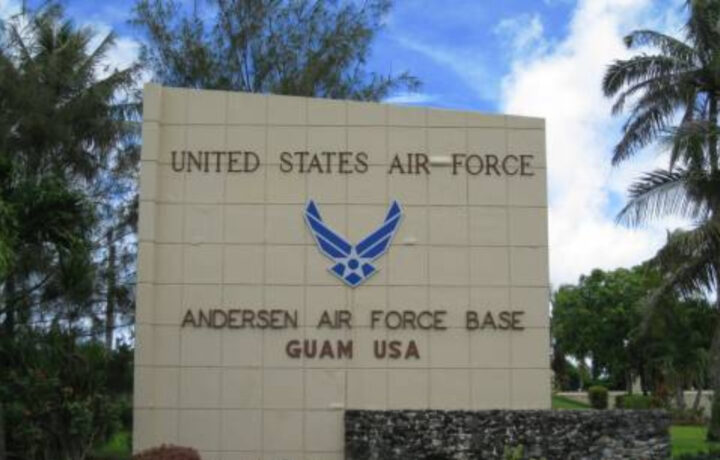
Earlier this month, the United States Army activated a new air defense battalion on the U.S. territory of Guam. The 3rd Battalion, 43rd Air Defense Artillery Regiment (3-43-ADA) was officially activated at a ceremony at Andersen Air Force Base (AFB), Guam, inheriting and expanding upon the air and missile defense responsibilities previously handled for more than a decade via Task Force Talon. The Army created this unit in 2013 at Andersen to operate the Terminal High Altitude Area Defense (THAAD) missile system.
Task Force Talon formally cased its colors and “sunset,” essentially disbanding this year, and was replaced by the 3-43-ADA, which will now support Guam’s defense by maintaining readiness and providing air and missile defense capabilities against potential threats. This transition from a rotational task force to a battalion is part of the United States military’s expansion of permanent, multi-capability air defense on the island territory that is strategically vital to the U.S. military as a sovereign forward-operating hub, logistics center, and power-projection base in the Western Pacific.
“Your work here will never be ordinary. Your vigilance will have strategic consequences,” said U.S. Army Col. Moseph Sauda, the commander of the 38th ADA BDE, who addressed the significance of the activation and the responsibility of the soldiers assigned to the unit.
“Your readiness will assist in shaping regional stability, and your professionalism will ensure millions living under the umbrella of peace that your discipline helps to maintain,” added Sauda.
Before 3-43 ADA’s activation, Task Force Talon handled Guam’s air defenses and worked alongside joint service partners and the Guam Army National Guard. TFT’s deactivation signaled a change in the United States Army’s defensive architecture on the island.
Strategically Vital Guam
Although a territory and not a state, Guam is still U.S. soil, acquired from Spain after the Spanish-American War in 1898. Located approximately 3,300 to 4,000 miles west of HI, it is much closer to Asian hotspots such as China, North Korea, and the Philippines, reducing response times across the Indo-Pacific.
As it is U.S. soil, the military can stage forces, store heavy munitions, and launch operations without needing permission from a foreign government. The island has vast deepwater port facilities, airfields with long runways, and extensive fuel and munition depots that support joint-force operations throughout the Indo-Pacific.
Andersen AFB hosts rotating deployments of long-range U.S. strategic bombers, including the Rockwell B-1B Lancer, Northrop B-2 Spirit, and Boeing B-52 Stratofortress. In addition, Naval Base Guam serves as a home port for nuclear-powered fast-attack submarines and submarine tenders, allowing rapid maritime response and blockade-breaking capabilities.
Marine Corps Base Camp Blaz also accommodates thousands of relocating U.S. Marines.
The 3-43 ADA will help protect the U.S. facilities from airborne threats.
“This battalion helped transform an ambitious concept into operational capabilities,” explained Lt. Col. Joshua Urness, 3-43 ADA BN commander. “The Soldiers developed new procedures, relationships, and integration required to connect sensors, command and control systems, launchers, and interceptors to promote a unified defensive architecture. It’s only fitting that 3-43 ADA now stands up the Army’s contribution to the strategic Guam Defense System.”
The current air defenses consist of six U.S. Army THAAD launchers, which will remain, along with the U.S. Navy’s Aegis Combat System warships that are deployed to Guam on an “as-needed basis,” USNI News reported, adding, “Future plans aim to integrate a networked system capable of conducting 360-degree detection and interception of air and missile threats.”
The 43rd ADA
The U.S. Army acknowledged that the battalion will carry on the history of the 43rd Air Defense Artillery Regiment, which traces its lineage to 1916, when its predecessor organization was established in the Philippine Islands.
“The regiment’s history includes multiple reorganizations as the Army adapted its air defense formations to meet changing military requirements,” the U.S. Army explained. ‘Today, the battalion’s mission reflects the continued importance of air and missile defense throughout the Indo-Pacific region. As potential threats evolve, Soldiers must remain trained, equipped, and ready to respond while working with joint partners to support regional security.”
The 3-43 ADA will operate a layered air and missile defense network on Guam. In addition to THAAD, which intercepts ballistic missiles during their final, or terminal, phase of flight, the unit will be equipped with the Patriot air defense system, which can intercept ballistic and cruise missiles, as well as enemy aircraft.
The battalion will also have an indirect fire protection capability (IFPC) that is designed to counter short- to medium-range threats such as low-altitude cruise missiles and drones. An Integrated Air and Missile Defense Battle Command System (IBCS) will serve as the battalion’s unified command-and-control network, integrating advanced sensors such as the Lower Tier Air and Missile Defense Sensor (LTAMDS) and AN/TPY-6.


