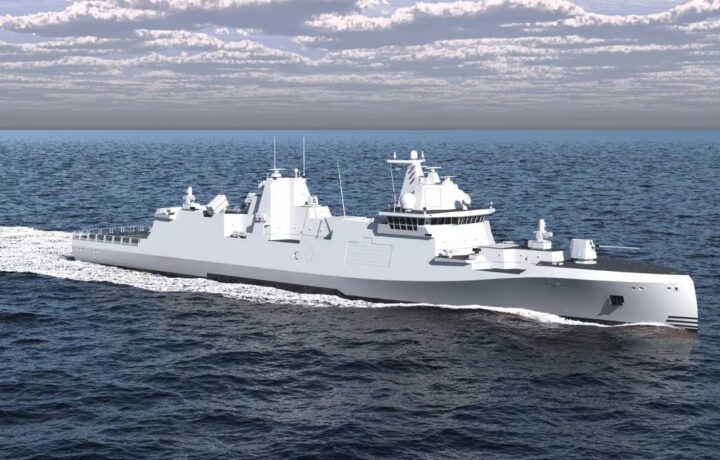
German defense group Rheinmetall is actively pitching its GMF 140 guided-missile frigate design to the United States Navy, Naval News first reported this week. Berlin has sought to position the platform as the standard small warship across NATO, even as France, Italy, and the UK develop other frigates.
Still, Rheinmetall could be among the seven international frigate designs currently being evaluated by, or at least pitched to, the U.S. Navy.
The GMF 140 was first unveiled in August, and since that time additional details have emerged. The small warship, which is about 140 meters (459 feet) in length and displaces approximately 6,000 tonnes (6,613 U.S. tons), is considerably larger than the U.S. Navy’s Littoral Combat Ships (LCS), and arguably far more capable; designed for anti-aircraft warfare (AAW), anti-submarine warfare (ASW), and anti-surface warfare (ASuW), as well as long-range precision strike missions.
“The GMF 140 is a next-generation guided missile frigate designed to deliver unmatched capability across the full spectrum of modern naval warfare. Developed to meet the evolving operational requirements of NATO and allied navies, the GMF 140 establishes a new benchmark for survivability, lethality and mission flexibility in the global frigate market,” Rheinmetall explained on the frigate’s website.
It added that the warships are “purpose-built for operations in the world’s most demanding threat environments,” combining advanced air and ballistic missile defense, anti-submarine warfare, and long-range strike capabilities within a highly survivable, digitally integrated, and minimally manned platform. The vessels are optimized for blue-water operations, yet retain the flexibility to support expeditionary, littoral and coalition missions.
Frigate Reboot
The United States Navy hasn’t operated a frigate to fill the critical capability gap between small patrol boats and expensive, multi-billion-dollar Arleigh Burke-class guided-missile destroyers since it retired the final Oliver Hazard-Perry-class guided-missile frigate, the USS Simpson (FFG-56), in late September 2015.
The U.S. Navy had moved forward with a new class of frigates based on the Franco-Italian-designed Frégate Européenne Multi-Mission/Fregata Europea Multi-Missione (FREMM), to be designated the Constellation-class. The multi-purpose frigates are already in service with the navies of France and Italy, designated as the Aquitaine-class and Bergamini-class, respectively.
It began as a simple transition, but the program ran behind schedule as the service sought to incorporate significant design changes. This made the warships up to 13% heavier than the base FREMM variants, which in turn reduced the frigates’ top speeds. The modifications also affected what systems could be outfitted on the vessels.
A year ago, the U.S. Navy abruptly canceled the Constellation-class frigate program, citing repeated cost overruns and delays. Although the service announced it would accept delivery of the two vessels currently under construction at Fincantieri Marine Group’s (FMG’s) Wisconsin shipyards, it continues to explore its options.
That has included adopting HII’s FF(X) Patrol Frigate, based on the United States Coast Guard’s Legend-class National Security Cutter. It has already passed its Critical Design Review (CDR), and the U.S. Navy awarded an advanced long-lead materials contract. The sea service is weighing multiple parallel paths and design options, including acquiring a foreign-designed frigate via the “Finland Model.”
The naval acquisition and industrial strategy allows foreign allied shipyards to construct the first two vessels of an approved ship class overseas to speed up delivery times. In exchange, the foreign shipbuilder must transition all subsequent production to the United States.
The framework originated from U.S.-Finland/ICE Pact agreements to build Arctic icebreakers, notably the U.S. Coast Guard’s Arctic Security Cutter program, to quickly build polar capabilities. This past August, a Presidential Memorandum expanded the framework across broader naval and auxiliary categories, which included light surface combatants such as anti-submarine and escort warships, strategic sealift Roll-on/Roll-off (Ro-Ro) vessels, and fast-tracked replenishment tankers.
International Options
The United States Navy has already evaluated several allied frigate designs, including three that have been seen to have the inside track:
- Japan’s Mitsubishi Heavy Industries Mogami-class (FFM) guided-missile frigate
- South Korea’s HD Hyundai/Hanhwa Chungnam-class guided-missile frigate
- Turkey’s Istanbul-class guided-missile frigate
In addition, the U.S. Navy has reviewed concepts including the UK’s Type 31 frigate. Now Germany’s Rheinmetall GMF 140 could join the shortlist.
“In the proposed configuration, it exceeds NATO requirements for ballistic missile defense and is on par with American Arleigh Burke-class destroyers,” Rheinmetall officials told Naval News, and added that it could become a NATO frigate if the U.S. comes on board. “Numerous NATO navies have already expressed an interest in participating in such a project, provided that a U.S.-German GMF 140 frigate is realized.”
The German defense firm has also indicated that the frigate was developed with U.S.-sourced radar integration, allowing it to track and engage a variety of conventional air threats, as well as hypersonic weapons and ballistic missiles.
“The GMF 140 has been specifically developed for the requirements of NATO and allied navies seeking a highly capable, affordable and interoperable next-generation surface combatant. Its design is particularly well suited to nations modernizing their fleets in response to increasingly complex security challenges across Europe, the North Atlantic and the Indo-Pacific,” Rheinmetall stated on the frigate’s website. “Its combination of integrated air and missile defence, ballistic missile defence, anti-submarine warfare and long-range strike capability positions it as one of the most advanced and capable frigates available in its class.”
It is likely too early to tell whether those selling points will move the GMF 140 to the short list, but it is clear the U.S. Navy has options to consider.


