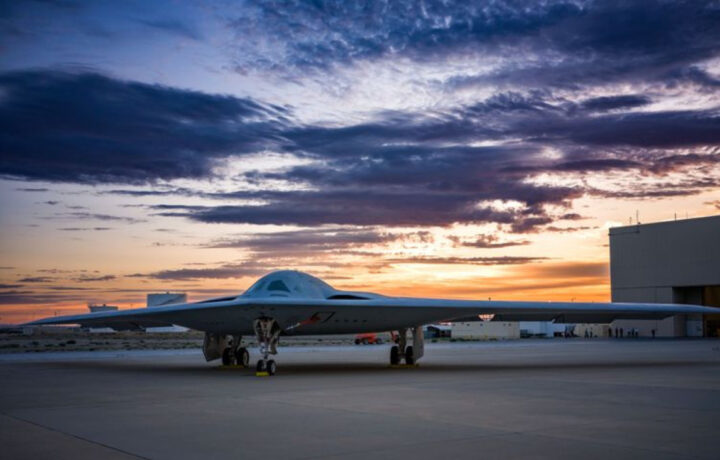
The United States Air Force conducted an aerial refueling of a Northrop Grumman B-21 Raider long-range strategic bomber, part of the flight testing for the future backbone of the service’s bomber fleet. It highlighted the long-range strike capabilities of the B-21 Raider and demonstrated “the rapid maturation” of the aircraft.
Northrop Grumman, the B-21 Raider’s prime contractor, noted that the bomber will be able to “go anywhere” in the world and, by holding any target at risk, will serve to deter and defeat threats.
“Our teams are moving the B-21 Raider through testing at an unprecedented pace, continually proving its outstanding performance – including aerial refueling,” said Tom Jones, corporate vice president and president, Northrop Grumman Aeronautics Systems. “We’ve designed and built a reliable, adaptable aircraft that is vital to our warfighters’ missions, while operating with a sense of wartime urgency to accelerate production and deliver this capability.”
The Raider Requires Less Fuel
The United States Air Force operates a fleet of aerial tankers that ensures its combat aircraft can reach targets nearly anywhere on the globe. Still, the B-21 was developed to reduce dependence on aircraft such as the KC-135 Stratotanker.
“As the most fuel-efficient bomber ever built, the B-21 consumes a fraction of the fuel used by fourth- and fifth-generation aircraft. This reduces demand for theatre tanker logistics and provides operational commanders with greater flexibility in force packaging,” Northrop Grumman explained.
The B-21’s operational flexibility is also enhanced by the aircraft’s design, with the Air Force describing it as “the most fuel-efficient bomber ever built.” That will significantly reduce demand for theater tanker logistics and provide commanders with greater flexibility in force packaging.
“The B-21’s fuel efficiency is one of the core components of its lethality,” said Air Force Chief of Staff Gen. Ken Wilsbach. “This long-range strike bomber will reduce the demand on our tanker fleet and free up assets to support the joint force. This will provide a wider range of employment options and the deterrence our nation requires.”
Yet, the ability to refuel in flight remains fundamental to the B-21’s role in projecting power globally and reassuring allies and partners of the U.S. Air Force’s reach. The Raider can also provide combatant commanders with flexible options to deliver decisive effects anywhere in the world.
“For our bomber crews and the combatant commanders they support, this is about endurance and mission readiness,” added Gen. S.L. Davis, commander of Air Force Global Strike Command. “This capability ensures we can deliver penetrating long-range strike anywhere in the world, at any time. We are strengthening the capabilities of our bomber force and putting a highly effective and lethal weapon system into the hands of our warfighters.”
According to the U.S. Force, the B-21 aligns closely with the National Defense Strategy, enabling it to operate in a high-end threat environment, deliver a mix of conventional and nuclear munitions, and, in addition, serve as a visible and flexible component of the nuclear triad.
The Raider’s open systems architecture will also allow for rapid integration of future capabilities, ensuring the platform remains adaptable and dominant as the threat environment evolves.
Acquisition Mindset
The recent aerial fueling is part of the ongoing flight testing of B-21, with at least six prototypes produced. It was two years ago that the Raider entered low-rate initial production (LRIP), with the first five production lots producing 21 aircraft. That was by design and is meant to ensure the costs are managed accordingly. The Raider program is expected to include more than 100 bombers.
“The B-21 program is the leading edge of the acquisition mindset we are instilling across the force. Every test proves the success of empowering our leaders to deliver integrated capability from the start,” said Gen. Dale White, the Pentagon’s direct reporting portfolio manager for critical major weapon systems. “The program’s use of digital engineering and modern production processes is delivering a mature, highly capable system, giving us confidence as we continue to smartly scale our production capacity at the speed of relevance.”
Northrop Grumman developed the B-21 using its pioneering digital engineering practices and advanced manufacturing techniques together.
The B-21 Raider will continue testing and evaluation at Edwards Air Force Base (AFB), California, as part of a collaborative effort among the Air Force Test Center, the 412th Test Wing, and our industry partner, Northrop Grumman. The testing is meant to reduce risk and mature the B-21 weapon system, moving it closer to operational service. As the B-21 Raider enters service, it will replace the U.S. Air Force’s fleet of aging Rockwell B-1B Lancer and Northrop B-2 Spirit bombers.


