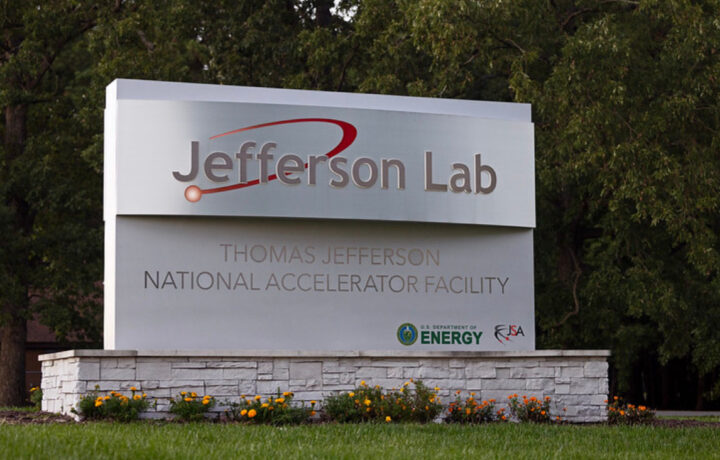
The United States Department of Energy (DOE) announced last month that it had selected Virginia Tech and the Southeastern Universities Research Association (SURA) to manage and operate the Thomas Jefferson National Accelerator Facility (TJNAF or Jefferson Lab) in Newport News. SURATech will assume operations of the facility, one of the country’s leading nuclear physics research laboratories, on June 1.
The initial base-term contract is for five years, running through May 31, 2031, and it offers an award-term incentive “for exemplary performance,” which could see the DOE extend the contract for up to 15 years beyond the base term.
The mission of the Federally Funded Research and Development Center (FFRDC) isn’t likely to change; instead, it will evolve from a single-purpose laboratory to a multi-purpose National Laboratory over the coming years.
A Sure Thing From SURATech
The SURATech, LLC team is comprised of two team member entities, which include Southeastern Universities Research Association, Inc., and Virginia Polytechnic Institute and State University, and four major subcontractors: Honeywell International, Inc., Longenecker and Associates, Inc., Akima Support Operations, and AtkinsRéalis.
Jefferson Lab will see the advancement of SC’s Advanced Scientific Computing Research (ASCR) High Performance Data Facility (HPDF) project.
“Virginia Tech is proud to partner in this effort to lead one of the nation’s premier research facilities,” said Virginia Tech President Tim Sands. “As part of SURATech, we’re ready to support Jefferson Lab’s mission and push the boundaries of discovery in ways that benefit the commonwealth, nation, and world.”
This marks the first time that a university has partnered with an organization to manage Jefferson Lab.
“We are excited for Virginia Tech to bring its expertise in science, engineering, and computation to a premier national facility located right here in Virginia,” said Dan Sui, the university’s senior vice president for research and innovation. “We are proud to join a distinguished group of universities entrusted with the management and operations responsibilities for our national laboratories, including Princeton, Stanford, the University of Chicago, and the University of California system.”
Lab Partners
The facility, which employs around 840 people and sits on a 169-acre federal government-owned site, currently operates with an annual budget of approximately $238 million. In addition to its permanent staff, more than 1,300 scientists and students from across the United States and the world conduct research via Jefferson Lab.
The lab is focused on the construction and operation of world-leading accelerator and detector facilities and on leading the development of the underlying technology for nuclear physics research. That included the study of the structure of protons and neutrons, the role of gluons, and the nature of the strong force.
According to the DOE, its primary mission “is to deliver breakthrough science and technology in nuclear physics; accelerator science and technology; and large-scale user facilities/advanced instrumentation.”
It operates the Continuous Electron Beam Accelerator Facility (CEBAF), which studies the atomic nucleus, focusing on protons, neutrons, and quarks to understand the fundamental structure of matter.
Beyond basic physics, the lab develops technologies in superconducting radio frequency, cryogenics, and computing, resulting in over 180 patents for applications in medicine, homeland security, and industry.
New Management Group
The DOE and the lab confirmed that it will continue to be led by Lab Director Jens Dilling, who will provide continuity of scientific leadership and deep institutional knowledge.
Johnathon Huff will remain the deputy laboratory director for operations, leading science and operations with state-of-the-art systems, processes, and tools to ensure operational excellence and mission delivery; and Eric Brown will serve as deputy laboratory director for science and technology, with a focus on ensuring excellence in science and optimization of scientific facilities.
“Jefferson Lab’s greatest strength has always been its people, and that does not change,” said Dilling. “What this contract represents is DoE’s confidence in our scientific excellence, our operational performance, and our potential as a multi-purpose national laboratory. As we continue our evolution, our commitment remains unwavering: to deliver groundbreaking science, focused on nuclear physics using advanced computing and particle accelerators, and exceptional operations in service of the DOE and the nation. We are not starting over; we are building forward.”


