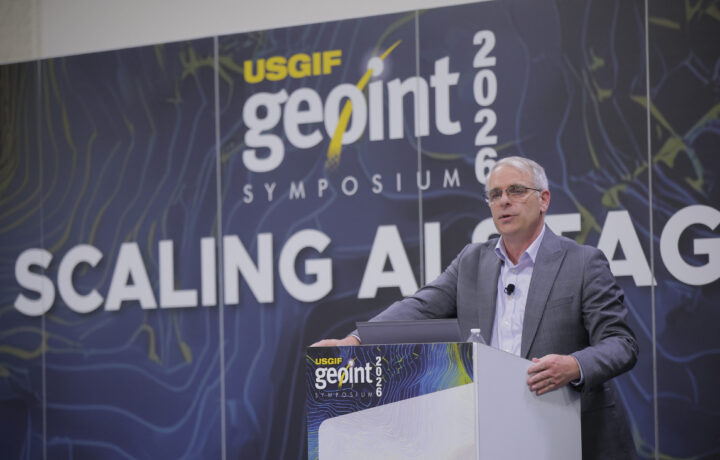
If there’s one thing the national security workforce is learning in real time, it’s this: the old timelines don’t work anymore. At GEOINT 2026, hosted by the United States Geospatial Intelligence Foundation, Brett Scott, Director of GEOINT at the National Reconnaissance Office, offered a clear-eyed look at how the mission is evolving—and what that means for government, industry, and the workforce supporting it.
His message wasn’t about incremental change. It was about a fundamental shift in how intelligence is built, delivered, and improved. And it starts with one uncomfortable idea: we have to get comfortable failing—just not catastrophically.
From Film Canisters to 10-Second Decisions
Scott walked through the evolution of GEOINT in a way that makes today’s expectations feel almost unreal.
Decades ago, intelligence collection meant:
- Capturing imagery on film
- Dropping canisters from space
- Waiting days—or even weeks—for processing and analysis
Today, the expectation isn’t minutes. It’s seconds. The mission is moving toward timelines where intelligence must be delivered in as little as 10 seconds to support tactical operations.
That’s not just a technology challenge. It’s a systems, workforce, and acquisition challenge all at once.
The Real Shift: From Images to Information
One of the most important ideas Scott emphasized is a shift that’s already underway—but not fully realized. Historically, GEOINT has been about moving imagery. Now, it’s about extracting and delivering just the information that matters.
Instead of pushing massive volumes of imagery across networks, the goal is to:
- Pull key detections from the image
- Attach confidence levels and context
- Deliver only what the operator needs to act
That shift does two critical things:
- Speeds up delivery
- Makes sharing easier
By separating insight from the source imagery, intelligence can often be shared at lower classification levels—making it more usable across coalition partners and even downrange operators. And that’s where this becomes a workforce issue, not just a tech one.
Machines for Machines, Humans for the “Why”
Another theme that stood out: the role of automation. Scott didn’t frame AI as a future concept. He framed it as a necessity. The volume of data is already too large for human-only workflows. And when timelines shrink to seconds, there’s no room for manual processes in the middle.
The model he described is simple but significant:
- Machines handle the “what” (detection, tracking, processing)
- Humans focus on the “why” (analysis, context, decision-making)
That’s a major shift for the GEOINT workforce. It means reskilling isn’t optional. And it means the workforce of the future will need to understand AI—not just use it.
No Single System Will Solve This
If there’s a temptation to look for a single breakthrough system or platform to solve these challenges, Scott pushed back on that idea directly. No one satellite, no one system, no one discipline will solve the problem.
Instead, the future is about integration across everything:
- Multiple orbital layers
- Diverse sensor types (EO, radar, infrared, and more)
- Commercial and government systems
- Intelligence from across disciplines
This is where cross-coordination becomes mission-critical. And it’s also where industry plays a bigger role than ever before.
A Bigger Door for Industry—and Smaller Companies
One of the more practical takeaways for your audience: the barrier to entry is changing.
Lower launch costs and smaller satellite architectures mean:
- More companies can participate
- More experimentation is possible
- New ideas can get on orbit faster
This isn’t just about traditional primes anymore. It’s about tapping into a broader ecosystem of innovation. Scott shared, “We can experiment more… decide what works, and then roll that into the operational constellation.”
For contractors and companies trying to break into the space, that’s a meaningful shift. But it comes with expectations.
Industry’s Role Isn’t Just Tech—It’s Culture Change
Scott made it clear that NRO doesn’t just need new technology from industry. It needs help changing how it thinks about risk. For decades, government acquisition—especially in space—has been built around risk avoidance. Failure wasn’t an option. But in today’s environment, that mindset creates a different kind of risk: moving too slowly.
Scott pointed out that “If you fail faster and in measurable ways, you end up solving issues faster and better.”
This isn’t about reckless development. It’s about managed risk.
- Avoid catastrophic failure
- Accept smaller, recoverable failures
- Learn quickly and iterate
And this is where industry—especially more agile companies—can push the government forward. Scott even called it out directly: Industry should help identify where government processes are overly risk-averse—and push for change.
That’s not something you hear every day from inside the government. He shared, “An 80% solution delivered on time is better than a perfect solution delivered too late.”
For a workforce used to long timelines and rigid requirements, that’s a significant mindset shift.
What This Means for the National Security Workforce
For cleared professionals, contractors, and anyone working in this space, the implications are real:
- Adaptability matters more than ever
- Understanding AI is becoming foundational
- Speed is now part of mission success—not just accuracy
- Collaboration across government and industry is no longer optional
And maybe most importantly: Being part of the mission doesn’t just mean delivering a product. It means helping shape how the mission gets done.


