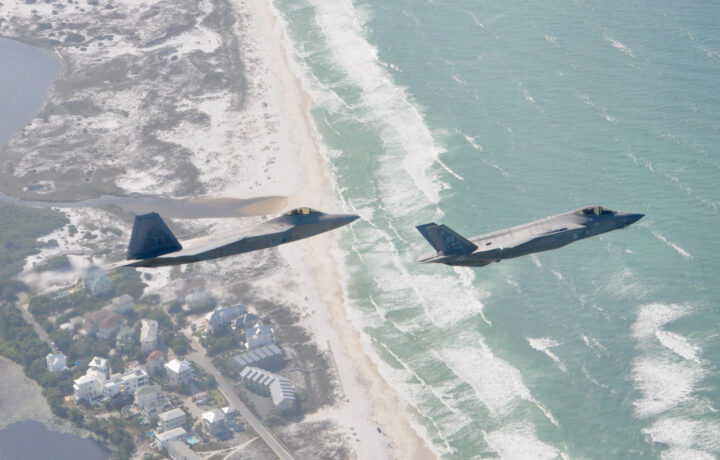
It is a term often seen in media reports about the Lockheed Martin F-35 Lightning II, but also the Russian Sukhoi Su-57 (NATO reporting name “Felon”) and even China’s Chengdu J-20 Mighty Dragon – namely that these aircraft are “fifth-generation.” But what exactly does that mean? What are the different generations, and what will the sixth generation have to offer?
Simply put, “fifth-generation” began as a strategic marketing and market-differentiation tool by Lockheed Martin. In a September 2005 press release, the aerospace firm specifically labeled the F-22 Raptor as the world’s only “fifth-generation fighter” as it prepared for Initial Operational Capability (IOC). It may be hard to believe now, as terms like fourth-generation, fourth-generation plus (4+ or 4.5), and even fourth-generation plus, plus (4++) have become so ubiquitous.
However, aircraft such as the Dassault Rafale, the Eurofighter Typhoon, the Boeing F/A-18 Super Hornet, and others were never designated as “fourth-generation” until the F-22 was deemed a fifth-generation aircraft.
Still, Lockheed Martin heavily promoted its F-22 Raptor and F-35 Lightning II as being a generation ahead of other aircraft in service.
What Are the Generations?
Because the generation classifications are retroactive, there is some disagreement about where certain aircraft should be classified. But generally speaking, the first generation included jet aircraft produced from the mid-1940s into the early 1950s.
These were essentially propeller-era airframes that were retrofitted with jet engines. These early jets featured straight wings and largely relied on machine guns and unguided munitions for combat. The Lockheed P-80 Shooting Star and the Soviet Mikoyan-Gurevich MiG-15 are considered first-generation jets.
The second generation of the 1950s to early 1960s, which included such noteworthy aircraft as the North American F-100 Super Sabre and the Mikoyan-Gurevich MiG-21, featured swept wings. These area-rule fuselage designs enabled supersonic speeds, onboard radars, and early infrared-guided air-to-air missiles.
The third generation highlighted the maturation of early jet technology, with the aircraft being true multirole fighters, equipped with pulse-Doppler radars and capable of engaging targets beyond visual range (BVR). The McDonnell Douglas F-4 Phantom II and Mikoyan-Gurevich MiG-23 are among the best of the generation of aircraft built from the early 1960s to the early 1970s.
That led to the fourth generation of aircraft developed from the 1970s to the 1980s, which saw the introduction of digital avionics, fly-by-wire flight control systems, and notably look-down/shoot-down radar capabilities. The “teen” series of U.S. jet fighters that included the Grumman F-14 Tomcat, the McDonnell Douglas F-15 Eagle, and the General Dynamics F-16 Fighting Falcon are examples of fourth-generation fighters. The F-15 and F-16 aircraft have subsequently been updated, improving their capabilities and thus falling into the fourth-generation-plus category.
The Soviet Union countered with its Sukhoi Su-27 (NATO reporting name “Flanker”), an aircraft that served as the basis for other Soviet/Russian designs, including the Su-27M, Su-35, Su-30, Su-33, and the Su-34. The Chinese also produced versions of the Su-27 and Su-30 as the J-11 and J-16.
Enter the Fifth-Generation
Today’s fifth-generation fighters are considered the most advanced class of jet aircraft currently in widespread military service. It features a combination of low-observable stealth, advanced integrated avionics, sensor fusion, and high-performance airframes.
The sensor fusion consists of advanced onboard computers that can utilize data from multiple radar, optical,, and electronic warfare systems and fuse it into a single, cohesive picture for the pilot. Fifth-generation aircraft are also connected to a broader battlespace that enables seamless sharing of intelligence with other aircraft, ships, and even ground personnel. Supercruise is another feature seen with some, but not all, fifth-generation fighters, allowing the warplane to sustain supersonic flight without an afterburner.
The U.S. Air Force remains the sole operator of the F-22 Raptor air superiority fighter. It was developed in the 1980s, and the service originally planned to acquire as many as 750 of the aircraft. Still, after the end of the Cold War and the dissolution of the Soviet Union, the number was reduced to just under 20, including eight test and development aircraft. Due to the high costs and a changing need when the U.S. became embroiled in the Global War on Terror (GWoT), priorities shifted to the F-35 Lightning II, a multirole fighter produced in three variants.
That has included the F-35A, the conventional takeoff and landing (CTOL) model; the F-35B, a short takeoff and vertical landing (STOVL) version that can operate from short runways as well as from specific aircraft carriers or amphibious assault ships; and the F-35C, a carrier-capable version employed by the U.S. Navy.
More than 1,100 F-35s across all variants have been produced for the United States military, its allies, and partners. The Lightning II is now in service with more than a dozen nations worldwide, and production is likely to continue well into the 2030s, making it the most successful fifth-generation fighters and one of the most widely adopted post-World War II combat aircraft.
By comparison, it is believed that fewer than three dozen Su-57s have been produced, and Russia continues to seek foreign buyers, with only Algeria adopting the export model. However, China has been making great strides, developing the J-20 Mighty Dragon and the Shenyang J-35 Cloud Dragon. The latter aircraft is the first fifth-generation fighter in the world to have been launched from an aircraft carrier equipped with electromagnetic catapults.
What Will the Sixth Generation Bring?
Multiple sixth-generation programs are underway, with these “systems of systems” including a manned or optionally manned fighter, supported by unmanned systems acting as loyal wingmen. The aircraft will be further based on advanced stealth, with airframes fitted with “smart skins” of sensors and adaptive-cycle engines that provide high thrust for combat and high efficiency for long-range cruising. The sixth-generation will also offer advanced sensor fusion, enhanced networks, and optional manning, with AI assisting the pilots in navigating a complex battlespace.
Current sixth-generation programs include the United States Air Force’s Next Generation Air Dominance (NGAD) program and the Collaborative Combat Aircraft (CCA).
Boeing was awarded a contract last year to build the future F-47 sixth-generation manned fighter, and the first CCA program is now underway with Anduril and General Atomics Aeronautical Systems now conducting flight testing of their respective unmanned aerial systems (UAS).
Later this year, the U.S. Navy is expected to announce a contract award to either Boeing or Northrop Grumman for its F/A-XX program, which will develop an aircraft to replace the F/A-18E/F Super Hornet.
In Europe, there are now two competing sixth-generation programs: the British-led Global Combat Air Program (GCAP), with Italy and Japan as partners, and the Franco-German-Spanish Future Combat Air System (FCAS). However, the latter program has faced turbulence over issues of work and technology sharing. That has led to speculation that Germany could abandon the FCAS and join the GCAP.
China and Russia are also reported to be developing sixth-generation fighters.
The first such aircraft is expected to take flight in the early 2030s.


