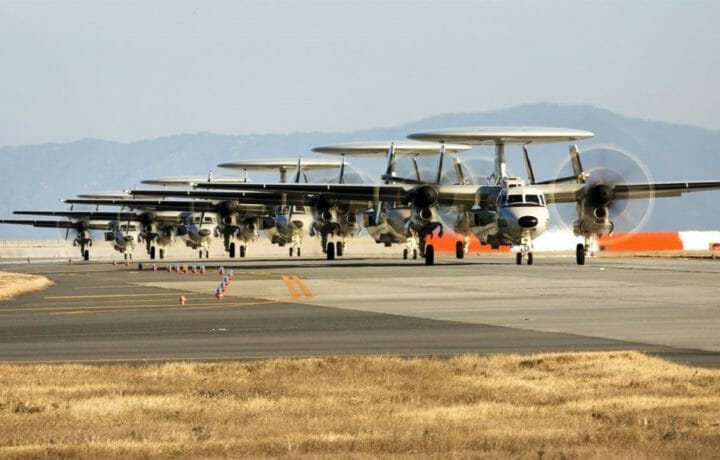
Worldwide, many military air bases share runways with civilian airports. Known as “joint-use” or “shared-use” airports, this practice primarily saves money, maximizes land use, and lets communities share expensive infrastructure. That can also include radar systems and air traffic control towers.
Building a major runway requires thousands of acres and billions of dollars, so sharing an existing field reduces costs for local governments and the military. In such cases, the runways employ the same heavy-duty paving, high-intensity lighting, and sophisticated navigation aids.
In addition, fire departments, snow-removal fleets, and weather-tracking tools serve both civilian and military operations.
The practice of using shared runways or full airfields began during World War II, when the federal government required and then built massive dual-purpose airfields that later split into civilian and military roles.
The largest joint-use airfield in the United States is Hickam Field, located at Joint Base Pearl Harbor-Hickam, Hawaii. It supports operations for the United States Air Force, the Hawaii Air National Guard, and global allied transient aircraft. It operates in tandem with the civilian Honolulu International Airport sector, sharing adjacent airspace and coordination.
Several Dedicated Military Air Bases Getting Upgrades
A major benefit of shared-use airports is that the Pentagon can split the costs for building and upgrading the runways. However, many bases still bear that burden alone.
This week, aviation news site Simple Flying reported that at least five U.S. military bases are set to receive major runway improvements, partly to accommodate more advanced aircraft and partly because, like much of the country’s civilian infrastructure, they have been ignored for too long.
Selfridge Air National Guard Base, Michigan
Located north of Detroit in Harrison Township, Michigan, Selfridge Air National Guard Base (ANGB) is undergoing a more than $1 billion modernization program that includes a $152 million state-funded initiative paired with a nearly $800 million in federal investment to shift and upgrade the main runway, clearing the way for the Boeing-made F-15EX Eagle II air superiority fighters, and Boeing KC-46A refueling aircraft by 2028.
The primary modification will shift the runway 1,000 feet north to resolve historical southern encroachment and safety issues tied to nearby residential neighborhoods built decades ago.
This week, officials also reported that they will break ground on a highway relocation and reconstruction near the base to meet future mission requirements.
The base currently hosts the Fairchild Republic A-10 Thunderbolt II and the Boeing KC-135R Stratotanker.
Ellsworth Air Force Base, South Dakota
As previously reported, Ellsworth AFB has been preparing for the arrival of the Northrop Grumman B-21 Raider for several years. Ellsworth AFB hosted the Rockwell B-1B Lancer nearly 40 years ago, in early 1987, and, along with Dyess AFB, Texas, remains the only base to operate Cold War long-range strategic bombers.
The South Dakota facility is on track to host the next-generation B-21 beginning sometime in 2028.
Last December, the 28th Bomb Wing celebrated the completion of a $129.5 million runway construction upgrade with a ribbon-cutting ceremony. According to Simple Flying, the 13,497-foot (4,113-meter) runway’s top 12 inches (30.48 cm) were replaced, with both runway overruns rebuilt. The renovations fully refurbished one taxiway and partially refurbished another. “The entire runway was fully rebuilt using 106,000 tons of concrete cement, 105 miles of joint sealing, and 83 miles of electrical conduit,” Simple Flying reported.
Originally slated to take three years, the project was completed in just 10 months due to operational needs.
“This is a significant milestone in the survivability of this airfield for at least the next 50 years,” said Col. Erick Lord, 28th Bomb Wing commander, during the December 3 ceremony. “It also gives Ellsworth the ability to receive and launch America’s first sixth-generation combat aircraft.”
The base, located near Rapid City, is already one of the largest employers in South Dakota. According to a 2017 estimate, it had an annual economic impact of over $350 million. However, it nearly shut down, and in 2005, it was briefly on the Pentagon’s list of military bases to be closed or relocated. In March 2019, it was selected as the preferred base to host the first Raider bomber unit and the first formal training unit.
Tyndall Air Force Base, Florida
Although some runways and other facilities at military bases were rebuilt due to age, that wasn’t exactly the case at Tyndall AFB in Florida. Hurricane Michael largely destroyed the base and required a multi-billion-dollar overhaul, including flight line and infrastructure reconstruction, after it struck the installation as a catastrophic Category 5 storm on October 10, 2018, leveling nearly all its facilities and ruining local infrastructure.
Rather than patching the wreckage, the U.S. Air Force used the disaster to redesign the installation as a “Base of the Future.”
The runway, which is approximately 10,270 feet (3,130 meters), is being repaired, reportedly using “a milling and overlaying process, and the entire project is expected to cost $20.4 million.
The runway repairs were among 49 military construction projects, seven of which were completed by the end of 2024.
“The base from October 10, 2018, to today is night and day,” said Colleen Duffy, U.S. Air Force 325th Mission Support Group deputy director, in February 2025. “It’s amazing to see the base literally come out of the ground and rise from the damage of Hurricane Michael.”
The upgrades also included 120 new facilities and 260 facility sustainment, restoration, and modernization projects valued at $4.5 billion, undertaken by the Natural Disaster Recovery Division, now the Special Programs Division.
“As of May 2026, the SPD has turned over several vital facilities to support Tyndall’s mission, including the 325th Fighter Wing Headquarters, Emergency Operations Center, and an F-35 flight training simulator,” the base announced this spring. “To support the morale of Airmen and their families, SPD has also turned over the new marina, swimming pool, chapel and two community commons buildings, equipped with a bowling alley and library. Construction is still ongoing, and several projects are nearing completion.”
Grand Forks Air Force Base, North Dakota
For much of 2025, Ellsworth AFB’s B-1B fleet was relocated to Grand Forks AFB, North Dakota, but that facility is now also undergoing a renovation that began this spring.
Slated to take an estimated six months, it will include replacing the top four inches of existing asphalt through a mill-and-overlay process. This will replace 10,270 feet of the runway surface that was originally installed in 2005, the 319 Reconnaissance Wing confirmed.
“The runway is about ten years past the recommended period of renovation, and we are excited to see the hard work of our civil engineers, contracting personnel, and operations support personnel all come together,” said Lt. Col. Eugene Bently, commander for the 319th Civil Engineer Squadron. “This has been a highly anticipated project for years, with advocacy at multiple command levels and even within the Senate. Various key leaders may even have small chunks of our degraded runway sitting on their desk.”
The project required that the 319th RW relocate its RQ-4 Global Hawk Block 40 fleet to Robins AFB, Georgia, in early April of this year. With completion planned for September, the drone fleet will return to Grand Forks AFB.
This project improves power projection capabilities for not just the 319th RW mission, but also our mission partners at U.S. Customs and Border Protection, Grand Forks County’s GrandSKY, and will improve our support to the University of North Dakota’s pilot training program,” said Col. Alfred Rosales, commander for the 319th RW.
The Northrop Grumman RQ-4B has operated from the North Dakota base since 2011.
Moreover, as Simple Flying further explained, Grand Forks AFB hasn’t hosted manned aircraft since 2010, “when the USAF deactivated the base’s refueling unit which operated the Boeing KC-135.”
North Field, Mariana Islands
Unlike the other fields mentioned, this one was all the worse for wear because it was abandoned! A year ago, the United States Air Force announced it would restore two of the four runways at North Field on Tinian in the Mariana Islands chain.
North Field on Tinian was crucial to bringing World War II to a close. By 1945, it had become the world’s largest airport—largely thanks to its unique grid-like airfield design, which enabled faster, more frequent takeoffs and landings than conventional airports. It operated four 8,500-foot runways and had the infrastructure for more than 40,000 military personnel at a time. Among the aircraft that operated from the base were the Boeing B-28 bombers “Enola Gay” and “Bockscar,” which dropped the atomic bombs on Hiroshima and Nagasaki. Bombers operating from the base also conducted aerial mining of Japan’s sea lanes and naval harbors.
Those missions were both iconic and ironic, at least in the sense that North Field grew out of a far smaller Japanese airbase, with the U.S. facility built after Tinian was captured by the United States military in 1944.
Yet, just two years later, the last U.S. military planes flew out of the base, and for 80 years nature has done its best to reclaim the land.
Approximately $400 million is now being committed to clear some of the vegetation to make the runways usable again. The goal is to have a semi-permanent contingency location (SCL), a base designed and built to support a mission expected to last just a few years. A step above temporary contingency locations (TCLs), these facilities are designed to offer a flexible, adaptable base of operations without the need for complete infrastructure or permanent structures.
In essence, North Field could serve as a “fallback” if Andersen Air Force Base (AFB), Guam, becomes unusable in a future Pacific conflict with China. The U.S. military is also working to expand Tinian Airport, with work on the first phase of the project expected to be completed this fall.


