The United States Navy faces a battle it simply won’t easily win. It is in a unique quagmire of bad publicity, brought on by reports of missed deadlines, rising costs, and poor morale on one of its largest fighting ships. The Nimitz-class nuclear-powered supercarrier USS Abraham Lincoln (CVN-72) is now preparing to depart the Middle East after spending more than 250 days at sea without a port visit.
However, this week news broke that even as the crew of CVN-72 dealt with moldy showers and food shortages, it may have seemed like a true pleasure cruise compared with what another U.S. Navy warship faced thousands of miles away last week.
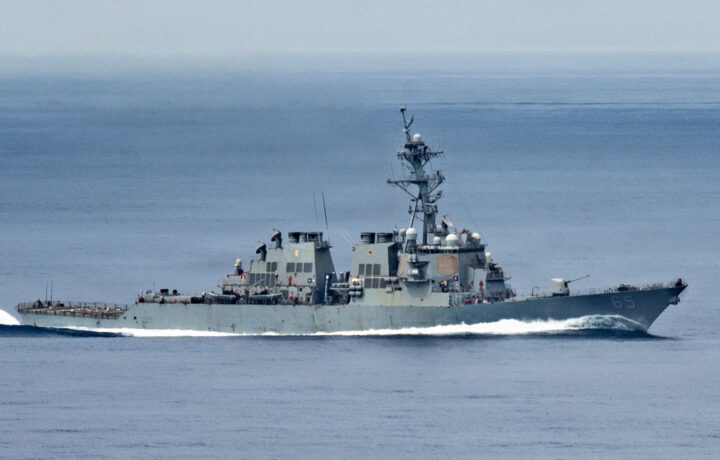
The Arleigh Burke-class multi-mission guided-missile destroyer USS Benfold (DDG-65) suffered a generator failure that left it exposed for days in the contested South China Sea, which China views as its sovereign waters.
The warship, a Flight I variant of the workhorse class of surface combatants and among the very first U.S. Navy ships to be fitted with the Aegis Ballistic Missile Defense System, was on a routine patrol in the Western Pacific with the George Washington Carrier Strike Group (CSG) when it suffered a power loss on July 24.
The power loss left the crew without access to drinking water, hot food, functioning toilets, and air conditioning for several days. USNI News first reported the incident last week.
The United States Navy was forced to tow the 9,000-ton destroyer, with more than 300 sailors aboard, to Subic Bay in the Philippines, where power was restored two days later, the U.S. 7th Fleet confirmed.
The U.S. Navy Ticonderoga-class guided-missile cruiser USS Robert Smalls (CG-62) assisted USS Benfold by providing meals to the crew of the stricken destroyer.
Upon arriving in Subic Bay, the crew was provided food and lodging off the ship while repairs were made by personnel from the Ship Repair Facility – Japan Regional Maintenance Center.
DDG-65 returned to active service on August 8. “With all engineering, combat systems, and crew support systems functioning normally,” the U.S. Navy confirmed in a statement.
Heading to the Middle East?
The USS George Washington (CVN-73), the United States Navy’s only forward-deployed aircraft carrier, and the rest of the CSG are now heading to the Middle East to relieve CVN-72 and have transited the Malacca Strait into the Indian Ocean this week. CVN-73 began its 2026 patrol in May, and it is expected to last around six months.
However, USS Benfold did not travel with the rest of the CSG; instead, it returned to Yokosuka, Japan. The U.S. Navy is investigating the cause of the engineering failure, USNI News also reported.
According to ship spotters who routinely track the movements of U.S. Navy warships, the guided-missile destroyer departed Yokosuka on Monday, the headquarters of the U.S. 7th Fleet and the largest overseas U.S. naval installation in the world.
It is unclear if USS Benfold will rejoin the George Washington CSG.
DDG-65 is named in honor of Hospital Corpsman Third Class Edward Clyde Benfold of the 1st Marine Division, who received the Medal of Honor for his brave actions that resulted in his death during the Korean War.
Power Losses Are Rare, But Do Happen
It is extremely uncommon for a U.S. Navy warship to suffer even a partial power and propulsion loss, but such incidents have occurred.
Another Arleigh Burke-class guided-missile destroyer, the USS John S. McCain (DDG-56), suffered severe compartment flooding and localized power/machinery disruptions following its August 21, 2017 collision with the chemical tanker Alnic MC near the Strait of Malacca. The collision flooded auxiliary machinery and communication rooms.


