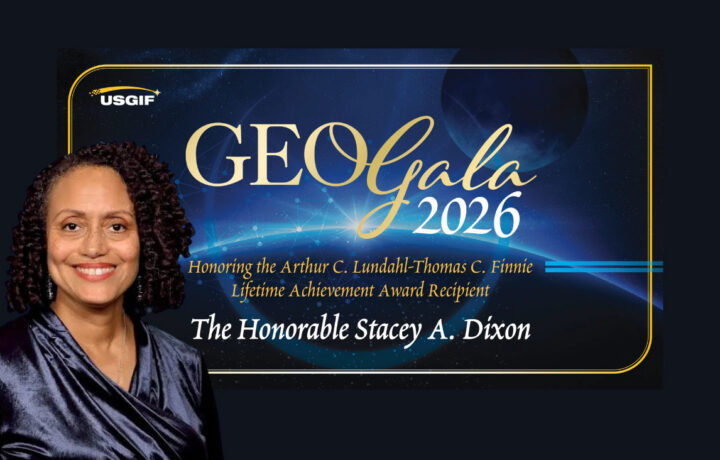
In her first weeks in the intelligence community, Dr. Stacey Dixon described herself as an engineer. A colleague corrected her: she was an intelligence officer. That shift stayed with her from her first role at the NRO through leadership roles at IARPA, NGA and ODNI.
Dixon joined me in conversation ahead of USGIF’s GEOGala, where she is receiving the 2026 Arthur C. Lundahl-Thomas C. Finnie Lifetime Achievement Award.
GEOINT’s integration gap
Commercial geospatial capabilities have grown dramatically, with small, innovative companies offering new solutions. But Dixon said government and funding cycles still favor “the shiny object,” meaning satellites and data, over the ground infrastructure that ties them together. As AI shortens decision timelines, she warned, collection and tasking could become the bottleneck.
Advice for future intel professionals
Her advice to anyone considering an IC career: do it. Government pay won’t match industry, but early-career roles offer hands-on mission experience and real decision-making. Agencies also increasingly hire mid-career and senior talent from industry, so you don’t have to pick one path for your whole career.
Two risks, one table
Dixon was closely involved in Trusted Workforce 2.0 and the move from the SF-86 to the Personnel Vetting Questionnaire. She called updating the policies “a necessary first step,” not the finish line. Her larger point is that security professionals are tasked with weighing only the risk of letting someone in. “There’s a risk of not having that kind of knowledge and experience in our community,” she said, referring to language skills and cultural understanding. Both risks, she argued, belong in the same conversation.
Not done yet
Dixon said she is proudest of the people and teams she helped succeed. Echoing Admiral Bob Sharp, she sees the award as a milestone, not a finish line. “This is not the end,” she said. “It is just the next step.”


