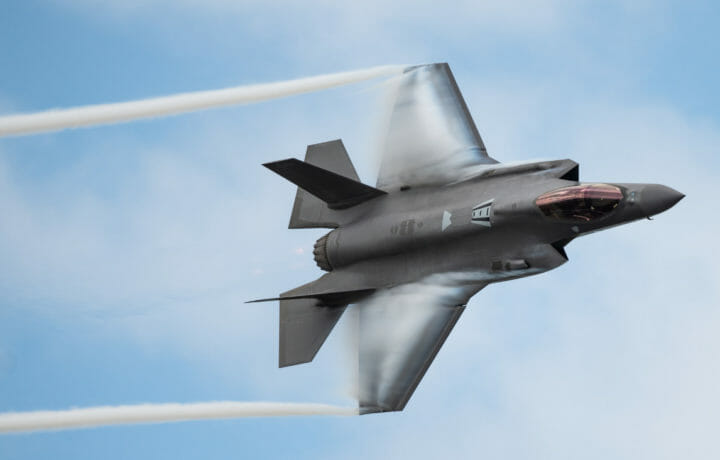
Even as upwards of 18 United States Air Force Lockheed Martin F-35A Lightning II fifth-generation multirole stealth aircraft are now deployed to bases in the Middle East and taking part in the ongoing Operation Epic Fury, other F-35s recently participated in exercises in the high north with NATO partners.
The U.S. Air Force confirmed that the conventional takeoff and landing (CTOL) F-35As from the 48th Fighter Wing, RAF Lakenheath, United Kingdom, were deployed to Ørland Air Force Station, Norway, and operated alongside Royal Norwegian Air Force F-35s assigned to the 123rd Luftving. The aircraft took part in the Cold Response 26 joint exercises.
The Norwegian-led multinational training event, designed to enhance collective defense, sharpen warfighting skills, and reinforce deterrence capabilities in the Arctic region, brought together more than 25,000 military and civilian personnel from over a dozen NATO nations, across all domains, operating from locations throughout Norway, Sweden, and Finland.
During Cold Response 26, U.S. Air Force forces successfully integrated with allies to execute high-intensity scenarios that tested interoperability and readiness in harsh Arctic conditions.
“During Cold Response, we are able to help strengthen the alliance by practicing and integrating with the other partners, from the mission planning to the actual execution at the squadron level,” said U.S. Air Force Lt. Col. Dustin Merritt, 493rd Fighter Squadron commander.
The F-35s operated alongside Finnish Air Force F/A-18 Hornets from the 211th Fighter Squadron, and Swedish Air Force JAS 39 Gripens from Karelia Air Wing.
Finland has committed to adopting the Lightning II, and its first F-35 arrived at Ebbing Air National Guard Base in Arkansas on January 20, 2026, for Finnish pilot and maintenance training. The initial eight aircraft are scheduled to arrive in Finland for operational use later in 2026, with full operational capability expected by 2030. Sweden, which operates the domestically produced Saab JAS 39 Gripen, is unlikely to adopt the F-35, but the SAF has participated in multiple joint exercises with the U.S. Air Force.
U.S. Aerial Refuelers Also Played a Role
The U.S. Air Force F-35s were supported by KC-135 Stratotankers assigned to the 100th Air Refueling Wing, based at RAF Mildenhall, United Kingdom, which provided aerial refueling support, extending the range and endurance of U.S. and allied aircraft.
“Air-to-air refueling is an inherently a dangerous job because you’re flying two or more airplanes very, very close together in proximity, so it takes a lot of preplanning, mission planning and coordination prior to, and good communication with our NATO allies and partners,” said U.S. Air Force Capt. Jeff Chae, KC-135 pilot, with the 100th ARW. “Overall, I think the exercise really helps us to practice what we play and strengthens the NATO alliance, making us a more cohesive and capable force.”
The aerial refueling mission was further supported by HC-130J Combat King II aircraft assigned to the 23rd Wing, stationed at Moody Air Force Base, GA. The aircraft conducted in-air refueling with Swedish Air Force JAS 39 Gripens, expanding the reach and flexibility of multinational combat air operations.
Beyond serving as flying fuel stations, the HC-130J also participated in combat search and rescue missions alongside Airmen assigned to the 56th and 57th Rescue Squadrons at Aviano Air Base, Italy.
“From Bardufoss Air Station, these units trained with Swedish Air Force Rangers to execute personnel recovery operations in austere Arctic conditions,” the Air Force announced. “Using HH-60W Jolly Green IIs from the 56th RQS, the integrated team conducted hoist, rappelling and simulated recovery missions, strengthening their ability to locate, treat and extract isolated personnel.”
Cold Warfare Training
The exercise was part of NATO’s increased focus on the High North. It involved aircraft maintainers from across all participating units, ensuring aircraft survivability and mission readiness despite extreme Arctic conditions.
“Working in freezing temperatures, high winds, rain and snow, they kept aircraft mission-capable across the Arctic, enabling aircrews and rescue crews the ability to execute complex missions,” the Air Force added.
In addition to the U.S. Air Force personnel, U.S. Marines from the 2nd Marine Division, U.S. Navy P-8 Poseidon maritime patrol and reconnaissance aircraft, and U.S. Army units also took part in this year’s Cold Response drills.
The exercises further supported NATO’s ongoing Arctic Sentry, a multi-domain enhanced vigilance activity designed to strengthen security in the high north.
“By exercising in Cold Response, the ability to execute missions rapidly and flexibly is one of the byproducts of this,” Merritt continued. “It sends a message that we’re ready as part of NATO to deter and defend whatever we need to when the time arises.”


