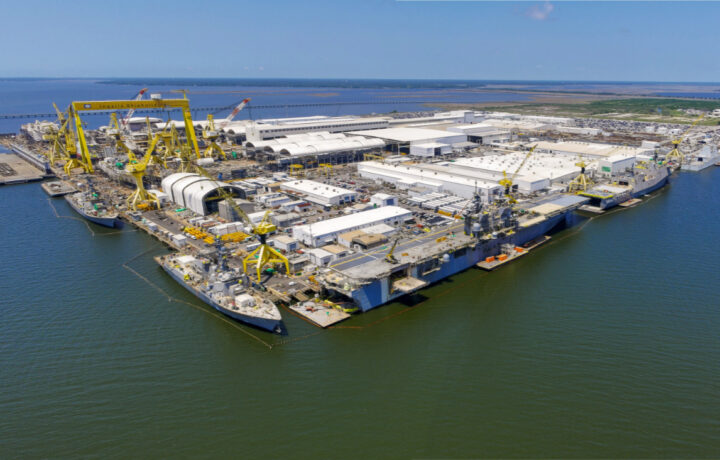
The U.S. Navy announced that HII’s Ingalls Shipbuilding division was awarded a $283 million contract to support the FF(X) class frigate lead yard support activities. This initial contract will allow the Pascagoula, Miss., shipyard to procure long lead-time material, execute design work, and begin pre-construction activities for the first ship of the class.
“We are proud of our past performance in engineering, design, and production of warships that meet U.S. military standards, a performance that gave the Navy confidence to select the national security cutter as the basis for the next small surface combatant and to choose Ingalls as the program’s lead yard,” said Brian Blanchette, Ingalls Shipbuilding president. “We are excited to partner with the Navy to bring these preproduction steps under contract to accelerate delivery of the frigates that our warfighters need.”
Change of Course For the U.S. Navy
It was just last November that the United States Navy abruptly canceled the Constellation-class frigate program, citing repeated cost overruns and delays. However, the service also confirmed that it accepts delivery of the two vessels currently under construction at Fincantieri Marine Group’s (FMG’s) Wisconsin shipyards.
Several factors came into play, including the U.S. Navy’s effort to build a new class of frigates based on the Franco-Italian-designed Frégate Européenne Multi-Mission/Fregata Europea Multi-Missione (FREMM). The multi-purpose frigates are already in service with the navies of France and Italy, designated as the Aquitaine class and Bergamini class, respectively.
It should have been a simple transition, but the program ran behind schedule as the service sought to incorporate significant design changes. That led to the warships being up to 13% heavier than the base FREMM variants, which in turn negatively affected the frigates’ top speeds. The modifications also affected what systems could be outfitted on the vessels.
The issue was so great that the Government Accountability Office (GAO) warned last year, “As a result of these changes, in part, the frigate now bears little resemblance to the parent design that the Navy touted as a built-in, risk reduction measure for the program in 2020.”
It added, “The ongoing redesign has driven weight growth at levels that exceed available tolerances. Already the Navy is considering a reduction in the frigate’s speed requirement as one potential way, among others, to resolve this weight growth.”
A Frigate Do Over
The U.S. Navy isn’t giving up on the frigates, which remain crucial as the service seeks to expand its fleet size cost-effectively. The smaller, multi-mission surface combatants can provide specialized capabilities, serving in anti-submarine warfare (ASW) and air defense roles. Such warships could be less expensive to build than the larger Arleigh Burke-class destroyers that have become the workhorses of the U.S. Navy.
After canceling the Constellation-class, the U.S. Navy announced it would launch the new FF(X) frigate program, which is based on the United States Coast Guard’s Legend-class National Security Cutter (NSC). At 418 feet in length, the NCS is the largest and most sophisticated cutter in the Coast Guard fleet. Ingalls previously delivered 10 of the vessels and announced that it would employ the same proven build sequence for the U.S. Navy frigates.
“Under this contract, Ingalls Shipbuilding will begin cutting and shaping raw material to support future phases of work on the main structure foundation and the overall construction sequencing plan of the first frigate. This new approach will enable a smooth transition from design to production at Ingalls Shipbuilding and eventually across the industrial base,” HII explained.
The company added that FF(X) frigates will be constructed alongside the production line that currently supports the Arleigh Burke-class DDG-61 Flight III destroyers, the America-class LHA assault ships, the San Antonio-class LPD Flight II amphibious transport docks, and the modernization program for the Zumwalt-class guided-missile stealth destroyers.
To support these efforts, including the FF(X) program, Ingalls Shipbuilding has invested more than $1 billion to modernize its infrastructure, facilities, and toolsets.


