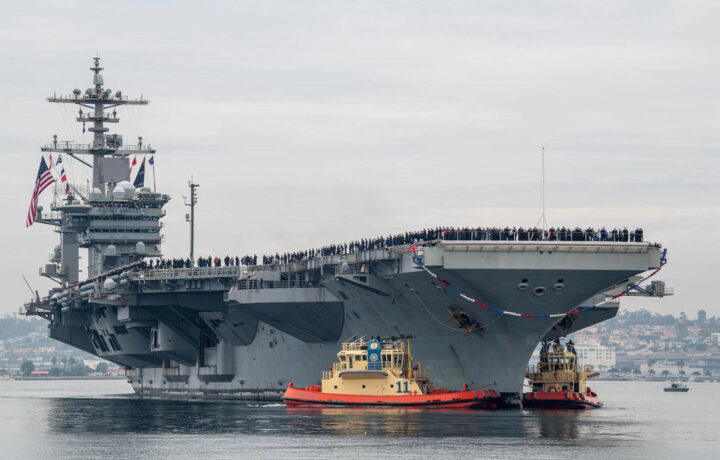
Last Thursday, the United States Navy’s Nimitz-class nuclear-powered aircraft carrier, the USS Abraham Lincoln (CVN-72), returned to its homeport of Naval Base San Diego, Calif. The warship, which looked a bit worse for wear with rust on the hull, had been deployed for 321 days since November 21, 2025.
It was the second-longest deployment of a U.S. Navy aircraft carrier since the Vietnam War, and the second-longest for a nuclear-powered flattop. Much of the time was at sea, with CVN-72 spending more than 250 days deployed without a port visit.
Only the USS Gerald R. Ford (CVN-78), which spent 326 days, or roughly 11 months, deployed from Naval Station Norfolk, Va., from June 24, 2025, to May 16, 2026, was longer. It was hardly a pleasure cruise, as the warship suffered a significant fire in a laundry room that took a reported 36 hours to contain. The fire affected the crew’s berthing areas.
Both supercarriers supported Operation Epic Fury, launching aircraft sorties against Iran during the record-long deployments. Such long missions could be the new normal.
The USS George H.W. Bush (CVN-77), the tenth and final Nimitz-class supercarrier, also began its 2026 deployment on March 31, 2026, and is nearing 200 days at sea. To address the issue, CVN-77 did make a port call in Thailand last week to give the crew a respite from being on station in the Arabian Sea and the U.S. 5th Fleet area of operations to support the U.S. Navy’s ongoing blockade of Iran. The USS George H.W. Bush arrived in Phuket, Thailand, on October 4, 2026, for a scheduled rest-and-recreation port visit after an unannounced departure from the Middle East. It is unclear how long CVN-77 could remain in the region, but it likely could stretch beyond 300 days.
At issue is that the United States Navy currently operates just 11 supercarriers, all nuclear-powered. That may provide unlimited range and endurance, but such carriers are slow to build and require significant maintenance periods. All ten Nimitz-class aircraft carriers also require midlife refueling and complex overhauls (RCOH), a process that stretches for years and sidelines one of the U.S. Navy’s most valuable assets.
Currently, one carrier – the USS John C. Stennis (CVN-74) – is completing its RCOH at HII’s Newport News Shipbuilding, with the USS Harry S. Truman (CVN-75) arriving at the same facility on September 30.
There Were Even Longer Deployments
During the Vietnam War, notably in the 1960s and early 1970s, there were several occasions where the U.S. Navy’s aircraft carriers spent 300 days or longer at sea.
The conventionally powered USS Midway (CVA-41), the lead vessel of a class of aircraft carriers built at the end of World War II and the first U.S. Navy aircraft carrier too big to transit the Panama Canal, still holds the record for the longest deployment of an American aircraft carrier.
CVA-41 was deployed for 332 days in 1972 and 1973 during the Vietnam War, six days longer than CVN-78 this year. Although much of the time was spent supporting combat operations, it did make routine stops at Subic Bay, Philippines, for resupply, maintenance, and crew rest. The USS Midway made additional port visits to Hong Kong and Singapore. It stopped briefly at Pearl Harbor, Hawaii, in February 1973, to offload ammunition and take on fuel before heading back to the U.S. mainland.
According to the U.S. Navy/USNI News carrier database, crews of several other carriers endured long deployments. That included the U.S. Navy’s Midway-class USS Franklin D. Roosevelt (CVA-42), which spent 300 days at sea in 1972; the 308-day deployment in 1972-73 involving the Forrestal-class supercarrier USS Saratoga (CVA-60); and the deployment of Midwayclass flattop USS Coral Sea (CVA-43), which reached 329 days in 1964-65.


