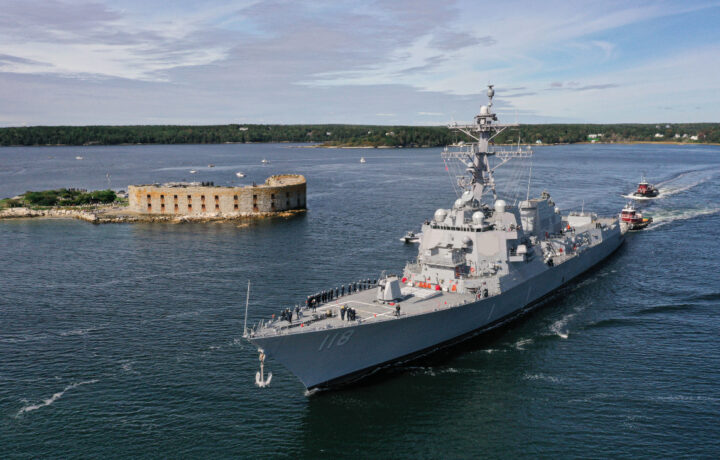
Today, nine major American shipyards serve as the backbone of American naval defense and undertake large-scale maritime construction. These include four public, government-owned shipyards and five Tier-1 private shipyards.
Together, these nine facilities build, maintain, and overhaul all U.S. Navy nuclear submarines, aircraft carriers, destroyers, and major auxiliary vessels.
Four Public Naval Shipyards
The U.S. Navy’s public shipyards are now positioned strategically on both the East and West Coasts, as well as Hawaii. The yards provide regional support to the active-duty fleet without requiring ships to transit to distant facilities or private builders. These facilities include:
Norfolk Naval Shipyard (NNSY)
Portsmouth, Virginia
This is the oldest and largest of the United States Navy’s industrial facilities. Located in Portsmouth, Virginia, across the river from Norfolk in the Hampton Roads region, it was founded in 1767 as the Gosport Shipyard under British rule, making it the oldest continuously operated naval shipyard in the United States.
It even predates the U.S. Navy Department by 31 years.
NNSY can repair, overhaul, modernize, and inactivate U.S. Navy warships and submarines, with a heavy focus on nuclear-powered vessels and aircraft carriers. It employs thousands of military and civilian personnel, and is supported by a long-running Apprentice Program that provides technical and craft training.
Portsmouth Naval Shipyard (PNSY)
Kittery, Maine
This U.S. Navy shipyard focuses primarily on overhauling, repairing, and modernizing the Navy’s nuclear-powered attack submarine fleet, specifically the Los Angeles-class and Virginia-class fast attack submarines. Founded in 1800, it is the second oldest continuously operating naval shipyard in the United States. It is located on the Piscataqua River about an hour north of Boston, Massachusetts. It is staffed predominantly by a skilled federal civilian workforce rather than active-duty military personnel, with approximately 8,000 civilian workers and about 1,000 military personnel.
Puget Sound Naval Shipyard (PSNS & IMF)
Bremerton, Washington
The Puget Sound Naval Shipyard and Intermediate Maintenance Facility (PSNS & IMF) is the United States Navy’s largest Pacific Northwest shore facility and one of Washington state’s largest industrial installations. Founded in 1891 at Sinclair Inlet in Bremerton, Washington, and operating continuously since, it merged with the Naval Intermediate Maintenance Facility in 2003.
Today, it can drydock aircraft carriers and perform complex nuclear maintenance and inactivation. It is now undergoing a multi-billion-dollar expansion and modernization program under the U.S. Navy’s Shipyard Infrastructure Optimization Program (SIOP), which includes constructing a new, fully pressure-relieved multi-mission dry dock at PSNS & IMF.
Once completed, the facility will provide depot-level maintenance and servicing for both current Nimitz-class and new Gerald R. Ford-class nuclear-powered aircraft carriers, as well as submarines and other surface ships. Currently, the West Coast lacks a dry dock capable of servicing the new class of nuclear-powered supercarriers.
PSNS & IMF employs more than 14,000 people, most of whom are federal civilian employees, including marine engineers; specialized tradespeople such as welders, pipefitters, and electricians; administrative staff; and project managers.
Pearl Harbor Naval Shipyard (PHNSY & IMF)
Oahu, Hawaii
The Pearl Harbor Naval Shipyard is strategically located in the mid-Pacific, providing critical maintenance and mid-cycle repair support to submarines and surface fleets stationed in the Indo-Pacific region. It was authorized by Congress in May 1908 and established following earlier U.S. access agreements. The PHSY & IMF has played a critical role in salvaging and rebuilding the U.S. fleet after the December 7, 1941, attack and has supported every major conflict from World War II through the Cold War. It provides depot- and intermediate-level maintenance, repair, overhaul, and modernization for U.S. Navy surface ships and nuclear-powered fast-attack submarines, keeping the fleet “Fit to Fight,” and it is located about a week’s steaming time closer to Indo-Pacific operational areas than West Coast shipyards.
The shipyard includes historic and active concrete dry docks – including Dry Docks 1 through 4- with ongoing infrastructure expansion like Dry Dock 5 under the Navy’s Shipyard Infrastructure Optimization Program.
The facility serves as the largest industrial employer in the state of Hawaii, supporting a workforce of roughly 7,100 civilian, military, and contractor personnel.
Five Private “Tier-1” Shipyards
Today, five Tier-1 shipyards owned by major defense prime contractors can construct major frontline warships and nuclear vessels. These include:
HII’s Newport News Shipbuilding (NNS)
Newport News, Virginia
Newport News Shipbuilding (NNS) is a division of HII (Huntington Ingalls Industries) and the nation’s sole designer, builder, and refueler of nuclear-powered aircraft carriers for the U.S. Navy. Collis P. Huntington founded it on January 28, 1886.
Over its 140-year history, the shipyard has built, overhauled, and repaired more than 800 ships.
Located on 550 acres along the James River in Newport News, Virginia, NNS is the largest industrial employer in the Old Dominion State, with more than 26,000 employees.
General Dynamics Electric Boat
Groton, Connecticut
General Dynamics Electric Boat is the primary designer and builder of the U.S. Navy’s nuclear submarines, including the Virginia-class and the next-generation Columbia-class ballistic missile submarines.
Isaac Rice established it in 1899 to build the U.S. Navy’s first modern commissioned submarine, the USS Holland.
The shipyard employs more than 23,000 workers.
Ingalls Shipbuilding
Pascagoula, Mississippi
The massive shipyard spanning more than 800 acres on the Pascagoula River specializes in complex surface combatants, including Arleigh Burke-class guided-missile destroyers, amphibious assault ships, and U.S. Coast Guard National Security Cutters.
Ingalls Shipbuilding, a division of HII, was founded in 1938 by Robert Ingersoll Ingalls Sr. It revolutionized ship construction early on by welding steel plates end-to-end instead of riveting, and today the shipyard builds roughly 70% of the U.S. Navy’s surface fleet. It also employs more than 11,000 workers, making it Mississippi’s largest manufacturing employer.
Bath Iron Works (BIW)
Bath, Maine
Another historic shipyard, Bath Iron Works – a division of General Dynamics – is located on the Kennebec River in Bath, Maine. It is renowned for designing and constructing advanced surface combatants, including the U.S. Navy’s destroyers in the Arleigh Burke and Zumwalt classes.
Bath Iron Works was founded in 1884 by Thomas W. Hyde, but its roots trace back to an 1826 foundry. General Dynamics has owned it since 1995. Over more than 140 years of operation, it has delivered more than 430 ships, including World War II frigates, destroyers, and cruisers, as well as commercial and private vessels.
BIW is one of Maine’s largest private employers, providing jobs for over 6,900 workers across the state, specializing in trades like welding, shipfitting, marine engineering, and electrical work.
National Steel and Shipbuilding Company (NASSCO)
San Diego, California
The National Steel and Shipbuilding Company (NASSCO) was founded in 1905 as California Iron Works in San Diego, California, and formally named NASSCO in 1957. Today, it is the largest and only full-service, new-construction shipyard on the U.S. West Coast. NASSCO, acquired by General Dynamics in 1998, specializes in designing and building auxiliary, logistics, and support ships for the Navy, as well as commercial cargo vessels. Its workforce includes about 3,300 to 3,500 employees.


