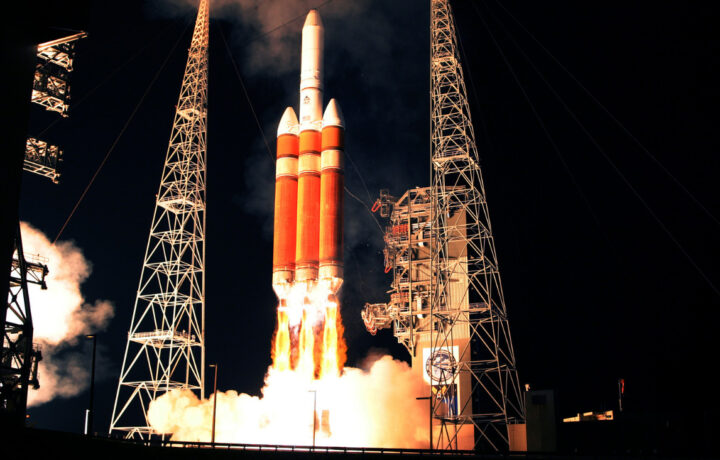
The term “spaceport” (sometimes spelled “space port”) emerged in early 1930s pulp science fiction, and although it didn’t include the word “space,” the novella “Affair of the Brains” by Harry Bates and D.W. Hall, appearing in Astounding Stories, referenced Port Midway. The compound term “spaceport” emerged in 1950s science fiction and later appeared in the original Star Wars in 1977.
Today, a spaceport, or cosmodrome, is simply a ground facility used to launch, land, service, and maintain spacecraft, rockets, and satellites, functioning much as an airport or seaport does for planes or ships. A spaceport is a facility that includes launch pads, where rockets are assembled, fueled, and fired; control centers that manage launch timing, telemetry, tracking, and mission safety; and support infrastructure that can include assembly hangars, propellant storage tanks for liquid or cryogenic fuels, research laboratories, and recovery areas for reusable vehicles.
14 Active, Non-Federal Spaceports
In the United States, commercial spaceports and the launches from the facilities are regulated and licensed by the Federal Aviation Administration (FAA). Today, 14 such commercial spaceports are licensed, including both launch and reentry site operators.
These include:
Huntsville International Air and Space Port
Huntsville, Alabama
In 2022, this facility became the 14th FAA-licensed commercial spaceport. Still, it is also the first commercial airport in the United States approved to serve as an official commercial space reentry site for Sierra Space’s Dream Chaser, a reusable spaceplane designed to return cargo and supplies from the International Space Station (ISS) under NASA’s Commercial Resupply Services (CRS-2) contract. During missions, the Dream Chaser approaches from the south on an ascending trajectory, flying over parts of Central America or the southwestern U.S. before descending into Huntsville.
The facility reinforces Huntsville’s historical identity as “Space City,” linking traditional aviation infrastructure with commercial space logistics, future space tourism, and aerospace.
Pacific Spaceport Complex – Alaska (PSCA)
Narrow Cape, Kodiak Island, Alaska
Formerly known as the Kodiak Launch Complex, the Pacific Spaceport Complex – Alaska (PSCA) is a dual-use commercial and military spaceport located on Narrow Cape at Kodiak Island, Alaska. It was established in 1998 and rebranded in 2016 after repairs following a 2014 launch failure.
It became the first FAA-licensed commercial spaceport in the U.S. not co-located on a federal range.
PSCA’s coastal location allows for unrestricted launches over the North Pacific Ocean into polar, sun-synchronous, and high-inclination orbits (59° to 110°) without land overflights. The 3,700-acre site features multiple launch pads for orbital and sub-orbital vehicles, a 17-story rocket assembly building, payload processing clean rooms, and a mission control center. Alaska Aerospace Corporation, a state-owned entity in the 49th state, owns and operates it.
Mojave Air & Space Port at Rutan Field
Mojave California
Located about 78 miles north of Los Angeles and 17 miles west of Edwards Air Force Base (AFB), the Mojave Air & Space Port at Rutan Field is the first U.S. facility licensed for horizontal launches of reusable spacecraft. Originally established in 1935 for local mining, it served as a U.S. Marine Corps air station during World War II and the Korean War before transitioning to a civilian test facility in 1972. It was renamed Mojave Air and Space Port at Rutan Field in honor of pioneer designers Dick and Burt Rutan. The FAA licensed it as a spaceport on June 17, 2004.
It also serves as a hub for private suborbital spaceflight research and horizontal launch systems and is home to numerous experimental aircraft companies, maiden flights, and high-speed flight research.
Vandenberg Space Force Base
Santa Barbara County, California
Vandenberg SFB supports both vertical and horizontal launches. Although it is primarily a U.S. Space Force military base, it hosts commercial space launches, such as SpaceX missions, alongside federal launches.
Originally established in 1941 as the U.S. Army’s Camp Cooke, it was transferred to the Air Force in 1957, named Vandenberg Air Force Base in 1958, and renamed Vandenberg Space Force Base on May 14, 2021. It serves as the U.S. West Coast space launch base for the Western Range and acts as the nation’s main site for launching satellites into polar and sun-synchronous orbits.
Colorado Air and Space Port
Watkins, Colorado
Originally opened in 1984 as Front Range Airport, it was renamed the Colorado Air and Space Port after receiving its FAA commercial spaceport operator license in August 2018. It is now a public-use general aviation airport and FAA-licensed horizontal-launch commercial spaceport near Watkins in Adams County, Colorado, about seven miles southeast of Denver International Airport.
The facility, which functions as a horizontal launch and landing facility designed for reusable suborbital space vehicles, aerospace research, and point-to-point high-speed transportation, spans 3,349 acres with extensive surrounding industrial acreage, and features two primary 8,000-foot-long, 100-foot-wide asphalt runways.
Space Florida Launch Complex 46
Brevard County, Florida
Situated on the eastern tip of Cape Canaveral Space Launch Complex 46 (SLC-46), it is an active rocket launch facility owned by the United States Space Force and managed/leased commercially by Space Florida. The United States Navy originally built it in the mid-1980s to test UGM-133 Trident II (D5) submarine-launched ballistic missiles. After the U.S. Navy moved Trident testing to sea, the site was redesigned in the 1990s by the Spaceport Florida Authority (not Space Florida) to support small-to-medium-class commercial and government launch vehicles.
During the 1990s, it hosted early commercial launches like the Athena I and Athena II, and returned to service in 2017 with the Orbital ATK Minotaur IV launch for the U.S. Air Force (ORS-5). NASA used it in 2019 for the Orion Ascent Abort-2 (AA-2) crew safety test.
Space Coast Regional Airport / Exploration Spaceport
Titusville, Brevard County, Florida
The Space Coast Regional Airport (TIX) and Exploration Spaceport comprise a 2,083-acre public aviation and federally licensed commercial spaceport campus operated by the Titusville-Cocoa Airport Authority in Titusville, Florida. It is eight miles west of the Kennedy Space Center and Cape Canaveral.
In 2020, the FAA’s Office of Spaceports designated the Space Coast Regional Airport and Exploration Spaceport as one of the select few licensed spaceports in the U.S., specifically authorized for horizontal launch and landing operations. The facility features 662 airfield acres, runway-accessible parcels, full-service Fixed Base Operators (FBOs), maintenance, repair, and overhaul (MRO) capabilities, and direct multimodal access to highways, rail, and maritime access via Port Canaveral.
Cecil Air and Space Port
Jacksonville, Florida
This combined public-use airport was the first licensed horizontal-launch commercial spaceport on the U.S. East Coast. Located about 15 miles west of downtown Jacksonville, Florida, it is owned and operated by the Jacksonville Aviation Authority (JAA).
The 6,082-acre site is the former Naval Air Station Cecil Field, a major U.S. Navy jet base active from 1941 until it was decommissioned in 1999. In January 2010, it became the eighth FAA-licensed commercial spaceport in the United States and the first approved specifically for horizontal takeoff and landing operations. Cecil Air and Space Port features four runways, including a 12,503-foot primary runway – the third-longest in Florida – capable of handling any production aircraft in the world.
Space Florida Launch & Landing Facility (LLF)
Orlando, Florida
Formerly known as the Shuttle Landing Facility (SLF), the Space Florida Launch and Landing Facility (LLF) features a 5,000-foot-long, 300-foot-wide concrete runway with a 16-inch central thickness, one of the longest and strongest runways in the country. It was first opened in 1976 and was built primarily for NASA’s Space Shuttle program, hosting 78 shuttle landings from 1984 until the program ended in 2011.
Today, it supports horizontal flight operations, suborbital training, and orbital return vehicles, including Sierra Space’s Dream Chaser.
Spaceport America
Sierra County, New Mexico
Spaceport America is a fitting name, as it is the world’s first purpose-built commercial spaceport. Built on 18,000 acres in the Jornada del Muerto desert basin in southern New Mexico – near Truth or Consequences and Las Cruces – and adjacent to the U.S. Army’s White Sands Missile Range, it is owned and operated by the State of New Mexico through the New Mexico Spaceport Authority. Spaceport America features a 12,000-foot-long, 200-foot-wide paved runway for horizontal launches, vertical launch complexes, a 130,000-square-foot hangar known as the “Gateway to Space,” mission control, and 6,000 square miles of restricted airspace.
It currently serves as the anchor base for Virgin Galactic suborbital space tourism flights, alongside other commercial and research companies like UP Aerospace, SpinLaunch, and HAPSMobile/AeroVironment; and it also hosts annual events, including the Spaceport America Cup, the world’s largest intercollegiate rocket engineering competition.
Infinity One Oklahoma Spaceport
Burns Flat, Oklahoma
Formerly known as the Clinton-Sherman Industrial Airpark and the Oklahoma Air & Space Port, it is a public-use airport, industrial complex, and FAA-licensed commercial spaceport located near Burns Flat in Washita County, Oklahoma, about 100 miles west of Oklahoma City. It received its FAA license in June 2006 to handle suborbital, reusable launch vehicles, making it one of a select number of licensed spaceports in the U.S. and the first in a landlocked state.
It features a 13,503-foot-long, 300-foot-wide concrete runway, one of the longest and widest civilian-use runways in North America, originally built for military operations. The Oklahoma Department of Aerospace and Aeronautics (ODAA) manages the facility after merging with the Oklahoma Space Industry Development Authority (OSIDA). The spaceport is within the “Infinity One” space flight corridor. The roughly 152-mile-long and 50-mile-wide corridor sits clear of restricted airspace and Military Operations Areas (MOAs).
The 2,700-acre site also includes commercial hangars, office spaces, an industrial park, and infrastructure supporting aerospace R&D, flight testing, maintenance, repair, and overhaul (MRO) operations/
Houston Spaceport
Houston, Texas
Established in 2015, it became the 10th commercial spaceport in the United States to receive an FAA license for spaceflight operations. Located on 400 acres at Ellington Airport in Houston, it is currently licensed for horizontal launches and landings of suborbital, reusable launch vehicles.
Houston Spaceport serves as a research, development, manufacturing, and education center that supports the transition from government-led space programs to commercial space exploration. The facility hosts prominent commercial space and aerospace companies, including Axiom Space, Intuitive Machines, Collins Aerospace, and Venus Aerospace. It supports more than 8,500 jobs and generates billions of dollars in annual economic output for the region’s aerospace sector.
Midland International Air and Space Port
Midland, Texas
The Midland International Air and Space Port is the first commercial spaceport in the United States co-located with a major commercial airport. The FAA licensed it in September 2014 as a Commercial Space Launch Site (FAA Part 420) for horizontal spaceflight operations and reusable launch vehicles.
It features extensive runways, up to 9,501 feet, and uncongested airspace. The site is home to aerospace and defense innovators such as AST SpaceMobile, Firehawk Aerospace, and Starfighters Space, and it also houses the Midland Altitude Chamber Complex (MACC), which features human-rated hypobaric chambers for pressure suit and aerospace equipment testing.
Mid-Atlantic Regional Spaceport
Wallops Island, Virginia
The Mid-Atlantic Regional Spaceport (MARS) is an FAA-licensed commercial and government space launch facility located on Wallops Island along Virginia’s Eastern Shore, within NASA Wallops Flight Facility. It is owned and operated by the Virginia Spaceport Authority, formerly the Virginia Commercial Space Flight Authority. It is currently licensed for vertical orbital and sub-orbital launches with trajectories over the Atlantic Ocean (supporting inclinations from 38° to 60°). Its key infrastructure includes Pad 0-A, which supports liquid-fueled rockets like Northrop Grumman’s Antares that support cargo missions to the International Space Station; Pad 0-B, which supports solid-fueled vehicles such as Minotaur rockets; and Pad 0-C / Pad 0-D, the expanding infrastructure for Rocket Lab’s launch complexes supporting vehicles including the Neutron and Electron rockets.
The Mid-Atlantic Regional Spaceport also includes an Integration and Control Facility, a Payload Processing Facility, and an Unmanned Aerial Systems (UAS) Airfield, and it is one of only a few active public spaceports in the United States providing commercial, scientific, and national security space.
Spaceport Camden
Camden County, Georgia
Had this proposed commercial space launch site been approved, there would be 15 FAA-licensed spaceports. However, the project was scrapped and halted in 2023 after local voter opposition and a unanimous Georgia Supreme Court ruling blocking the land purchase.


