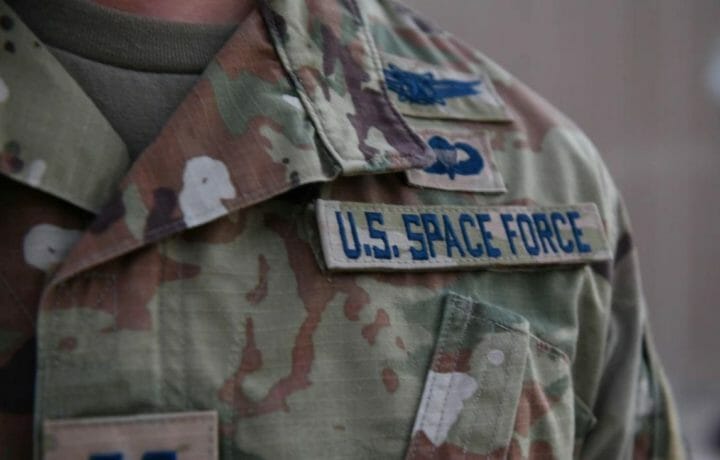
United States military service members have until October 16 to file an application for a fiscal year 2027 (FY27) Interservice Transfer (IST) to the United States Space Force, the sixth and newest branch of the U.S. Armed Forces. The IST program opened on September 15, 2026, and was originally slated to close on October 2.
Even as the U.S. Space Force – along with every branch of the U.S. military – met its fiscal year 2026 (FY26) recruiting goals months early, it is still seeking to more than double in size over the next five years from approximately 11,000 uniformed service members to around 25,000. Much of the growth is expected to be at Peterson Space Force Base (SFB) and Schriever SFB, both in Colorado.
The Space Force continues to take on more responsibilities and needs the uniformed workforce to accomplish the mission. It was actually born out of transfers, with most transferring from the United States Air Force. The branch previously held transfer windows in FY22, FY23, and FY24, accepting 720, 511, and 148 transfers, respectively.
Looking to Current Service Members
To meet future challenges, the Space Force has prioritized the types of ISTs it needs, focusing on mid-grade officers and enlisted personnel, especially in fields such as Space Operations, Cyber, Intelligence, Acquisitions, and Engineering.
Although applicants without direct space experience may apply, preference is being given to those who do not require retraining.
The U.S. Space Force is seeking active-duty, full-time officers and enlisted members from the U.S. Air Force, Army, Navy, and Marine Corps. Warrant officers are not eligible, as the Space Force does not currently have a warrant officer structure.
Moreover, Reserve, Guard, and U.S. Coast Guard members are not eligible for this active-duty window.
As the U.S. Coast Guard is part of the Department of Homeland Security, not the Department of War in peacetime, its service members cannot use the interservice transfer process. Instead, Coast Guard personnel interested in joining the Space Force generally must complete their current service commitment and apply through standard prior-service or accession channels.
Eligible service members must submit a service career brief, provide their last five performance reports, their most recent physical fitness and body composition assessment, and an endorsement for transfer from their unit commander. Interested members must also submit documentation of any approved religious or medical accommodations they have received and whether they have been selected for promotion.
Selected members will agree to a four-year service commitment with the U.S. Space Force.
“Individuals on any form of administrative or medical hold are not eligible to apply for the FY27 Interservice Transfer opportunity. Should a service member be placed on medical or administrative hold between application and executing transfer, the member’s selection for transfer will be withdrawn,” the Space Force explained.
Great Responsibilities Require Growth
The Space Force is requiring the larger force due to exponentially rising operational demands; a massive influx of new satellites, and growing threats from adversaries have turned space into a contested warfighting domain.
Within the next three years, the service expects to command and control 500% more satellites, roughly a fivefold increase in outer space assets. It already controls 33% to 50% more satellites than two years ago, outpacing current staffing levels.
In addition, all six geographic combatant commands are actively requesting more spacepower support, and current availability falls far short of operational requirements.
“The demand signal is growing exponentially,” said Lt. Gen. Gregory Gagnon, commander, U.S. Space Force Combat Forces Command, during the “Growth of the Space Force” panel at last month’s 2026 Air and Space Forces Association Air, Space and Cyber Conference.
“Across every geographic combatant command, requests for spacepower far outpace current availability. Controlling 33% to 50% more satellites today than two years ago is only the baseline; in three years, that workload will expand fivefold,” Gagnon added. “Operating at that scale requires expanding total force capacity from under 11,000 Guardians to roughly 25,000.”
For FY26, which ended on September 30, the U.S. Space Force enlisted 730 active-duty Guardians. More than one in five of those recruits hold a college degree. For FY27, the service set a target of 1,402 recruits.


